
Tratamiento del ojo seco evaporativo grave con terapia de luz pulsada intensa
Título original: Managing Severe Evaporative Dry Eye with Intense Pulsed Light Therapy
Guanghao Qin, Jiayan Chen, Liangzhe Li, Xia Yang, Qing Zhang, Yi Wu, Lanting Yang, Salissou Moutari, Jonathan Edward Moore, Ling Xu, Wei He, Sile Yu, Xingru He, Emmanuel Eric Pazo
 Ophthalmology and Therapy, 2023 · artículo · doi:10.1007/s40123-023-00649-5 · citado 22 veces · Acceso abierto (CC BY-NC)
De un vistazo
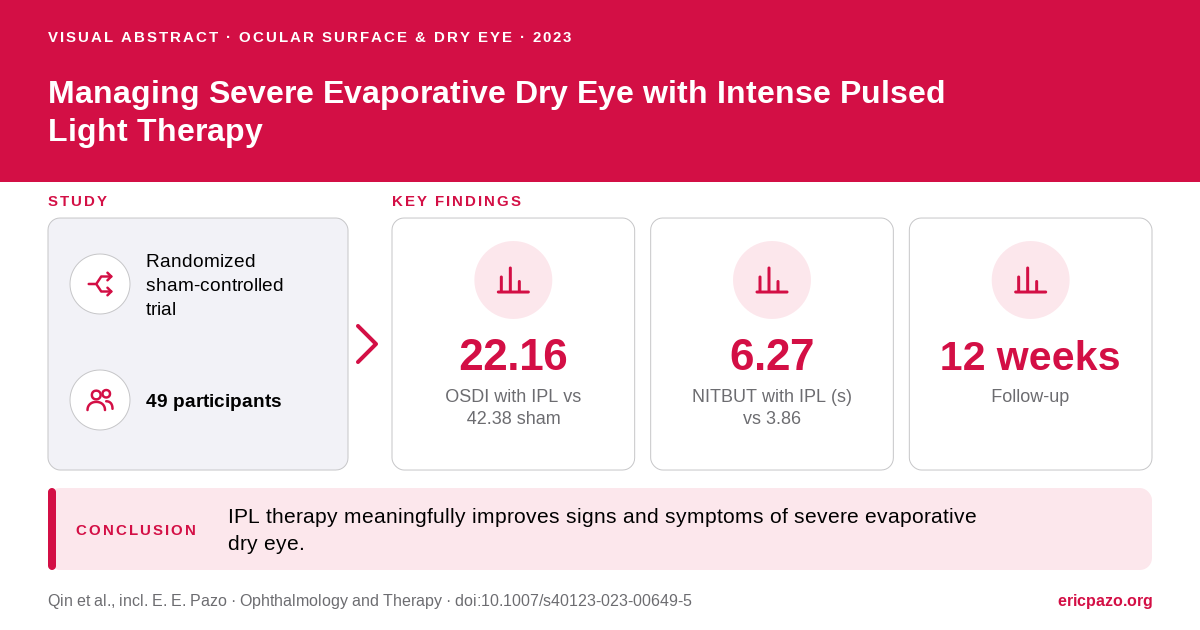
La terapia IPL mejora de forma relevante los signos y síntomas del ojo seco evaporativo grave.
- Diseño
- Ensayo aleatorizado controlado con simulación
- Muestra
- 49 participantes
- OSDI con IPL frente a 42.38 con simulación
- 22.16
- NITBUT con IPL (s) frente a 3.86
- 6.27
- Seguimiento
- 12 weeks
Resumen
INTRODUCCIÓN: Este estudio evaluó la eficacia y la seguridad de la terapia con luz pulsada intensa (IPL) en participantes con enfermedad de ojo seco (EOS) evaporativa grave. MÉTODOS: Este estudio aleatorizado, controlado y unicéntrico incluyó a 49 participantes adultos (≥ 18 años) con EOS evaporativa grave que recibieron tres veces terapia IPL (n = 56 ojos) o terapia simulada (n = 42 ojos). Los parámetros principales de eficacia fueron la puntuación del índice de enfermedad de la superficie ocular (OSDI), el tiempo de ruptura lagrimal no invasivo (NITBUT), la capa lipídica de la película lagrimal (TFLL), la puntuación de tinción conjuntivocorneal (CS), la puntuación MG, la calidad de las glándulas de Meibomio (MG) y la puntuación de expresión de las MG. RESULTADOS: Las edades medias del grupo IPL y del grupo control fueron de 28.05 ± 3.41 años (57.1% mujeres) y 28.14 ± 3.53 años (52.4% mujeres), respectivamente. La comparación entre el grupo IPL y el grupo control mostró diferencias significativas en la puntuación OSDI media (22.16 ± 6.08 frente a 42.38 ± 6.60; P < 00.01), el NITBUT (6.27 ± 0.84 frente a 3.86 ± 0.68; P < 0.001), la TFLL (2.14 ± 0.44 frente a 3.45 ± 0.50; P < 0.001), la puntuación MG (1.34 ± 0.55 frente a 1.88 ± 0.33; P < 0.001), la calidad de las MG (1.59 ± 0.07 frente a 2.67 ± 0.08) y la expresión de las MG (1.54 ± 0.57 frente a 2.45 ± 0.55) en el seguimiento a las 12 semanas; sin embargo, no hubo diferencias significativas en la CS (3.32 ± 1.11 frente a 3.74 ± 1.04; P = 0.063). CONCLUSIÓN: Los resultados sugieren que la terapia IPL es clínicamente beneficiosa para mejorar los signos y síntomas de la enfermedad de ojo seco evaporativa grave.
Traducido del resumen original en inglés (licencia: CC BY-NC).
Mostrar el resumen original
INTRODUCTION: This study assessed the efficacy and safety of intense pulsed light (IPL) therapy in participants with severe evaporative dry eye disease (DED). METHODS: This randomized, controlled, single-center study included 49 adult participants (≥ 18 years) with severe evaporative DED who received either IPL therapy (n = 56 eyes) or sham therapy (n = 42 eyes) three times. The primary efficacy parameters were ocular surface disease index (OSDI) score, non-invasive tear breakup time (NITBUT), tear film lipid layer (TFLL), conjunctivocorneal staining score (CS), MG Score, meibomian gland (MG) quality, and MG expression score. RESULTS: The mean ages for the IPL group and the control group were 28.05 ± 3.41 years (57.1% female) and 28.14 ± 3.53 years (52.4% female), respectively. Comparison between the IPL group and the control group found significant differences in the mean OSDI score (22.16 ± 6.08 vs. 42.38 ± 6.60; P < 00.01), NITBUT (6.27 ± 0.84 vs. 3.86 ± 0.68; P < 0.001), TFLL (2.14 ± 0.44 vs. 3.45 ± 0.50; P < 0.001), MG Score (1.34 ± 0.55 vs. 1.88 ± 0.33; P < 0.001), MG quality (1.59 ± 0.07 vs. 2.67 ± 0.08), and MG expression (1.54 ± 0.57 vs. 2.45 ± 0.55) at 12 weeks follow-up; however, there was no significant difference in CS (3.32 ± 1.11 vs. 3.74 ± 1.04; P = 0.063). CONCLUSION: The findings suggest that IPL therapy is clinically beneficial in ameliorating the signs and symptoms of severe evaporative dry eye disease.
Palabras clave: evaporative dry eye disease; intense pulsed light therapy; meibomian glands; meibography; tear film lipid layer; Ocular Surface Disease Index; treatment efficacy and safety
Acceso
Cómo citar
Mostrar BibTeX
@article{qin2023managing,
  title = {{Managing Severe Evaporative Dry Eye with Intense Pulsed Light Therapy}},
  author = {Qin, Guanghao and Chen, Jiayan and Li, Liangzhe and Yang, Xia and Zhang, Qing and Wu, Yi and Yang, Lanting and Moutari, Salissou and Moore, Jonathan Edward and Xu, Ling and He, Wei and Yu, Sile and He, Xingru and Pazo, Emmanuel Eric},
  journal = {Ophthalmology and Therapy},
  year = {2023},
  doi = {10.1007/s40123-023-00649-5},
  url = {https://doi.org/10.1007/s40123-023-00649-5},
}
Trabajos relacionados
- Análisis de la influencia del espacio del margen del colgajo en la regeneración de los nervios corneales tras LASIK asistido por láser de femtosegundo (2026)
- Comparación entre el efecto de la luz pulsada intensa y la higiene palpebral sobre la película lagrimal y la superficie ocular: un estudio controlado aleatorizado (2026)
- Effects of 3% diquafosol sodium on tear film stability, corneal aberration parameters, and vision-related quality of life in pediatric orthokeratology-associated dry eye disease (2026)
- Asociación entre el índice de masa corporal materno previo al embarazo y el astigmatismo y la curvatura corneal de la descendencia: un estudio transversal (2025)
- Expresión diferencial de linfotoxina α, inmunoglobulina E y metaloproteinasa de matriz 9 en lágrimas en el ojo seco asociado a conjuntivitis alérgica (2025)