
强脉冲光治疗重度蒸发过强型干眼
原文标题: Managing Severe Evaporative Dry Eye with Intense Pulsed Light Therapy
Guanghao Qin, Jiayan Chen, Liangzhe Li, Xia Yang, Qing Zhang, Yi Wu, Lanting Yang, Salissou Moutari, Jonathan Edward Moore, Ling Xu, Wei He, Sile Yu, Xingru He, Emmanuel Eric Pazo
 Ophthalmology and Therapy, 2023 · 期刊论文 · doi:10.1007/s40123-023-00649-5 · 被引 22 次 · 开放获取(CC BY-NC)
要点速览
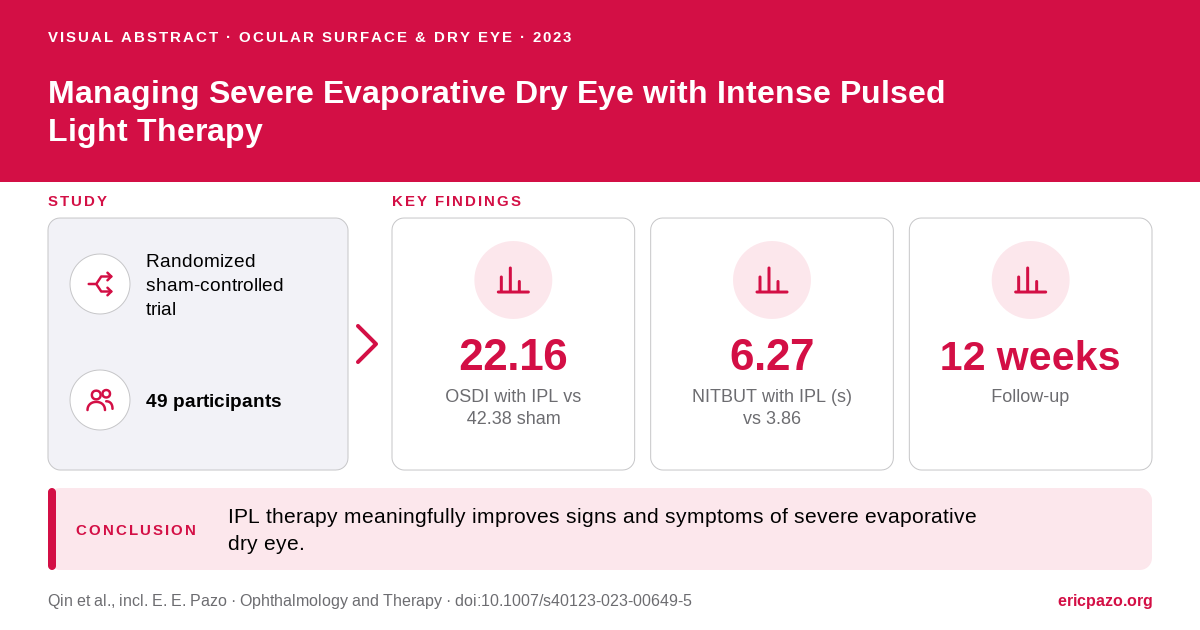
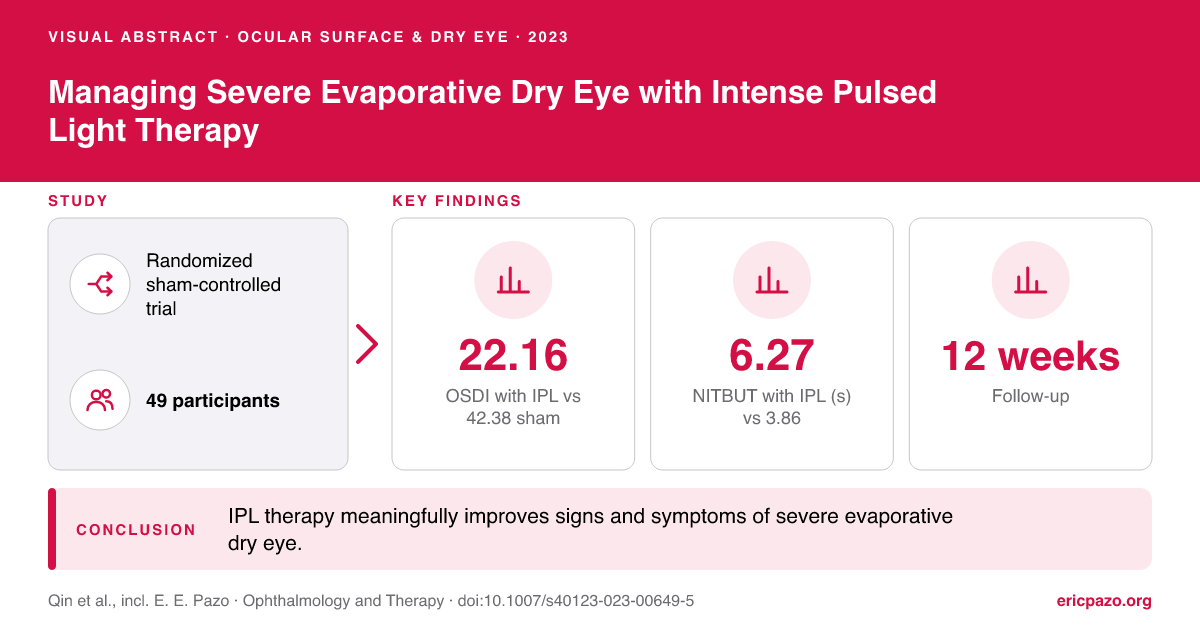
强脉冲光治疗可显著改善重度蒸发过强型干眼的体征和症状。
- 研究设计
- 随机假治疗对照试验
- 样本
- 49 名参与者
- 强脉冲光组 OSDI,假治疗组 42.38
- 22.16
- 强脉冲光组 NITBUT(秒),对照 3.86
- 6.27
- 随访时间
- 12 weeks
摘要
引言:本研究评估了强脉冲光(IPL)治疗重度蒸发过强型干眼(DED)参与者的有效性和安全性。方法:这项随机、对照、单中心研究纳入了 49 名成人重度蒸发过强型 DED 参与者(≥ 18 岁),分别接受三次 IPL 治疗(n = 56 只眼)或假治疗(n = 42 只眼)。主要疗效参数为眼表疾病指数(OSDI)评分、非侵入性泪膜破裂时间(NITBUT)、泪膜脂质层(TFLL)、角结膜染色评分(CS)、睑板腺评分(MG Score)、睑板腺(MG)质量和睑板腺可挤压性评分。结果:IPL 组和对照组的平均年龄分别为 28.05 ± 3.41 岁(女性 57.1%)和 28.14 ± 3.53 岁(女性 52.4%)。在 12 周随访时,IPL 组与对照组在平均 OSDI 评分(22.16 ± 6.08 对 42.38 ± 6.60;P < 00.01)、NITBUT(6.27 ± 0.84 对 3.86 ± 0.68;P < 0.001)、TFLL(2.14 ± 0.44 对 3.45 ± 0.50;P < 0.001)、MG 评分(1.34 ± 0.55 对 1.88 ± 0.33;P < 0.001)、MG 质量(1.59 ± 0.07 对 2.67 ± 0.08)和 MG 可挤压性(1.54 ± 0.57 对 2.45 ± 0.55)方面存在显著差异;但 CS 无显著差异(3.32 ± 1.11 对 3.74 ± 1.04;P = 0.063)。结论:结果表明,IPL 治疗在改善重度蒸发过强型干眼的体征和症状方面具有临床获益。
译自英文原文摘要(许可协议:CC BY-NC)。
显示英文原文摘要
INTRODUCTION: This study assessed the efficacy and safety of intense pulsed light (IPL) therapy in participants with severe evaporative dry eye disease (DED). METHODS: This randomized, controlled, single-center study included 49 adult participants (≥ 18 years) with severe evaporative DED who received either IPL therapy (n = 56 eyes) or sham therapy (n = 42 eyes) three times. The primary efficacy parameters were ocular surface disease index (OSDI) score, non-invasive tear breakup time (NITBUT), tear film lipid layer (TFLL), conjunctivocorneal staining score (CS), MG Score, meibomian gland (MG) quality, and MG expression score. RESULTS: The mean ages for the IPL group and the control group were 28.05 ± 3.41 years (57.1% female) and 28.14 ± 3.53 years (52.4% female), respectively. Comparison between the IPL group and the control group found significant differences in the mean OSDI score (22.16 ± 6.08 vs. 42.38 ± 6.60; P < 00.01), NITBUT (6.27 ± 0.84 vs. 3.86 ± 0.68; P < 0.001), TFLL (2.14 ± 0.44 vs. 3.45 ± 0.50; P < 0.001), MG Score (1.34 ± 0.55 vs. 1.88 ± 0.33; P < 0.001), MG quality (1.59 ± 0.07 vs. 2.67 ± 0.08), and MG expression (1.54 ± 0.57 vs. 2.45 ± 0.55) at 12 weeks follow-up; however, there was no significant difference in CS (3.32 ± 1.11 vs. 3.74 ± 1.04; P = 0.063). CONCLUSION: The findings suggest that IPL therapy is clinically beneficial in ameliorating the signs and symptoms of severe evaporative dry eye disease.
关键词: evaporative dry eye disease; intense pulsed light therapy; meibomian glands; meibography; tear film lipid layer; Ocular Surface Disease Index; treatment efficacy and safety
获取全文
引用格式
显示 BibTeX
@article{qin2023managing,
  title = {{Managing Severe Evaporative Dry Eye with Intense Pulsed Light Therapy}},
  author = {Qin, Guanghao and Chen, Jiayan and Li, Liangzhe and Yang, Xia and Zhang, Qing and Wu, Yi and Yang, Lanting and Moutari, Salissou and Moore, Jonathan Edward and Xu, Ling and He, Wei and Yu, Sile and He, Xingru and Pazo, Emmanuel Eric},
  journal = {Ophthalmology and Therapy},
  year = {2023},
  doi = {10.1007/s40123-023-00649-5},
  url = {https://doi.org/10.1007/s40123-023-00649-5},
}
相关研究
- 飞秒激光辅助 LASIK 术后角膜瓣边缘间隙对角膜神经再生影响的分析 (2026)
- 强脉冲光与睑缘清洁对泪膜和眼表影响的比较:一项随机对照研究 (2026)
- Effects of 3% diquafosol sodium on tear film stability, corneal aberration parameters, and vision-related quality of life in pediatric orthokeratology-associated dry eye disease (2026)
- 母亲孕前体重指数与子代散光及角膜曲率的关联:一项横断面研究 (2025)
- 过敏性结膜炎相关干眼中泪液淋巴毒素-α、免疫球蛋白 E 及基质金属蛋白酶-9 的差异表达 (2025)