
強パルス光療法による重症蒸発亢進型ドライアイの管理
原題: Managing Severe Evaporative Dry Eye with Intense Pulsed Light Therapy
Guanghao Qin, Jiayan Chen, Liangzhe Li, Xia Yang, Qing Zhang, Yi Wu, Lanting Yang, Salissou Moutari, Jonathan Edward Moore, Ling Xu, Wei He, Sile Yu, Xingru He, Emmanuel Eric Pazo
 Ophthalmology and Therapy, 2023 · 原著論文 · doi:10.1007/s40123-023-00649-5 · 被引用 22 回 · オープンアクセス(CC BY-NC)
要点
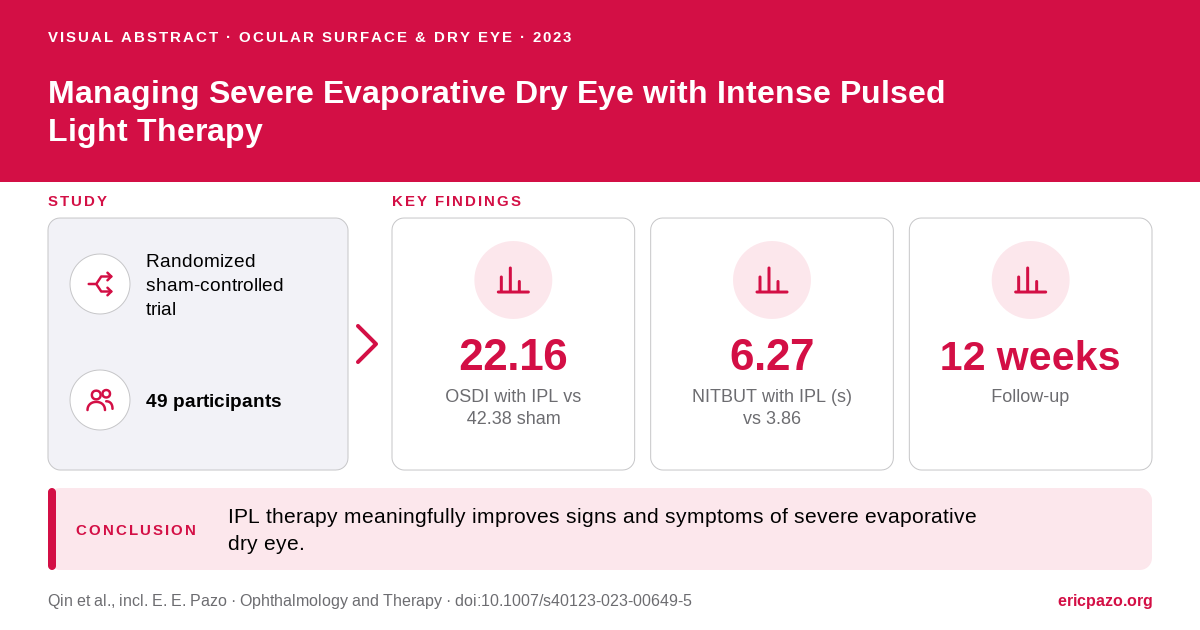
IPL 療法は重症の蒸発亢進型ドライアイの徴候と症状を有意義に改善する。
- 研究デザイン
- ランダム化シャム対照試験
- 対象
- 参加者 49 人
- IPL 群の OSDI 対シャム群 42.38
- 22.16
- IPL 群の NITBUT(秒)対 3.86
- 6.27
- 経過観察期間
- 12 weeks
抄録
はじめに:本研究は、重症の蒸発亢進型ドライアイ(DED)の参加者における強パルス光(IPL)療法の有効性と安全性を評価した。方法:本ランダム化単施設比較研究では、重症の蒸発亢進型 DED の成人参加者 49 人(≥ 18 歳)を対象とし、IPL 療法(n = 56 眼)またはシャム療法(n = 42 眼)を 3 回行った。主な有効性パラメータは、Ocular Surface Disease Index(OSDI)スコア、非侵襲的涙液層破壊時間(NITBUT)、涙液層脂質層(TFLL)、角結膜染色スコア(CS)、MG スコア、マイボーム腺(MG)の質、MG 圧出スコアとした。結果:IPL 群と対照群の平均年齢はそれぞれ 28.05 ± 3.41 歳(女性 57.1%)と 28.14 ± 3.53 歳(女性 52.4%)であった。12 週の経過観察時に IPL 群と対照群を比較すると、平均 OSDI スコア(22.16 ± 6.08 対 42.38 ± 6.60;P < 00.01)、NITBUT(6.27 ± 0.84 対 3.86 ± 0.68;P < 0.001)、TFLL(2.14 ± 0.44 対 3.45 ± 0.50;P < 0.001)、MG スコア(1.34 ± 0.55 対 1.88 ± 0.33;P < 0.001)、MG の質(1.59 ± 0.07 対 2.67 ± 0.08)、MG 圧出(1.54 ± 0.57 対 2.45 ± 0.55)に有意差がみられたが、CS には有意差はなかった(3.32 ± 1.11 対 3.74 ± 1.04;P = 0.063)。結論:IPL 療法は重症の蒸発亢進型ドライアイの徴候と症状の改善に臨床的に有益であることが示唆される。
英語の原文抄録からの翻訳です(ライセンス:CC BY-NC)。
原文の抄録を表示
INTRODUCTION: This study assessed the efficacy and safety of intense pulsed light (IPL) therapy in participants with severe evaporative dry eye disease (DED). METHODS: This randomized, controlled, single-center study included 49 adult participants (≥ 18 years) with severe evaporative DED who received either IPL therapy (n = 56 eyes) or sham therapy (n = 42 eyes) three times. The primary efficacy parameters were ocular surface disease index (OSDI) score, non-invasive tear breakup time (NITBUT), tear film lipid layer (TFLL), conjunctivocorneal staining score (CS), MG Score, meibomian gland (MG) quality, and MG expression score. RESULTS: The mean ages for the IPL group and the control group were 28.05 ± 3.41 years (57.1% female) and 28.14 ± 3.53 years (52.4% female), respectively. Comparison between the IPL group and the control group found significant differences in the mean OSDI score (22.16 ± 6.08 vs. 42.38 ± 6.60; P < 00.01), NITBUT (6.27 ± 0.84 vs. 3.86 ± 0.68; P < 0.001), TFLL (2.14 ± 0.44 vs. 3.45 ± 0.50; P < 0.001), MG Score (1.34 ± 0.55 vs. 1.88 ± 0.33; P < 0.001), MG quality (1.59 ± 0.07 vs. 2.67 ± 0.08), and MG expression (1.54 ± 0.57 vs. 2.45 ± 0.55) at 12 weeks follow-up; however, there was no significant difference in CS (3.32 ± 1.11 vs. 3.74 ± 1.04; P = 0.063). CONCLUSION: The findings suggest that IPL therapy is clinically beneficial in ameliorating the signs and symptoms of severe evaporative dry eye disease.
キーワード: evaporative dry eye disease; intense pulsed light therapy; meibomian glands; meibography; tear film lipid layer; Ocular Surface Disease Index; treatment efficacy and safety
アクセス
引用方法
BibTeX を表示
@article{qin2023managing,
  title = {{Managing Severe Evaporative Dry Eye with Intense Pulsed Light Therapy}},
  author = {Qin, Guanghao and Chen, Jiayan and Li, Liangzhe and Yang, Xia and Zhang, Qing and Wu, Yi and Yang, Lanting and Moutari, Salissou and Moore, Jonathan Edward and Xu, Ling and He, Wei and Yu, Sile and He, Xingru and Pazo, Emmanuel Eric},
  journal = {Ophthalmology and Therapy},
  year = {2023},
  doi = {10.1007/s40123-023-00649-5},
  url = {https://doi.org/10.1007/s40123-023-00649-5},
}
関連する論文
- フェムトセカンドレーザー併用 LASIK 後の角膜神経再生に対するフラップ縁間隙の影響の解析 (2026)
- 強パルス光と眼瞼清拭が涙液層と眼表面に及ぼす効果の比較:ランダム化比較試験 (2026)
- Effects of 3% diquafosol sodium on tear film stability, corneal aberration parameters, and vision-related quality of life in pediatric orthokeratology-associated dry eye disease (2026)
- 母親の妊娠前 BMI と子の乱視および角膜曲率との関連:横断研究 (2025)
- アレルギー性結膜炎に伴うドライアイにおける涙液中リンホトキシン α、免疫グロブリン E、マトリックスメタロプロテイナーゼ-9 の発現の違い (2025)