
Calidad visual subjetiva en pacientes con ojo seco evaporativo tras la luz pulsada intensa
Título original: Subjective Quality of Vision in Evaporative Dry Eye Patients After Intense Pulsed Light
Qing-Xia Fan, Emmanuel Eric Pazo, Yue You, Can Zhang, Chenguang Zhang, Ling Xu, Wei He
 Photobiomodulation Photomedicine and Laser Surgery, 2020 · artículo · doi:10.1089/photob.2019.4788 · citado 34 veces
De un vistazo
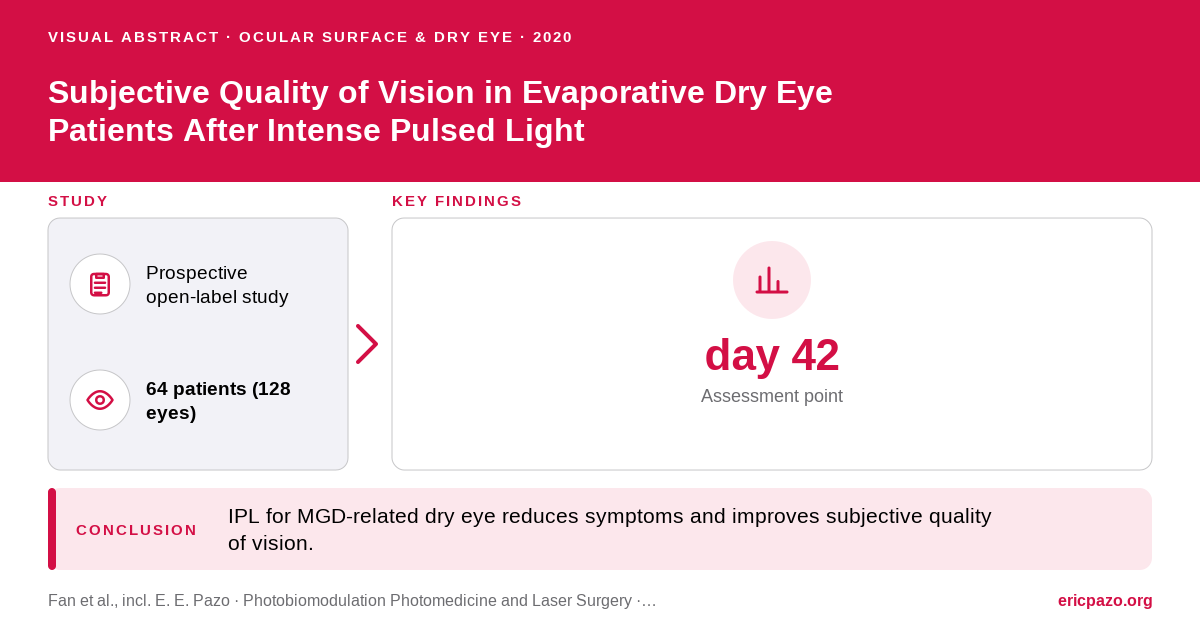
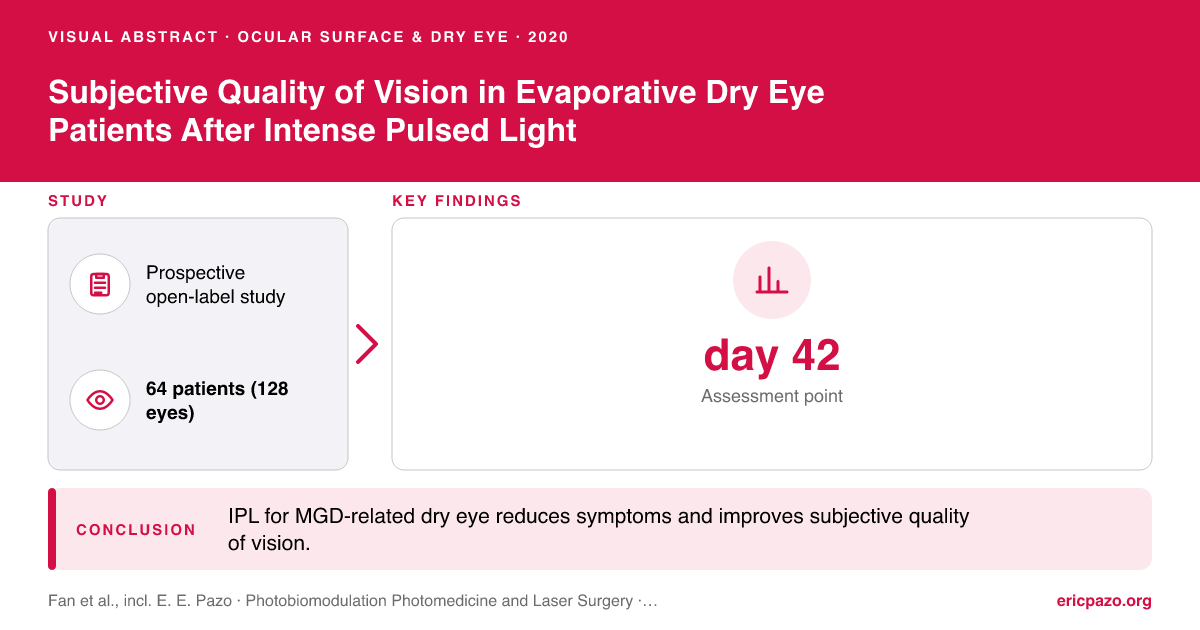
La IPL para el ojo seco relacionado con la DGM reduce los síntomas y mejora la calidad visual subjetiva.
- Diseño
- Estudio prospectivo abierto
- Muestra
- 64 pacientes (128 ojos)
- Momento de evaluación
- day 42
Resumen
Este resumen se muestra en su idioma original, el inglés, porque el artículo no tiene una licencia abierta que permita traducciones.
Background and objective: Intense pulsed light (IPL) improves visual and clinical symptoms of dry eye disease and helps improve meibomian gland (MG) function thereby positively contributing to the tear lipid layer, a major component for a normal tear film physiology. The objective of this study was to assess the effectiveness of IPL in moderate to severe evaporative dry eye (DE) owing to meibomian gland dysfunction (MGD) on the subjective quality of vision (QOV). Methods: This is a prospective, open-label study; patients with moderate to severe evaporative DE owing to MGD were consecutively enrolled and underwent two IPL treatment sessions at 3-week intervals. Clinical assessments included: Ocular Surface Disease Index (OSDI) and QOV questionnaires, noninvasive tear breakup time (NITBUT), interferometric fringe pattern as determined by tear film lipid layer (TFLL) quality, lid margin abnormalities, corneal fluorescein staining (CFS), conjunctival hyperemia (CH) redness score, MG (evaluated with a slit-lamp microscope), best-corrected visual acuity, endothelial cell count, and intraocular pressure were conducted at pretreatment, days 21 and 42 after IPL treatment. Results: A total of 128 eyes of 64 patients (39 women, 25 men; mean age 36.09 ± 11.13 years) with moderate to severe DE owing to MGD consecutively received IPL treatment at days 1 and 21. OSDI ( p < 0.05), QOV ( p < 0.05), NITBUT ( p < 0.05), TFLL score ( p < 0.05), and MG quality and expressibility ( p < 0.05) improved significantly at day 42, whereas CFS and CH showed minor not significant improvements ( p > 0.05) at day 42 of assessment. Conclusions: IPL treatment reduced the severity of DE symptoms and improved the overall tear film stability in patients with moderate to severe evaporative DE owing to MGD. In addition, visual complaints experienced by DE patients secondary to MGD significantly decreased.
Palabras clave: intense pulsed light; evaporative dry eye; meibomian gland dysfunction; tear film stability; meibomian gland function; Ocular Surface Disease Index; interferometric fringe patterns; fluorescein staining
Acceso
Cómo citar
Mostrar BibTeX
@article{fan2020subjective,
  title = {{Subjective Quality of Vision in Evaporative Dry Eye Patients After Intense Pulsed Light}},
  author = {Fan, Qing-Xia and Pazo, Emmanuel Eric and You, Yue and Zhang, Can and Zhang, Chenguang and Xu, Ling and He, Wei},
  journal = {Photobiomodulation Photomedicine and Laser Surgery},
  year = {2020},
  doi = {10.1089/photob.2019.4788},
  url = {https://doi.org/10.1089/photob.2019.4788},
}
Trabajos relacionados
- Análisis de la influencia del espacio del margen del colgajo en la regeneración de los nervios corneales tras LASIK asistido por láser de femtosegundo (2026)
- Comparación entre el efecto de la luz pulsada intensa y la higiene palpebral sobre la película lagrimal y la superficie ocular: un estudio controlado aleatorizado (2026)
- Effects of 3% diquafosol sodium on tear film stability, corneal aberration parameters, and vision-related quality of life in pediatric orthokeratology-associated dry eye disease (2026)
- Asociación entre el índice de masa corporal materno previo al embarazo y el astigmatismo y la curvatura corneal de la descendencia: un estudio transversal (2025)
- Expresión diferencial de linfotoxina α, inmunoglobulina E y metaloproteinasa de matriz 9 en lágrimas en el ojo seco asociado a conjuntivitis alérgica (2025)