
Qualité de vision subjective chez les patients atteints de sécheresse oculaire évaporative après lumière pulsée intense
Titre original : Subjective Quality of Vision in Evaporative Dry Eye Patients After Intense Pulsed Light
Qing-Xia Fan, Emmanuel Eric Pazo, Yue You, Can Zhang, Chenguang Zhang, Ling Xu, Wei He
 Photobiomodulation Photomedicine and Laser Surgery, 2020 · article · doi:10.1089/photob.2019.4788 · cité 34 fois
Surface oculaire et sécheresse oculaire
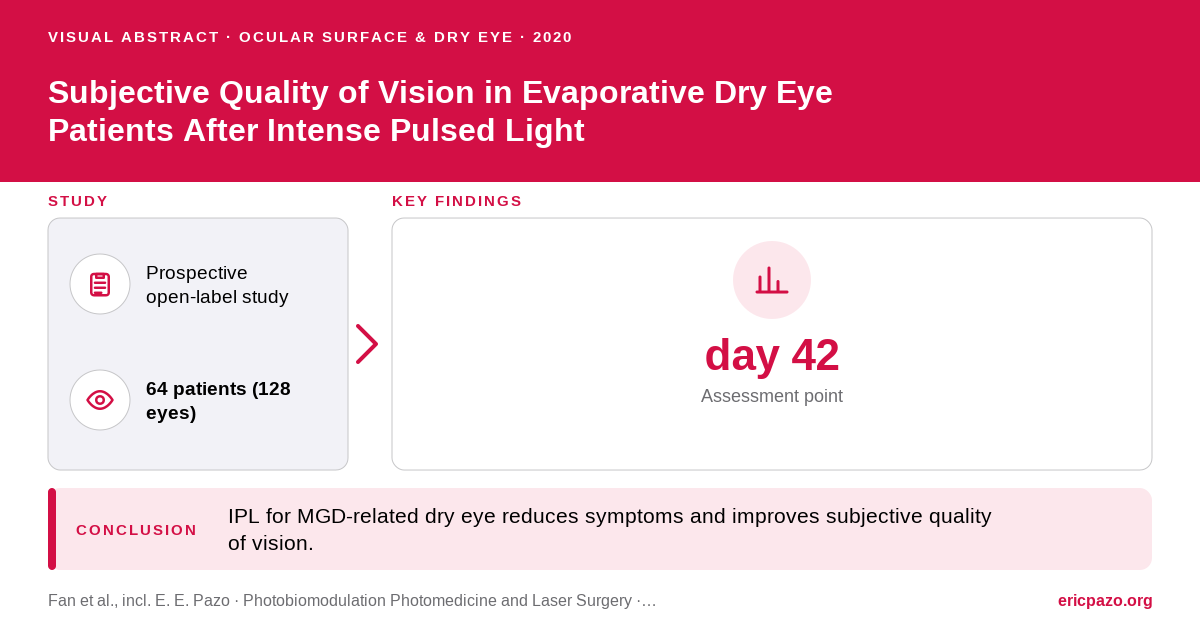
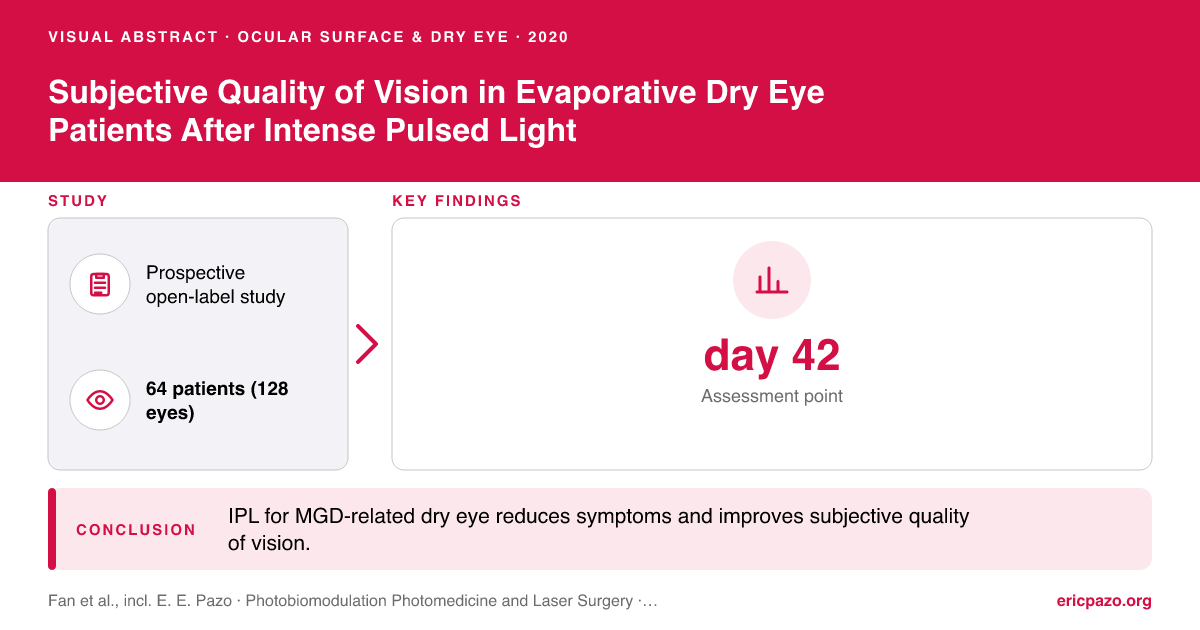
En bref
La LPI dans la sécheresse oculaire liée au DGM réduit les symptômes et améliore la qualité de vision subjective.
- Type d'étude
- Étude prospective en ouvert
- Échantillon
- 64 patients (128 yeux)
- Temps d'évaluation
- day 42
Résumé
Ce résumé est affiché dans sa langue d'origine, l'anglais, car l'article n'est pas publié sous une licence ouverte autorisant les traductions.
Background and objective: Intense pulsed light (IPL) improves visual and clinical symptoms of dry eye disease and helps improve meibomian gland (MG) function thereby positively contributing to the tear lipid layer, a major component for a normal tear film physiology. The objective of this study was to assess the effectiveness of IPL in moderate to severe evaporative dry eye (DE) owing to meibomian gland dysfunction (MGD) on the subjective quality of vision (QOV). Methods: This is a prospective, open-label study; patients with moderate to severe evaporative DE owing to MGD were consecutively enrolled and underwent two IPL treatment sessions at 3-week intervals. Clinical assessments included: Ocular Surface Disease Index (OSDI) and QOV questionnaires, noninvasive tear breakup time (NITBUT), interferometric fringe pattern as determined by tear film lipid layer (TFLL) quality, lid margin abnormalities, corneal fluorescein staining (CFS), conjunctival hyperemia (CH) redness score, MG (evaluated with a slit-lamp microscope), best-corrected visual acuity, endothelial cell count, and intraocular pressure were conducted at pretreatment, days 21 and 42 after IPL treatment. Results: A total of 128 eyes of 64 patients (39 women, 25 men; mean age 36.09 ± 11.13 years) with moderate to severe DE owing to MGD consecutively received IPL treatment at days 1 and 21. OSDI ( p < 0.05), QOV ( p < 0.05), NITBUT ( p < 0.05), TFLL score ( p < 0.05), and MG quality and expressibility ( p < 0.05) improved significantly at day 42, whereas CFS and CH showed minor not significant improvements ( p > 0.05) at day 42 of assessment. Conclusions: IPL treatment reduced the severity of DE symptoms and improved the overall tear film stability in patients with moderate to severe evaporative DE owing to MGD. In addition, visual complaints experienced by DE patients secondary to MGD significantly decreased.
Mots-clés : intense pulsed light; evaporative dry eye; meibomian gland dysfunction; tear film stability; meibomian gland function; Ocular Surface Disease Index; interferometric fringe patterns; fluorescein staining
Accès
Comment citer
Afficher le BibTeX
@article{fan2020subjective,
  title = {{Subjective Quality of Vision in Evaporative Dry Eye Patients After Intense Pulsed Light}},
  author = {Fan, Qing-Xia and Pazo, Emmanuel Eric and You, Yue and Zhang, Can and Zhang, Chenguang and Xu, Ling and He, Wei},
  journal = {Photobiomodulation Photomedicine and Laser Surgery},
  year = {2020},
  doi = {10.1089/photob.2019.4788},
  url = {https://doi.org/10.1089/photob.2019.4788},
}
Travaux liés
- Analyse de l'influence de l'espace au bord du volet sur la régénération des nerfs cornéens après LASIK assisté par laser femtoseconde (2026)
- Comparaison des effets de la lumière pulsée intense et de l'hygiène palpébrale sur le film lacrymal et la surface oculaire : une étude contrôlée randomisée (2026)
- Effects of 3% diquafosol sodium on tear film stability, corneal aberration parameters, and vision-related quality of life in pediatric orthokeratology-associated dry eye disease (2026)
- Association entre l'indice de masse corporelle maternel avant la grossesse et l'astigmatisme et la courbure cornéenne de l'enfant : une étude transversale (2025)
- Expression différentielle de la lymphotoxine α, de l'immunoglobuline E et de la métalloprotéinase matricielle 9 lacrymales dans la sécheresse oculaire associée à la conjonctivite allergique (2025)