
蒸发过强型干眼患者强脉冲光治疗后的主观视觉质量
原文标题: Subjective Quality of Vision in Evaporative Dry Eye Patients After Intense Pulsed Light
Qing-Xia Fan, Emmanuel Eric Pazo, Yue You, Can Zhang, Chenguang Zhang, Ling Xu, Wei He
 Photobiomodulation Photomedicine and Laser Surgery, 2020 · 期刊论文 · doi:10.1089/photob.2019.4788 · 被引 34 次
要点速览
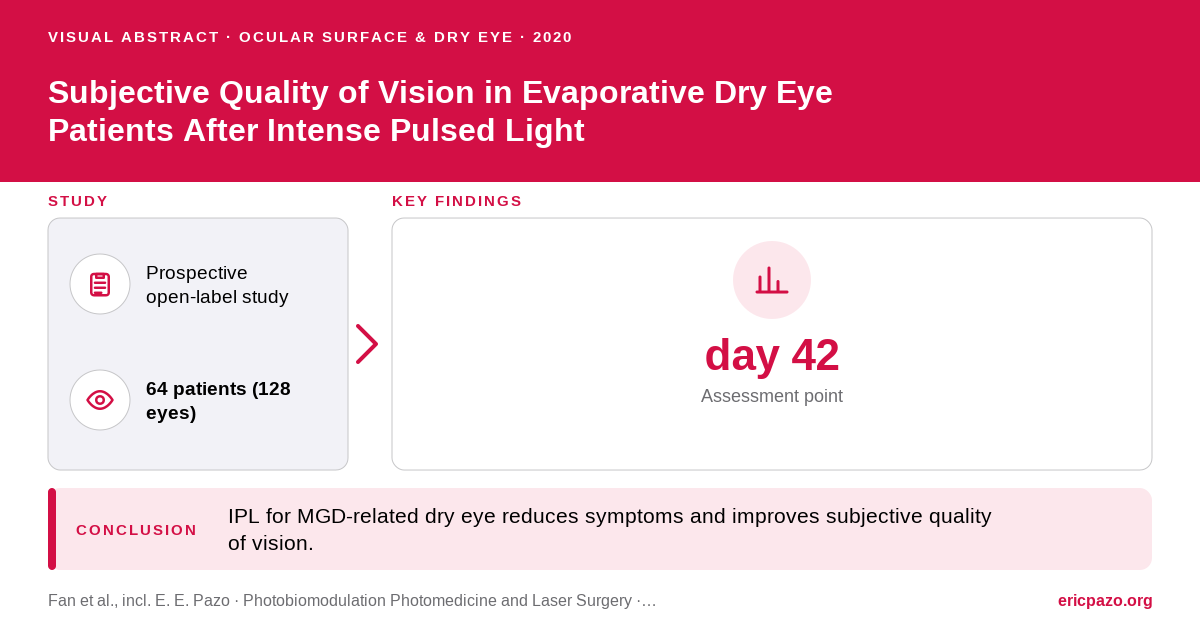
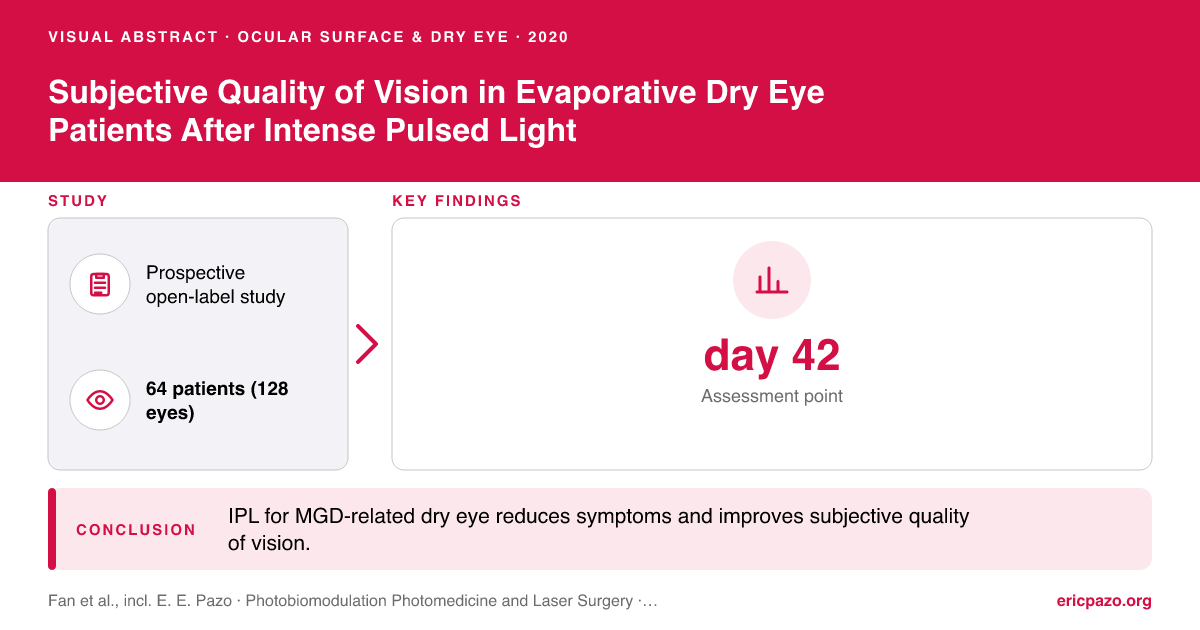
强脉冲光治疗 MGD 相关干眼可减轻症状并改善主观视觉质量。
- 研究设计
- 前瞻性开放标签研究
- 样本
- 64 例患者(128 只眼)
- 评估时间点
- day 42
摘要
本文摘要以原文(英文)显示,因为该文章未采用允许翻译的开放许可协议。
Background and objective: Intense pulsed light (IPL) improves visual and clinical symptoms of dry eye disease and helps improve meibomian gland (MG) function thereby positively contributing to the tear lipid layer, a major component for a normal tear film physiology. The objective of this study was to assess the effectiveness of IPL in moderate to severe evaporative dry eye (DE) owing to meibomian gland dysfunction (MGD) on the subjective quality of vision (QOV). Methods: This is a prospective, open-label study; patients with moderate to severe evaporative DE owing to MGD were consecutively enrolled and underwent two IPL treatment sessions at 3-week intervals. Clinical assessments included: Ocular Surface Disease Index (OSDI) and QOV questionnaires, noninvasive tear breakup time (NITBUT), interferometric fringe pattern as determined by tear film lipid layer (TFLL) quality, lid margin abnormalities, corneal fluorescein staining (CFS), conjunctival hyperemia (CH) redness score, MG (evaluated with a slit-lamp microscope), best-corrected visual acuity, endothelial cell count, and intraocular pressure were conducted at pretreatment, days 21 and 42 after IPL treatment. Results: A total of 128 eyes of 64 patients (39 women, 25 men; mean age 36.09 ± 11.13 years) with moderate to severe DE owing to MGD consecutively received IPL treatment at days 1 and 21. OSDI ( p < 0.05), QOV ( p < 0.05), NITBUT ( p < 0.05), TFLL score ( p < 0.05), and MG quality and expressibility ( p < 0.05) improved significantly at day 42, whereas CFS and CH showed minor not significant improvements ( p > 0.05) at day 42 of assessment. Conclusions: IPL treatment reduced the severity of DE symptoms and improved the overall tear film stability in patients with moderate to severe evaporative DE owing to MGD. In addition, visual complaints experienced by DE patients secondary to MGD significantly decreased.
关键词: intense pulsed light; evaporative dry eye; meibomian gland dysfunction; tear film stability; meibomian gland function; Ocular Surface Disease Index; interferometric fringe patterns; fluorescein staining
获取全文
引用格式
显示 BibTeX
@article{fan2020subjective,
  title = {{Subjective Quality of Vision in Evaporative Dry Eye Patients After Intense Pulsed Light}},
  author = {Fan, Qing-Xia and Pazo, Emmanuel Eric and You, Yue and Zhang, Can and Zhang, Chenguang and Xu, Ling and He, Wei},
  journal = {Photobiomodulation Photomedicine and Laser Surgery},
  year = {2020},
  doi = {10.1089/photob.2019.4788},
  url = {https://doi.org/10.1089/photob.2019.4788},
}
相关研究
- 飞秒激光辅助 LASIK 术后角膜瓣边缘间隙对角膜神经再生影响的分析 (2026)
- 强脉冲光与睑缘清洁对泪膜和眼表影响的比较:一项随机对照研究 (2026)
- Effects of 3% diquafosol sodium on tear film stability, corneal aberration parameters, and vision-related quality of life in pediatric orthokeratology-associated dry eye disease (2026)
- 母亲孕前体重指数与子代散光及角膜曲率的关联:一项横断面研究 (2025)
- 过敏性结膜炎相关干眼中泪液淋巴毒素-α、免疫球蛋白 E 及基质金属蛋白酶-9 的差异表达 (2025)