
Nuevo enfoque para la evaluación cuantitativa del estafiloma escleral: análisis de medidas de curvatura discreta de la esclera
Título original: New Approach for the Quantitative Assessment of Scleral Staphyloma: Discrete Curvature Measure Analysis of the Sclera
Di Wu, Xu Chu, Qing He, Mengdi Chai, Haoru Li, Xu He, Danyang Yu, Hua Rong, Emmanuel Eric Pazo, Xuejun Zhang, Yue Huang, Ruihua Wei
 Translational Vision Science & Technology, 2026 · artículo · doi:10.1167/tvst.15.1.8 · citado 1 vez · Acceso abierto (CC BY-NC-ND)
De un vistazo
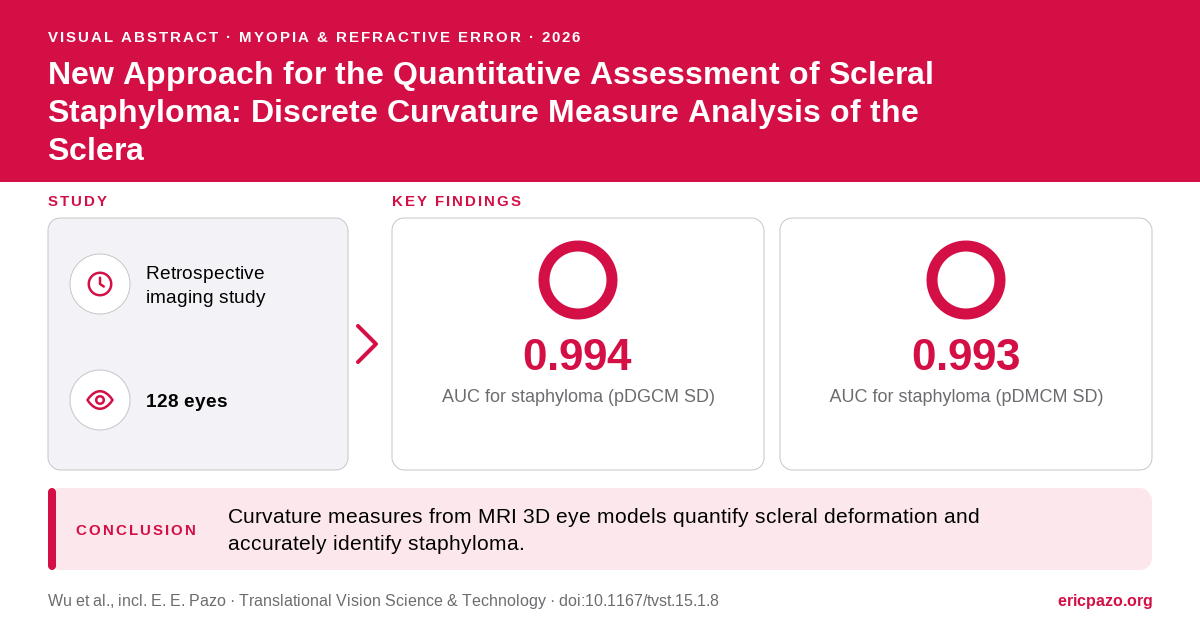
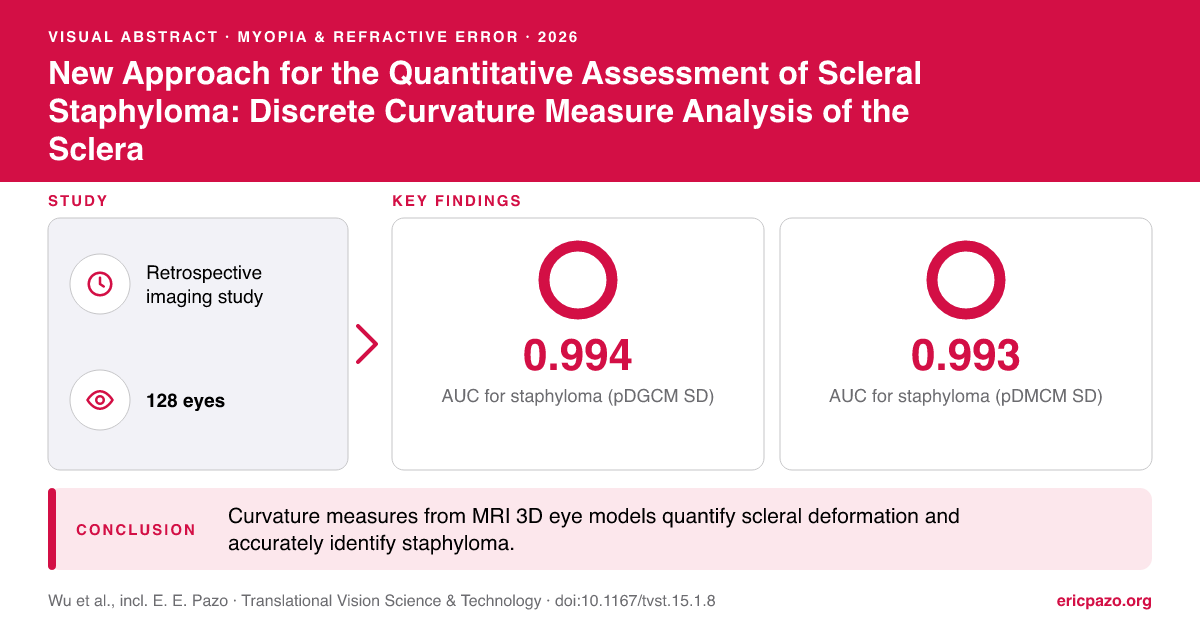
Las medidas de curvatura de modelos oculares 3D obtenidos por RM cuantifican la deformación escleral e identifican con precisión el estafiloma.
- Diseño
- Estudio de imagen retrospectivo
- Muestra
- 128 ojos
- AUC para estafiloma (DE de pDGCM)
- 0.994
- AUC para estafiloma (DE de pDMCM)
- 0.993
Resumen
Este resumen se muestra en su idioma original, el inglés, porque la licencia del artículo (CC BY-NC-ND) no permite publicar traducciones.
Purpose: Current methods for evaluating scleral staphyloma morphology fail to provide curvature data of global scleral deformation. This study aimed to develop a quantitative method based on discrete differential geometry for analyzing scleral deformation caused by staphyloma. Methods: This study retrospectively analyzed 128 eyes of 73 patients with pathological myopia. All patients underwent orbital magnetic resonance imaging and three-dimensional (3D) reconstruction. The discrete Gaussian curvature measures (DGCMs) and discrete mean curvature measures (DMCMs) of all vertices on the ocular 3D model were calculated. We further established a computational method for the degree of scleral staphyloma expansion (E/U ratio). Results: The posterior scleral DGCM (pDGCM) and DMCM (pDMCM) standard deviations (SDs) were significantly greater in the staphyloma group than in the non-staphyloma group (0.069 ± 0.026 vs. 0.025 ± 0.005 and 0.335 ± 0.096 vs. 0.154 ± 0.027, respectively; both P < 0.0001). The E/U ratio was strongly linearly correlated with both the pDGCM and pDMCM SDs (both P < 0.01). For staphyloma diagnosis, the areas under the receiver operating characteristic (ROC) curves for pDGCM and pDMCM SDs were 0.994 (95% confidence interval [CI], 0.984-1.000) and 0.993 (95% CI, 0.982-1.000), respectively (both P < 0.001). Conclusions: The variation in the curvature of the posterior sclera is significantly greater in eyes with staphyloma than in those without. This variation is highly specific and sensitive for staphyloma diagnosis. Translational Relevance: This method, based on discrete differential geometry, enables the direct quantification of scleral deformation, potentially providing a quantitative basis for the diagnosis and evaluation of staphyloma.
Palabras clave: scleral staphyloma; discrete differential geometry; pathologic myopia; posterior sclera; orbital MRI
Acceso
Cómo citar
Mostrar BibTeX
@article{wu2026new,
  title = {{New Approach for the Quantitative Assessment of Scleral Staphyloma: Discrete Curvature Measure Analysis of the Sclera}},
  author = {Wu, Di and Chu, Xu and He, Qing and Chai, Mengdi and Li, Haoru and He, Xu and Yu, Danyang and Rong, Hua and Pazo, Emmanuel Eric and Zhang, Xuejun and Huang, Yue and Wei, Ruihua},
  journal = {Translational Vision Science & Technology},
  year = {2026},
  doi = {10.1167/tvst.15.1.8},
  url = {https://doi.org/10.1167/tvst.15.1.8},
}
Trabajos relacionados
- Medición automatizada basada en aprendizaje profundo del volumen de retinosquisis y desprendimiento en la miopía patológica con contracción escleral posterior (2026)
- Desarrollo y validación interna de un modelo transformer sensible al tiempo para predecir la progresión de la miopía infantil a partir de datos longitudinales irregulares de cribado escolar (2026)
- Adherencia al seguimiento a largo plazo tras el implante de lente de colámero implantable en pacientes con miopía alta: un estudio unicéntrico de cohorte retrospectiva y encuesta CAP (2026)
- Predicción de la refracción ciclopléjica basada en aprendizaje automático con el Eyerobo Vision Screener: diseño, un estudio transversal comparativo de dispositivos (2026)
- Predicción de la progresión de la miopía pediátrica a partir de una única visita de cribado: un estudio de desarrollo y validación con múltiples desenlaces (2026)