
Analyse clinicopathologique et génétique des tumeurs fibreuses solitaires de l'orbite
Titre original : Clinicopathological and genetic analysis of orbital solitary fibrous tumors
Qing Wang, Zonghan Nan, Xun Liu, Limin Zhu, Emmanuel Eric Pazo, Tianming Jian, Liang Zhao, Jinzhi Zhao, Tingting Lin
 BMC Ophthalmology, 2025 · article · doi:10.1186/s12886-025-04223-4 · cité 5 fois · Accès libre (CC BY-NC-ND)
En bref
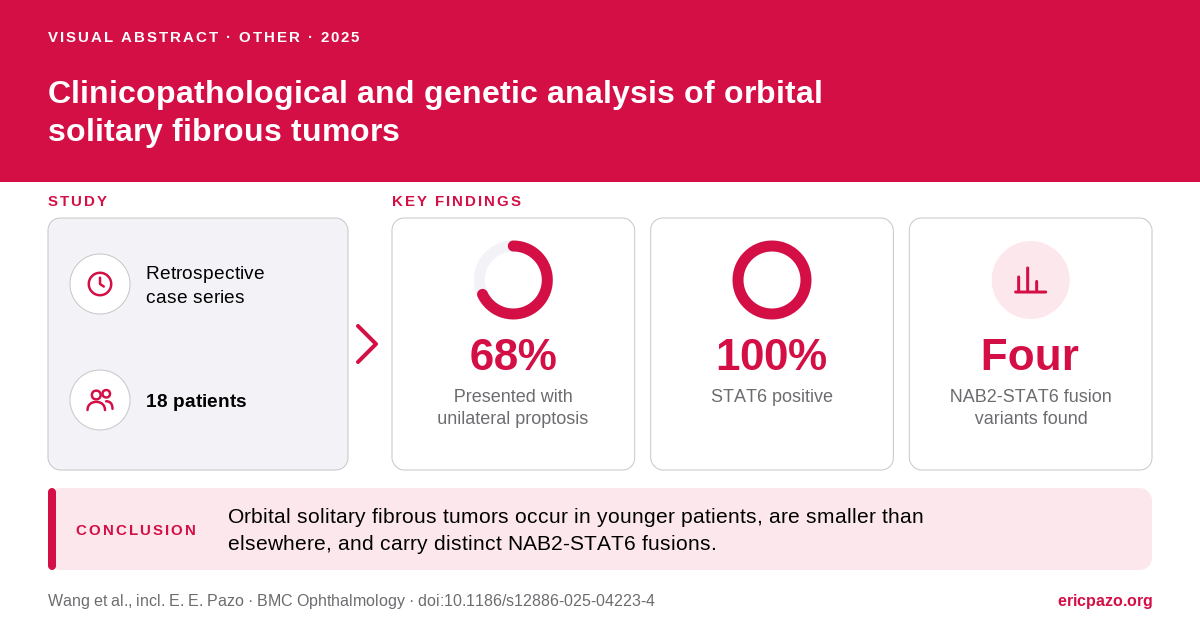
Les tumeurs fibreuses solitaires de l'orbite touchent des patients plus jeunes, sont plus petites qu'ailleurs et portent des fusions NAB2-STAT6 distinctes.
- Type d'étude
- Série de cas rétrospective
- Échantillon
- 18 patients
- Révélées par une exophtalmie unilatérale
- 68%
- STAT6 positif
- 100%
- Variants de fusion NAB2-STAT6 retrouvés
- Four
Résumé
Ce résumé est affiché dans sa langue d'origine, l'anglais, car la licence de l'article (CC BY-NC-ND) ne permet pas de publier des traductions.
PURPOSE: To investigate the clinicopathological and genetic characteristics of patients with orbital solitary fibrous tumor (SFT) for clinical reference. METHODS: This single-center retrospective case-series study assessed clinical manifestations, imaging features, treatment, and prognosis of patients with orbital SFT. Immunohistochemical staining and fusion gene detection were also performed. RESULTS: The mean age of monocular orbital SFT patients was 38.89 ± 19.69 years (10 males and 8 females). The most common complaint was unilateral proptosis (68%). Tumors were 2.47 ± 0.67 cm in diameter, primarily oval-like (72%), and located in the upper part of the orbit (82%). Immunohistochemical staining results are as follows: STAT6 + (100%), CD99 + (100%), GRIA2 + (100%), ALDH1 + (95%), CD34 + (86%), Bcl-2 + (62%), EMA + (57%), S-100 + (10%), SMA + (10%), CD31 + (0%), Desmin + (0%), P53 + ( 2-44%), Ki-67( 1-10%), VEGFR1 + (100%), VEGFR2 + (100%), VEGFR3 + (0%), PDGFRα + (90%), PDGFRβ + (100%). Among them, CD99 (95%), ALDH1 (90%), and CD34 (86%) were relatively high in moderate and strong positive expression. Bcl-2 staining score of the primary group was higher than that of the recurrent group, and the difference was statistically significant (P < 0.05). Bcl-2 staining score of the benign group was higher than that of the malignant group, and the difference was statistically significant (P < 0.05). Four NAB2-STAT6 fusion variants were detected in 21 paraffin samples, including 1 case each of NAB2ex4-STAT6ex2 and NAB2ex6-STAT6ex16 and 2 cases each of NAB2ex6-STAT6ex17 and NAB2ex7-STAT6ex4. CONCLUSION: Orbital SFT were found in younger cohorts and smaller in size than other SFT. STAT6, CD99, GRIA2, ALDH1, CD34, and Bcl-2 are sensitive indications for orbital SFT, while CD99, ALDH1 and CD34 are more sensitive. High Bcl-2 expression is more common in primary and benign orbital SFT. The orbital SFT gene fusion variants include NAB2ex4-STAT6ex2, NAB2ex6-STAT6ex16, NAB2ex6-STAT6ex17, and NAB2ex7-STAT6ex4. An in-depth clinicopathological study can help explain orbital SFT.
Mots-clés : NAB2-STAT6 fusion; STAT6; CD99; ALDH1; CD34; Bcl-2; immunohistochemistry; clinicopathological features
Accès
Comment citer
Afficher le BibTeX
@article{wang2025clinicopathological,
  title = {{Clinicopathological and genetic analysis of orbital solitary fibrous tumors}},
  author = {Wang, Qing and Nan, Zonghan and Liu, Xun and Zhu, Limin and Pazo, Emmanuel Eric and Jian, Tianming and Zhao, Liang and Zhao, Jinzhi and Lin, Tingting},
  journal = {BMC Ophthalmology},
  year = {2025},
  doi = {10.1186/s12886-025-04223-4},
  url = {https://doi.org/10.1186/s12886-025-04223-4},
}
Travaux liés
- Ocular Function Measures and Neurological Severity in Neurodegenerative Disease: A Systematic Review (2026)
- Impact du chitosane hydroxybutylé et du 5-fluorouracile sur la dacryocystorhinostomie endoscopique endonasale (2024)
- Analyse comparative des versions papier et en ligne du questionnaire National Comprehensive Cancer Network-Functional Assessment of Cancer Therapy-Breast Cancer Symptom Index (NFBSI-16) chez des patientes atteintes de cancer du sein : étude randomisée croisée (2021)