
眼窩孤立性線維性腫瘍の臨床病理学的・遺伝学的解析
原題: Clinicopathological and genetic analysis of orbital solitary fibrous tumors
Qing Wang, Zonghan Nan, Xun Liu, Limin Zhu, Emmanuel Eric Pazo, Tianming Jian, Liang Zhao, Jinzhi Zhao, Tingting Lin
 BMC Ophthalmology, 2025 · 原著論文 · doi:10.1186/s12886-025-04223-4 · 被引用 5 回 · オープンアクセス(CC BY-NC-ND)
要点
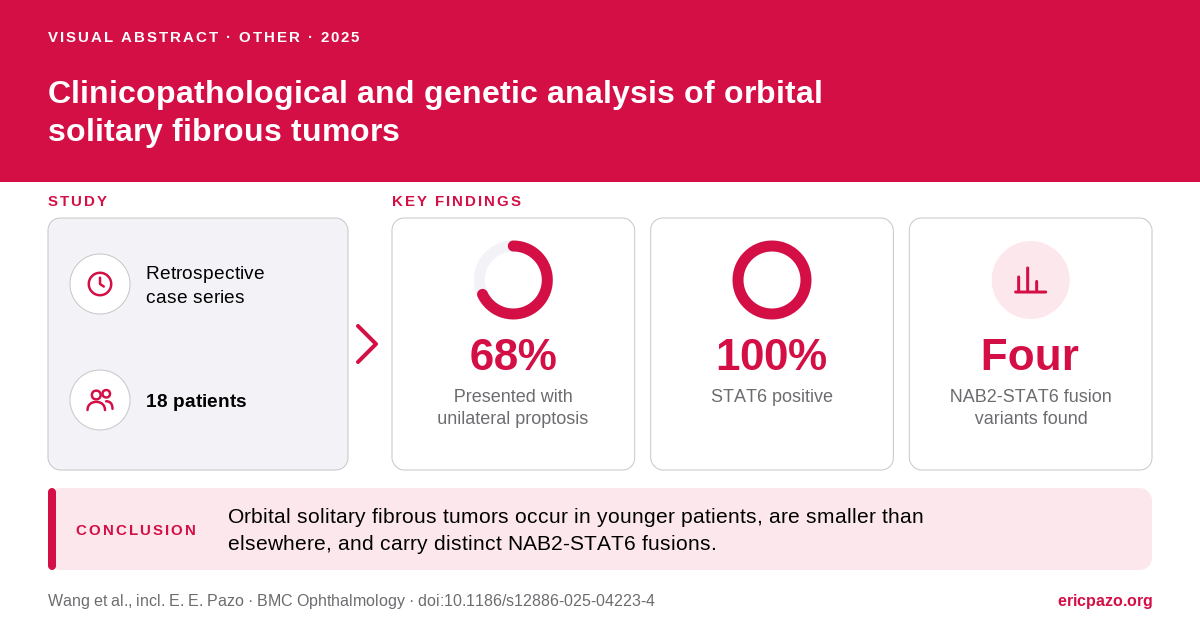
眼窩の孤立性線維性腫瘍はより若い患者に生じ、他部位より小さく、特徴的な NAB2-STAT6 融合を示す。
- 研究デザイン
- 後ろ向き症例集積
- 対象
- 患者 18 人
- 片眼性眼球突出で発症
- 68%
- STAT6 陽性
- 100%
- 検出された NAB2-STAT6 融合バリアント
- Four
抄録
この抄録は原語(英語)で表示しています。論文のライセンス(CC BY-NC-ND)では翻訳の公開が認められていないためです。
PURPOSE: To investigate the clinicopathological and genetic characteristics of patients with orbital solitary fibrous tumor (SFT) for clinical reference. METHODS: This single-center retrospective case-series study assessed clinical manifestations, imaging features, treatment, and prognosis of patients with orbital SFT. Immunohistochemical staining and fusion gene detection were also performed. RESULTS: The mean age of monocular orbital SFT patients was 38.89 ± 19.69 years (10 males and 8 females). The most common complaint was unilateral proptosis (68%). Tumors were 2.47 ± 0.67 cm in diameter, primarily oval-like (72%), and located in the upper part of the orbit (82%). Immunohistochemical staining results are as follows: STAT6 + (100%), CD99 + (100%), GRIA2 + (100%), ALDH1 + (95%), CD34 + (86%), Bcl-2 + (62%), EMA + (57%), S-100 + (10%), SMA + (10%), CD31 + (0%), Desmin + (0%), P53 + ( 2-44%), Ki-67( 1-10%), VEGFR1 + (100%), VEGFR2 + (100%), VEGFR3 + (0%), PDGFRα + (90%), PDGFRβ + (100%). Among them, CD99 (95%), ALDH1 (90%), and CD34 (86%) were relatively high in moderate and strong positive expression. Bcl-2 staining score of the primary group was higher than that of the recurrent group, and the difference was statistically significant (P < 0.05). Bcl-2 staining score of the benign group was higher than that of the malignant group, and the difference was statistically significant (P < 0.05). Four NAB2-STAT6 fusion variants were detected in 21 paraffin samples, including 1 case each of NAB2ex4-STAT6ex2 and NAB2ex6-STAT6ex16 and 2 cases each of NAB2ex6-STAT6ex17 and NAB2ex7-STAT6ex4. CONCLUSION: Orbital SFT were found in younger cohorts and smaller in size than other SFT. STAT6, CD99, GRIA2, ALDH1, CD34, and Bcl-2 are sensitive indications for orbital SFT, while CD99, ALDH1 and CD34 are more sensitive. High Bcl-2 expression is more common in primary and benign orbital SFT. The orbital SFT gene fusion variants include NAB2ex4-STAT6ex2, NAB2ex6-STAT6ex16, NAB2ex6-STAT6ex17, and NAB2ex7-STAT6ex4. An in-depth clinicopathological study can help explain orbital SFT.
キーワード: NAB2-STAT6 fusion; STAT6; CD99; ALDH1; CD34; Bcl-2; immunohistochemistry; clinicopathological features
アクセス
引用方法
BibTeX を表示
@article{wang2025clinicopathological,
  title = {{Clinicopathological and genetic analysis of orbital solitary fibrous tumors}},
  author = {Wang, Qing and Nan, Zonghan and Liu, Xun and Zhu, Limin and Pazo, Emmanuel Eric and Jian, Tianming and Zhao, Liang and Zhao, Jinzhi and Lin, Tingting},
  journal = {BMC Ophthalmology},
  year = {2025},
  doi = {10.1186/s12886-025-04223-4},
  url = {https://doi.org/10.1186/s12886-025-04223-4},
}
関連する論文
- Ocular Function Measures and Neurological Severity in Neurodegenerative Disease: A Systematic Review (2026)
- 内視鏡下鼻内涙嚢鼻腔吻合術におけるヒドロキシブチルキトサンと 5-フルオロウラシルの影響 (2024)
- 乳がん患者における National Comprehensive Cancer Network-Functional Assessment of Cancer Therapy-Breast Cancer Symptom Index(NFBSI-16)質問票の紙版とウェブ版の比較解析:ランダム化クロスオーバー研究 (2021)