
Impact du chitosane hydroxybutylé et du 5-fluorouracile sur la dacryocystorhinostomie endoscopique endonasale
Titre original : The impact of hydroxybutyl chitosan and 5-fluorouracil on the procedure of endoscopic endonasal dacryocystorhinostomy
Jia Qi Lin, Jin Zhao, Xun Liu, Emmanuel Eric Pazo, Qing Wang, Li Zhu, T.‐S. LIN
 Indian Journal of Ophthalmology, 2024 · article · doi:10.4103/ijo.ijo_3375_23 · cité 2 fois · Accès libre (CC BY-NC-SA)
En bref
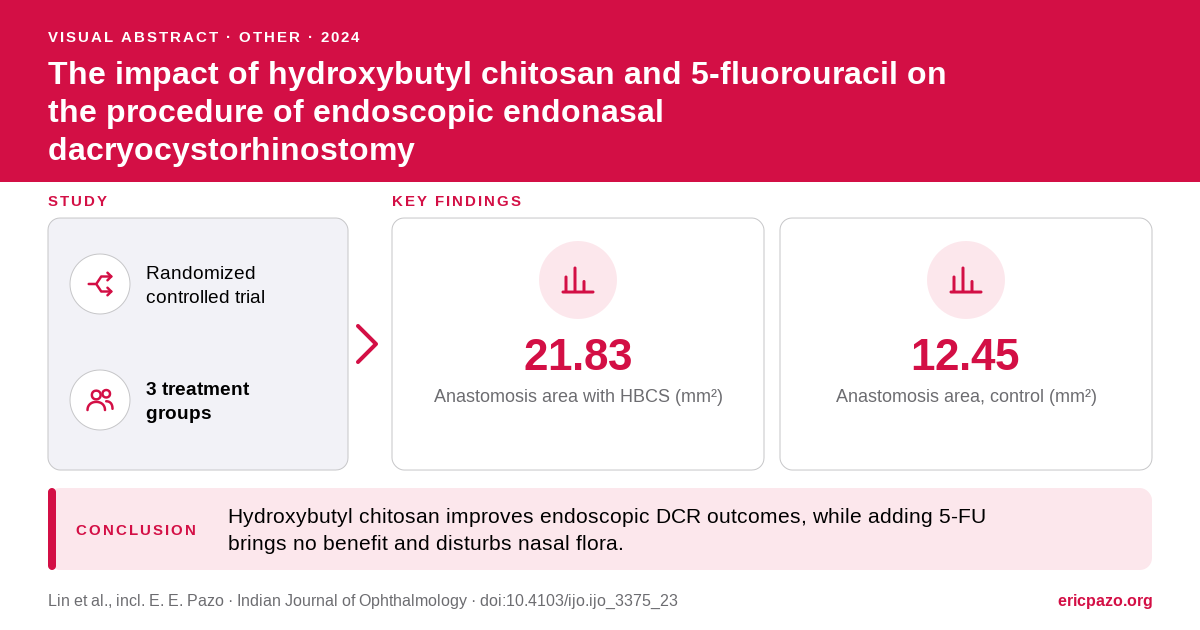
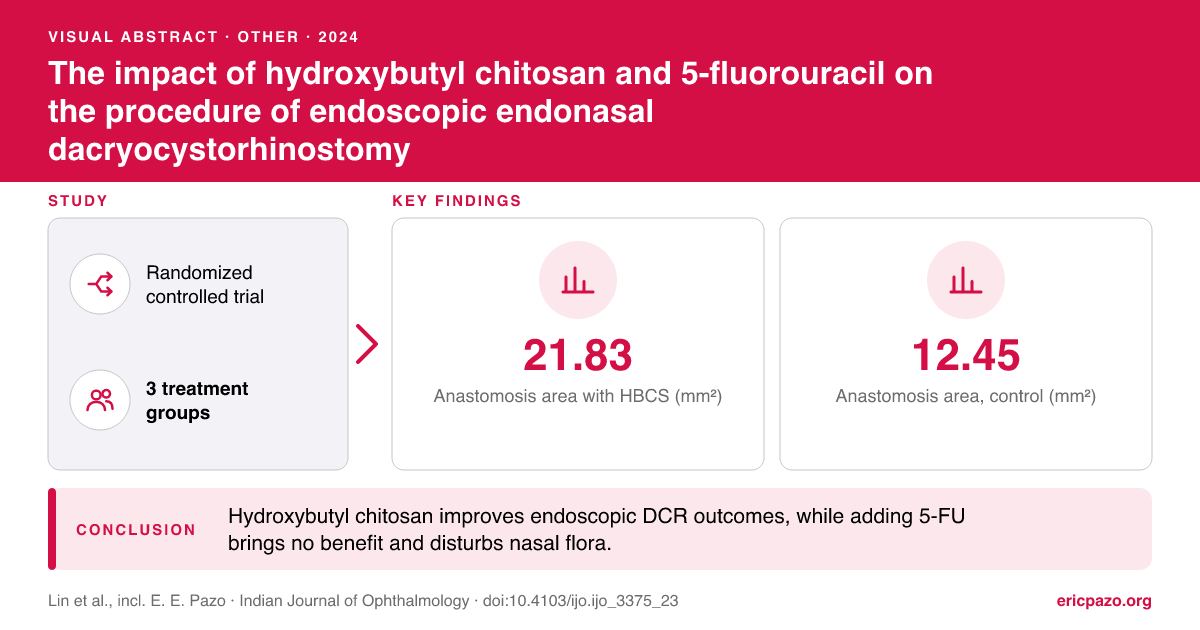
Le chitosane hydroxybutylé améliore les résultats de la DCR endoscopique, tandis que l'ajout de 5-FU n'apporte aucun bénéfice et perturbe la flore nasale.
- Type d'étude
- Essai contrôlé randomisé
- Échantillon
- 3 groupes de traitement
- Surface de l'anastomose avec HBCS (mm²)
- 21.83
- Surface de l'anastomose, témoin (mm²)
- 12.45
Résumé
OBJECTIF : Étudier les effets du chitosane hydroxybutylé (HBCS), avec et sans 5-fluorouracile (5-FU), lors de la dacryocystorhinostomie endoscopique endonasale (Endo-DCR). En outre, la présente étude a observé l'impact du HBCS et du 5-FU sur les fonctions de la population de cellules de la muqueuse nasale in vivo . MÉTHODES : Les patients ont été randomisés en un groupe HBCS (groupe A), un groupe HBCS associé au 5-FU (groupe B) et un groupe témoin avec éponge de gélatine (groupe C). Le séquençage à haut débit de l'ARNr 16S a permis d'examiner les modifications de la flore du sac conjonctival et des fosses nasales. De plus, le test CCK8, le test de rayure cellulaire et la cytométrie en flux ont été utilisés pour étudier les effets du HBCS et du 5-FU sur les populations de cellules de la muqueuse nasale. RÉSULTATS : Les sujets des groupes A, B et C présentaient des surfaces anastomotiques de 21.83 ± 12.69 mm 2 , 21.57 ± 14.53 mm 2 et 12.45 ± 8.16 mm 2 , respectivement ( P = 0.0359). Le groupe A présentait un larmoiement moins sévère que les deux autres groupes lors des suivis postopératoires à 1, 2 et 12 semaines ( P < 0.05). Les complications autour de l'anastomose étaient les moins sévères dans le groupe A ( P = 0.0259). Après la chirurgie, la proportion de bactéries pathogènes dans le sac conjonctival et la cavité nasale était plus élevée dans les groupes A et B que chez les adultes sains. Au suivi de 2 semaines, la structure de la flore nasale du groupe A était plus proche de celle des adultes sains que celle du groupe B. CONCLUSION : L'utilisation peropératoire de HBCS au niveau de l'anastomose améliore le résultat postopératoire de l'En-DCR. Le 5-FU n'améliore pas les résultats postopératoires de l'En-DCR et nuit à la normalisation de la flore postopératoire chez les patients atteints de dacryocystite chronique. Au niveau cellulaire, le HBCS comme le 5-FU inhibent la migration des populations de cellules de la muqueuse nasale, et le 5-FU inhibe la prolifération sans favoriser l'apoptose.
Traduit du résumé original en anglais (licence : CC BY-NC-SA).
Afficher le résumé original
PURPOSE: To investigate the effects of hydroxybutyl chitosan (HBCS) with and without 5-fluorouracil (5-FU) during endoscopic endonasal dacryocystorhinostomy (Endo-DCR). In addition, the present study observed the impact of HBCS and 5-FU on the functions of the nasal mucosal cell population in vivo . METHODS: Patients were randomized into HBCS (group A), HBCS combined with 5-FU (group B), and gelatin sponge control group (group C). 16S rRNA high-throughput sequencing technology examined the conjunctival sac and nasal flora changes. In addition, CCK8, cell scratching, and flow cytometry were used to investigate the effects of HBCS and 5-FU on the nasal mucosal cell populations. RESULTS: Subjects in groups A, B, and C had anastomotic areas of 21.83 ± 12.69 mm 2 , 21.57 ± 14.53 mm 2 , and 12.45 ± 8.16 mm 2 , respectively ( P = 0.0359). Group A had less severe epiphora than the other two groups at 1-, 2-, and 12-week postoperative follow-up ( P < 0.05). Complications around the anastomosis in group A were the least severe of the three groups ( P = 0.0259). After surgery, the proportion of pathogenic bacteria in the conjunctival sac and nasal cavity was higher in groups A and B than in healthy adults. At the 2-week follow-up, the structure of nasal flora in group A was more similar to that of the healthy adults compared to group B. CONCLUSION: Intraoperative use of HBCS at the anastomose improves the postoperative outcome of En-DCR. 5-FU cannot give better postoperative results in En-DCR and is detrimental to the normalization of the postoperative flora in patients with chronic dacryocystitis. At the cellular level, both HBCS and 5-FU inhibit the migration of nasal mucosal cell populations, and 5-FU inhibits proliferation but does not promote apoptosis.
Mots-clés : hydroxybutyl chitosan; 5-fluorouracil; endoscopic endonasal dacryocystorhinostomy; chronic dacryocystitis; nasal mucosa; nasal microbiota; anastomotic healing; epiphora
Accès
Comment citer
Afficher le BibTeX
@article{lin2024the,
  title = {{The impact of hydroxybutyl chitosan and 5-fluorouracil on the procedure of endoscopic endonasal dacryocystorhinostomy}},
  author = {Lin, Jia Qi and Zhao, Jin and Liu, Xun and Pazo, Emmanuel Eric and Wang, Qing and Zhu, Li and LIN, T.‐S.},
  journal = {Indian Journal of Ophthalmology},
  year = {2024},
  doi = {10.4103/ijo.ijo_3375_23},
  url = {https://doi.org/10.4103/ijo.ijo_3375_23},
}
Travaux liés
- Ocular Function Measures and Neurological Severity in Neurodegenerative Disease: A Systematic Review (2026)
- Analyse clinicopathologique et génétique des tumeurs fibreuses solitaires de l'orbite (2025)
- Analyse comparative des versions papier et en ligne du questionnaire National Comprehensive Cancer Network-Functional Assessment of Cancer Therapy-Breast Cancer Symptom Index (NFBSI-16) chez des patientes atteintes de cancer du sein : étude randomisée croisée (2021)