
Análisis clinicopatológico y genético de los tumores fibrosos solitarios orbitarios
Título original: Clinicopathological and genetic analysis of orbital solitary fibrous tumors
Qing Wang, Zonghan Nan, Xun Liu, Limin Zhu, Emmanuel Eric Pazo, Tianming Jian, Liang Zhao, Jinzhi Zhao, Tingting Lin
 BMC Ophthalmology, 2025 · artículo · doi:10.1186/s12886-025-04223-4 · citado 5 veces · Acceso abierto (CC BY-NC-ND)
De un vistazo
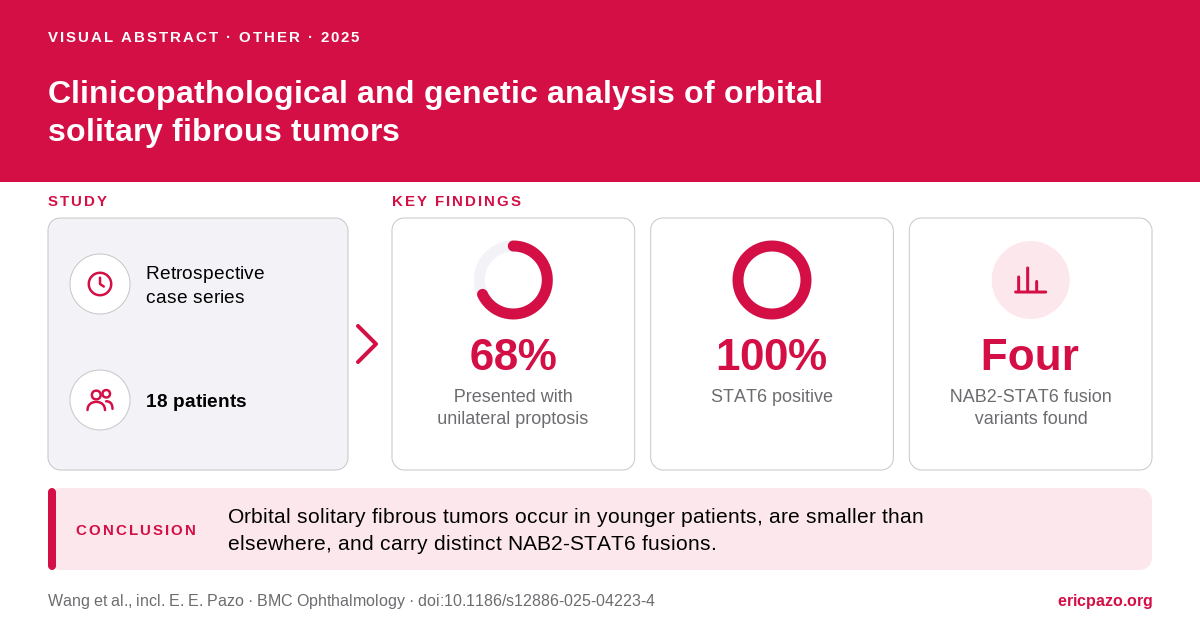
Los tumores fibrosos solitarios orbitarios aparecen en pacientes más jóvenes, son más pequeños que en otras localizaciones y presentan fusiones NAB2-STAT6 características.
- Diseño
- Serie de casos retrospectiva
- Muestra
- 18 pacientes
- Debutaron con proptosis unilateral
- 68%
- STAT6 positivo
- 100%
- Variantes de fusión NAB2-STAT6 halladas
- Four
Resumen
Este resumen se muestra en su idioma original, el inglés, porque la licencia del artículo (CC BY-NC-ND) no permite publicar traducciones.
PURPOSE: To investigate the clinicopathological and genetic characteristics of patients with orbital solitary fibrous tumor (SFT) for clinical reference. METHODS: This single-center retrospective case-series study assessed clinical manifestations, imaging features, treatment, and prognosis of patients with orbital SFT. Immunohistochemical staining and fusion gene detection were also performed. RESULTS: The mean age of monocular orbital SFT patients was 38.89 ± 19.69 years (10 males and 8 females). The most common complaint was unilateral proptosis (68%). Tumors were 2.47 ± 0.67 cm in diameter, primarily oval-like (72%), and located in the upper part of the orbit (82%). Immunohistochemical staining results are as follows: STAT6 + (100%), CD99 + (100%), GRIA2 + (100%), ALDH1 + (95%), CD34 + (86%), Bcl-2 + (62%), EMA + (57%), S-100 + (10%), SMA + (10%), CD31 + (0%), Desmin + (0%), P53 + ( 2-44%), Ki-67( 1-10%), VEGFR1 + (100%), VEGFR2 + (100%), VEGFR3 + (0%), PDGFRα + (90%), PDGFRβ + (100%). Among them, CD99 (95%), ALDH1 (90%), and CD34 (86%) were relatively high in moderate and strong positive expression. Bcl-2 staining score of the primary group was higher than that of the recurrent group, and the difference was statistically significant (P < 0.05). Bcl-2 staining score of the benign group was higher than that of the malignant group, and the difference was statistically significant (P < 0.05). Four NAB2-STAT6 fusion variants were detected in 21 paraffin samples, including 1 case each of NAB2ex4-STAT6ex2 and NAB2ex6-STAT6ex16 and 2 cases each of NAB2ex6-STAT6ex17 and NAB2ex7-STAT6ex4. CONCLUSION: Orbital SFT were found in younger cohorts and smaller in size than other SFT. STAT6, CD99, GRIA2, ALDH1, CD34, and Bcl-2 are sensitive indications for orbital SFT, while CD99, ALDH1 and CD34 are more sensitive. High Bcl-2 expression is more common in primary and benign orbital SFT. The orbital SFT gene fusion variants include NAB2ex4-STAT6ex2, NAB2ex6-STAT6ex16, NAB2ex6-STAT6ex17, and NAB2ex7-STAT6ex4. An in-depth clinicopathological study can help explain orbital SFT.
Palabras clave: NAB2-STAT6 fusion; STAT6; CD99; ALDH1; CD34; Bcl-2; immunohistochemistry; clinicopathological features
Acceso
Cómo citar
Mostrar BibTeX
@article{wang2025clinicopathological,
  title = {{Clinicopathological and genetic analysis of orbital solitary fibrous tumors}},
  author = {Wang, Qing and Nan, Zonghan and Liu, Xun and Zhu, Limin and Pazo, Emmanuel Eric and Jian, Tianming and Zhao, Liang and Zhao, Jinzhi and Lin, Tingting},
  journal = {BMC Ophthalmology},
  year = {2025},
  doi = {10.1186/s12886-025-04223-4},
  url = {https://doi.org/10.1186/s12886-025-04223-4},
}
Trabajos relacionados
- Ocular Function Measures and Neurological Severity in Neurodegenerative Disease: A Systematic Review (2026)
- Impacto del hidroxibutil quitosano y del 5-fluorouracilo en la dacriocistorrinostomía endoscópica endonasal (2024)
- Análisis comparativo de las versiones en papel y web del cuestionario National Comprehensive Cancer Network-Functional Assessment of Cancer Therapy-Breast Cancer Symptom Index (NFBSI-16) en pacientes con cáncer de mama: estudio aleatorizado cruzado (2021)