
Influence de l'épaisseur cornéenne sur l'astigmatisme cornéen induit chirurgicalement dérivé de la kératométrie totale mesurée par OCT swept-source du segment antérieur
Titre original : The Influence of Corneal Thickness on Surgically Induced Corneal Astigmatism Derived from Total Keratometry Measured by Anterior Segment Swept-Source OCT
Fangyu Zhao, Yufan Yin, Emmanuel Eric Pazo, Fang Tian, Yuanfeng Jiang, Shaochong Bu
 Ophthalmology and Therapy, 2024 · article · doi:10.1007/s40123-024-00996-x · cité 1 fois · Accès libre (CC BY-NC)
Surface oculaire et sécheresse oculaireRétine et imagerie vasculaire
En bref
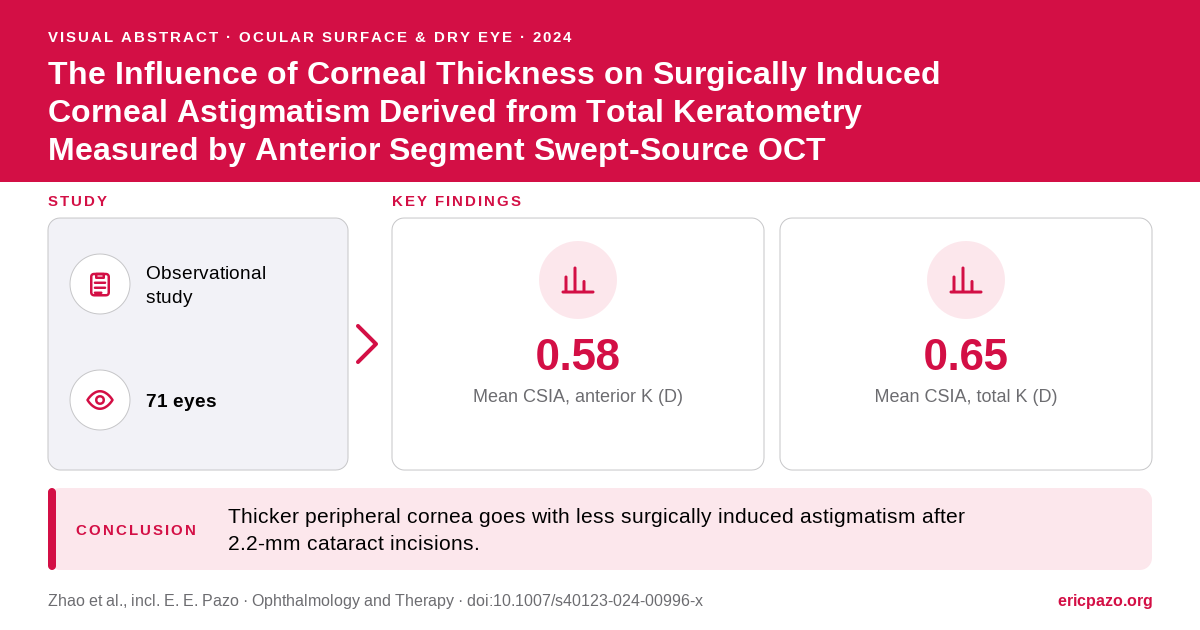
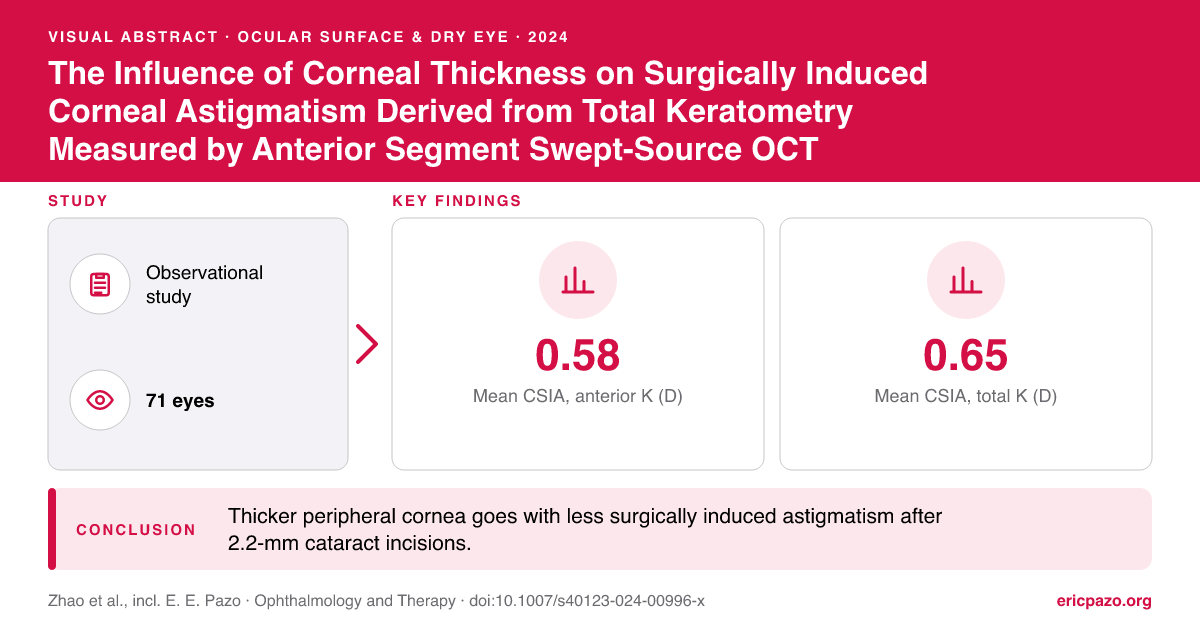
Une cornée périphérique plus épaisse va de pair avec moins d'astigmatisme induit chirurgicalement après des incisions de cataracte de 2.2 mm.
- Type d'étude
- Étude observationnelle
- Échantillon
- 71 yeux
- CSIA moyen, K antérieure (D)
- 0.58
- CSIA moyen, K totale (D)
- 0.65
Résumé
L'objectif de l'étude était d'explorer les corrélations possibles entre les paramètres du segment antérieur issus de la tomographie par cohérence optique swept-source du segment antérieur (AS-SS-OCT) et l'astigmatisme cornéen induit chirurgicalement (CSIA) calculé à partir de la kératométrie totale (TK) mesurée par AS-SS-OCT. Soixante et onze yeux de 67 patients atteints de cataracte liée à l'âge, opérés par phacoémulsification avec implantation d'une lentille intraoculaire par une incision de 2.2 mm, ont été inclus. Les valeurs de CSIA ont été calculées à partir de la kératométrie antérieure (CSIA Kant ) et de la TK (CSIA TK ) mesurées par AS-SS-OCT. Le test T 2 de Hotelling a été utilisé pour évaluer la différence. La corrélation du CSIA avec divers paramètres issus de l'AS-SS-OCT a été testée par le coefficient de corrélation de Spearman. Les centroïdes du CSIA Kant et du CSIA TK étaient de 0.31 ± 0.55 D @ 54° et 0.41 ± 0.59 D @ 51°, sans différence significative ( F = 1.283, p = 0.281, T 2 de Hotelling). Les CSIA Kant et CSIA TK absolus moyens étaient de 0.58 ± 0.24 D et 0.65 ± 0.28 D. Le test de Spearman a montré que l'amplitude du CSIA Kant était négativement corrélée à l'épaisseur cornéenne périphérique préopératoire (PCT, p = 0.045) et à l'amplitude de la kératométrie antérieure ( p = 0.044). L'amplitude du CSIA TK était négativement corrélée à l'épaisseur cornéenne centrale préopératoire (CCT, p = 0.003) et à la PCT préopératoire ( p = 0.015). L'augmentation de l'épaisseur de la cornée périphérique est corrélée à une diminution de l'amplitude du CSIA. La corrélation identifiée entre l'épaisseur cornéenne et le CSIA indique que certains paramètres préopératoires doivent être pris en compte pour prédire le CSIA en vue d'un résultat réfractif plus précis.
Traduit du résumé original en anglais (licence : CC BY-NC).
Afficher le résumé original
The purpose of the study was to explore the possible correlations between the anterior segment parameters derived from anterior segment swept-source optical coherence tomography (AS-SS-OCT) with the surgically induced corneal astigmatism (CSIA) calculated from total keratometry (TK) measured by AS-SS-OCT. Seventy-one eyes of 67 patients with age-related cataract who underwent phacoemulsification combined with intraocular lens implantation with 2.2-mm incision were included. The CSIA values were calculated from anterior keratometry (CSIA Kant ) and TK (CSIA TK ) measured by AS-SS-OCT, respectively. Hotelling’s T 2 test was used to evaluate the difference. The correlation of CSIA with various parameters derived from AS-SS-OCT was tested with the Spearman correlation coefficient. The centroid of CSIA Kant and of CSIA TK were 0.31 ± 0.55 D @ 54° and 0.41 ± 0.59 D @ 51°, with no significant difference ( F = 1.283, p = 0.281, Hotelling’s T 2 ). The mean absolute CSIA Kant and CSIA TK were 0.58 ± 0.24 D and 0.65 ± 0.28 D. Spearman test showed that the magnitude of CSIA Kant was negatively correlated with preoperative peripheral corneal thickness (PCT, p = 0.045) and the magnitude of anterior keratometry ( p = 0.044). The magnitude of CSIA TK was negatively correlated with preoperative central corneal thickness (CCT, p = 0.003) and preoperative PCT ( p = 0.015). The increased thickness of the peripheral cornea is correlated with the decrease in the magnitude of the CSIA. The correlation we identified between the corneal thickness and the CSIA indicated that certain preoperative parameters should be considered for the prediction of CSIA for a more precise refractive outcome.
Mots-clés : corneal thickness; central corneal thickness; peripheral corneal thickness; total keratometry; phacoemulsification; intraocular lens implantation; senile cataract; refractive outcome prediction
Accès
Comment citer
Afficher le BibTeX
@article{zhao2024the,
  title = {{The Influence of Corneal Thickness on Surgically Induced Corneal Astigmatism Derived from Total Keratometry Measured by Anterior Segment Swept-Source OCT}},
  author = {Zhao, Fangyu and Yin, Yufan and Pazo, Emmanuel Eric and Tian, Fang and Jiang, Yuanfeng and Bu, Shaochong},
  journal = {Ophthalmology and Therapy},
  year = {2024},
  doi = {10.1007/s40123-024-00996-x},
  url = {https://doi.org/10.1007/s40123-024-00996-x},
}
Travaux liés
- Prise en charge de la sécheresse oculaire liée au glaucome par lumière pulsée intense : une étude contrôlée randomisée (2024)
- Analyse de l'influence de l'espace au bord du volet sur la régénération des nerfs cornéens après LASIK assisté par laser femtoseconde (2026)
- Association entre la pression de perfusion oculaire moyenne et la rétinopathie diabétique proliférante dans une population du nord de la Chine (2026)
- Association des connaissances et des attitudes vis-à-vis du traitement anti-VEGF avec l'interruption autodéclarée du traitement : une étude de classification à séparation temporelle (2026)
- Mesure automatisée par apprentissage profond du volume de rétinoschisis et de décollement dans la myopie pathologique avec contraction sclérale postérieure (2026)