
Influencia del espesor corneal en el astigmatismo corneal inducido quirúrgicamente derivado de la queratometría total medida con OCT de fuente de barrido del segmento anterior
Título original: The Influence of Corneal Thickness on Surgically Induced Corneal Astigmatism Derived from Total Keratometry Measured by Anterior Segment Swept-Source OCT
Fangyu Zhao, Yufan Yin, Emmanuel Eric Pazo, Fang Tian, Yuanfeng Jiang, Shaochong Bu
 Ophthalmology and Therapy, 2024 · artículo · doi:10.1007/s40123-024-00996-x · citado 1 vez · Acceso abierto (CC BY-NC)
Superficie ocular y ojo secoRetina e imagen vascular
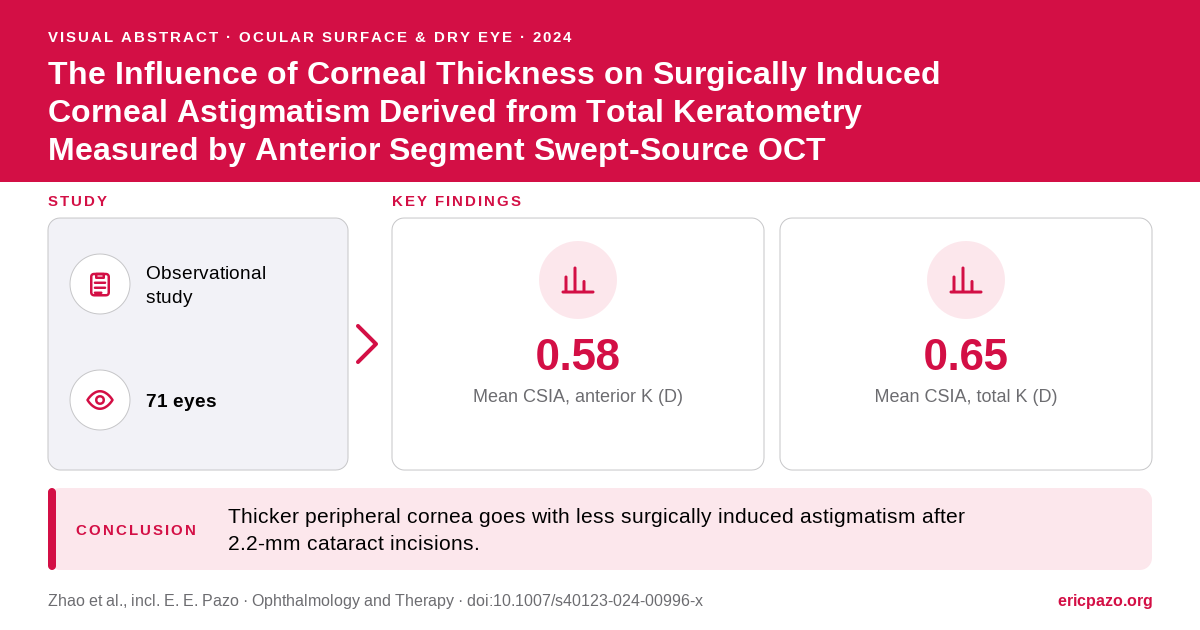
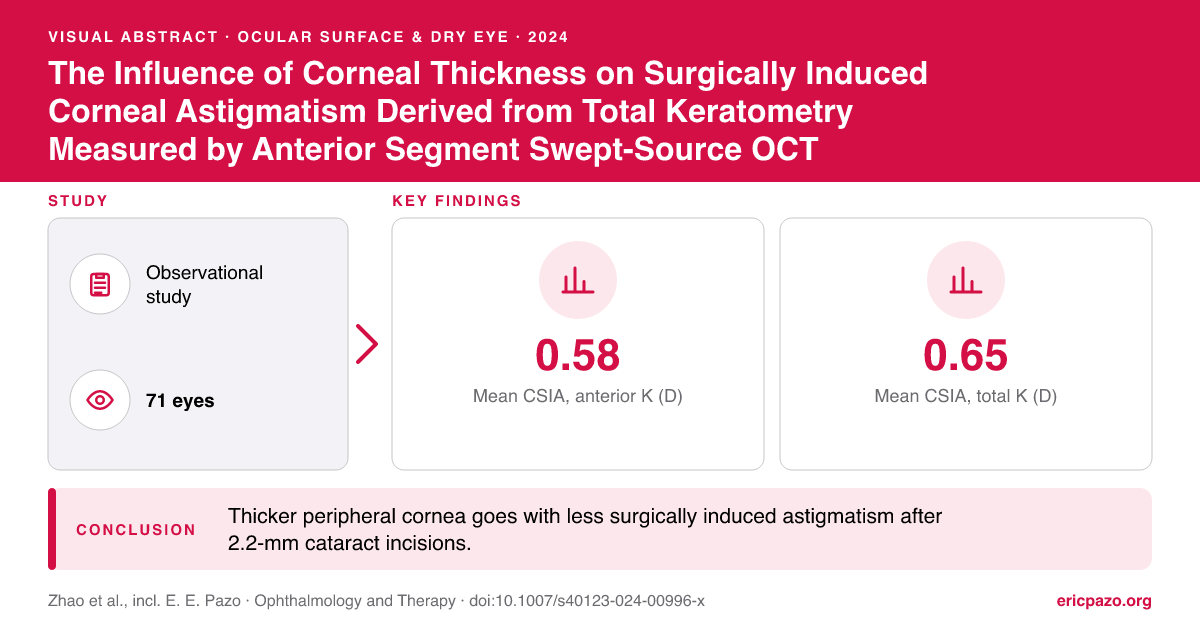
De un vistazo
Una córnea periférica más gruesa se asocia a menos astigmatismo inducido quirúrgicamente tras incisiones de catarata de 2.2 mm.
- Diseño
- Estudio observacional
- Muestra
- 71 ojos
- CSIA medio, K anterior (D)
- 0.58
- CSIA medio, K total (D)
- 0.65
Resumen
El objetivo del estudio fue explorar las posibles correlaciones entre los parámetros del segmento anterior obtenidos con la tomografía de coherencia óptica de fuente de barrido del segmento anterior (AS-SS-OCT) y el astigmatismo corneal inducido quirúrgicamente (CSIA) calculado a partir de la queratometría total (TK) medida con AS-SS-OCT. Se incluyeron setenta y un ojos de 67 pacientes con catarata relacionada con la edad sometidos a facoemulsificación combinada con implante de lente intraocular mediante una incisión de 2.2 mm. Los valores de CSIA se calcularon a partir de la queratometría anterior (CSIA Kant ) y de la TK (CSIA TK ) medidas con AS-SS-OCT, respectivamente. Se utilizó la prueba T 2 de Hotelling para evaluar la diferencia. La correlación del CSIA con diversos parámetros obtenidos con AS-SS-OCT se analizó mediante el coeficiente de correlación de Spearman. Los centroides del CSIA Kant y del CSIA TK fueron 0.31 ± 0.55 D @ 54° y 0.41 ± 0.59 D @ 51°, sin diferencias significativas ( F = 1.283, p = 0.281, T 2 de Hotelling). Los valores absolutos medios del CSIA Kant y del CSIA TK fueron 0.58 ± 0.24 D y 0.65 ± 0.28 D. La prueba de Spearman mostró que la magnitud del CSIA Kant se correlacionaba negativamente con el espesor corneal periférico preoperatorio (PCT, p = 0.045) y con la magnitud de la queratometría anterior ( p = 0.044). La magnitud del CSIA TK se correlacionaba negativamente con el espesor corneal central preoperatorio (CCT, p = 0.003) y con el PCT preoperatorio ( p = 0.015). El aumento del espesor de la córnea periférica se correlaciona con la disminución de la magnitud del CSIA. La correlación identificada entre el espesor corneal y el CSIA indica que deben considerarse ciertos parámetros preoperatorios para predecir el CSIA y lograr un resultado refractivo más preciso.
Traducido del resumen original en inglés (licencia: CC BY-NC).
Mostrar el resumen original
The purpose of the study was to explore the possible correlations between the anterior segment parameters derived from anterior segment swept-source optical coherence tomography (AS-SS-OCT) with the surgically induced corneal astigmatism (CSIA) calculated from total keratometry (TK) measured by AS-SS-OCT. Seventy-one eyes of 67 patients with age-related cataract who underwent phacoemulsification combined with intraocular lens implantation with 2.2-mm incision were included. The CSIA values were calculated from anterior keratometry (CSIA Kant ) and TK (CSIA TK ) measured by AS-SS-OCT, respectively. Hotelling’s T 2 test was used to evaluate the difference. The correlation of CSIA with various parameters derived from AS-SS-OCT was tested with the Spearman correlation coefficient. The centroid of CSIA Kant and of CSIA TK were 0.31 ± 0.55 D @ 54° and 0.41 ± 0.59 D @ 51°, with no significant difference ( F = 1.283, p = 0.281, Hotelling’s T 2 ). The mean absolute CSIA Kant and CSIA TK were 0.58 ± 0.24 D and 0.65 ± 0.28 D. Spearman test showed that the magnitude of CSIA Kant was negatively correlated with preoperative peripheral corneal thickness (PCT, p = 0.045) and the magnitude of anterior keratometry ( p = 0.044). The magnitude of CSIA TK was negatively correlated with preoperative central corneal thickness (CCT, p = 0.003) and preoperative PCT ( p = 0.015). The increased thickness of the peripheral cornea is correlated with the decrease in the magnitude of the CSIA. The correlation we identified between the corneal thickness and the CSIA indicated that certain preoperative parameters should be considered for the prediction of CSIA for a more precise refractive outcome.
Palabras clave: corneal thickness; central corneal thickness; peripheral corneal thickness; total keratometry; phacoemulsification; intraocular lens implantation; senile cataract; refractive outcome prediction
Acceso
Cómo citar
Mostrar BibTeX
@article{zhao2024the,
  title = {{The Influence of Corneal Thickness on Surgically Induced Corneal Astigmatism Derived from Total Keratometry Measured by Anterior Segment Swept-Source OCT}},
  author = {Zhao, Fangyu and Yin, Yufan and Pazo, Emmanuel Eric and Tian, Fang and Jiang, Yuanfeng and Bu, Shaochong},
  journal = {Ophthalmology and Therapy},
  year = {2024},
  doi = {10.1007/s40123-024-00996-x},
  url = {https://doi.org/10.1007/s40123-024-00996-x},
}
Trabajos relacionados
- Tratamiento de la enfermedad de ojo seco relacionada con el glaucoma mediante luz pulsada intensa: un estudio controlado aleatorizado (2024)
- Análisis de la influencia del espacio del margen del colgajo en la regeneración de los nervios corneales tras LASIK asistido por láser de femtosegundo (2026)
- Asociación entre la presión de perfusión ocular media y la retinopatía diabética proliferativa en una población del norte de China (2026)
- Asociación de los conocimientos y actitudes sobre el tratamiento anti-VEGF con la interrupción autodeclarada del tratamiento: un estudio de clasificación con separación temporal (2026)
- Medición automatizada basada en aprendizaje profundo del volumen de retinosquisis y desprendimiento en la miopía patológica con contracción escleral posterior (2026)