
Calculs asymptomatiques du canalicule lacrymal
Titre original : Asymptomatic stones in the lacrimal canaliculus
Hongda Zhang, Maosheng Xu, Guanghao Qin, Jiayan Chen, Yifan Qi, Ling Xu, Wei He, Emmanuel Eric Pazo
 Clinical Case Reports, 2023 · article · doi:10.1002/ccr3.8175 · cité 1 fois · Accès libre (CC BY)
Cataracte et chirurgie du segment antérieur
En bref
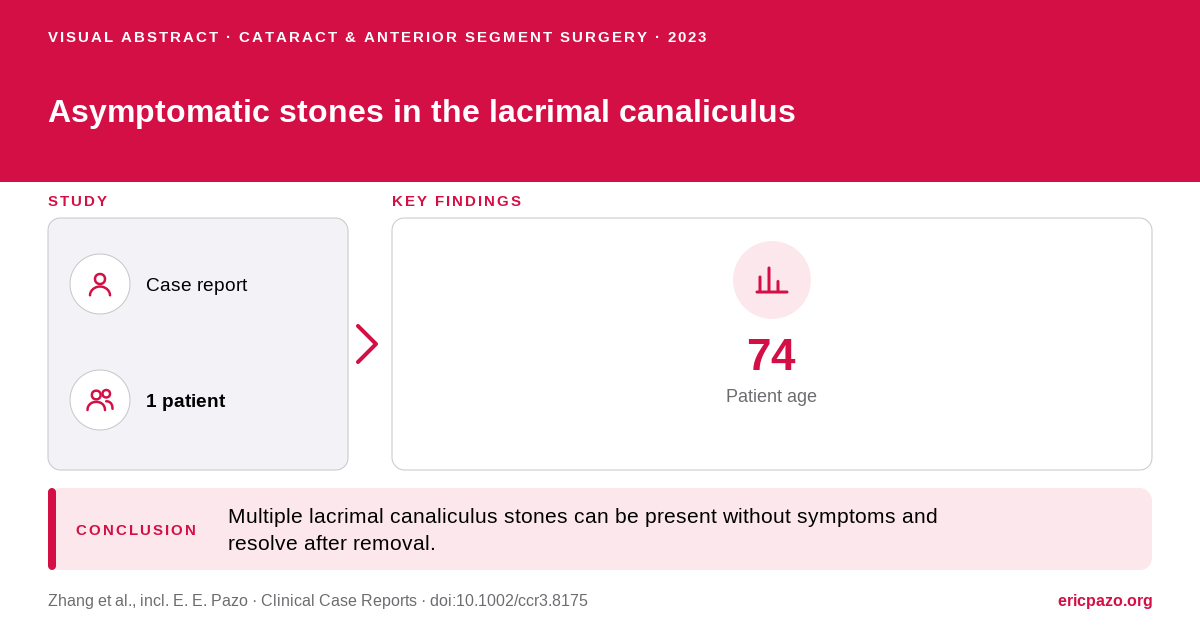
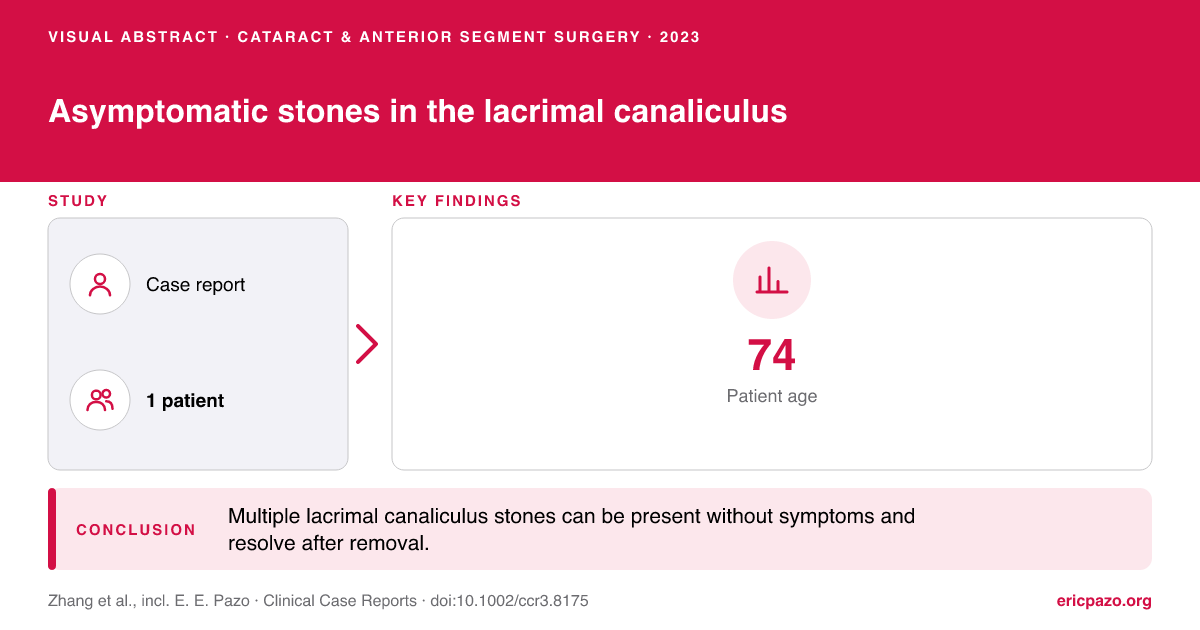
De multiples calculs du canalicule lacrymal peuvent être présents sans symptômes et disparaître après leur ablation.
- Type d'étude
- Cas clinique
- Échantillon
- 1 patiente
- Âge de la patiente
- 74
Résumé
Message clinique clé : Les calculs asymptomatiques du canalicule lacrymal formant de nombreux calculs sans symptômes sont rares. La patiente s'est bien rétablie en une semaine après l'ablation du dacryolithe. Ce diagnostic est fréquent dans cette tranche d'âge ; il faut néanmoins envisager une obstruction lacrymo-nasale asymptomatique. Résumé : Les dacryolithes, également appelés calculs symptomatiques, sont fréquemment observés dans les voies lacrymales. Ils se manifestent par des symptômes tels que conjonctivite, sécrétions et larmoiement. La présence de nombreux calculs dans le canalicule lacrymal en l'absence de symptômes apparents est toutefois inhabituelle. Nous présentons ici un cas de plusieurs calculs dans le canalicule lacrymal inférieur. Une patiente de 74 ans s'est présentée avec une cataracte sénile bilatérale et devait être opérée. Lors d'un examen ophtalmologique standard, la hauteur du ménisque lacrymal de l'œil gauche était plus importante que celle de l'œil droit. Une canaliculite avec dacryolithe a été confirmée par une série d'examens diagnostiques, dont l'inspection, le test de disparition du colorant fluorescent, la palpation, la biomicroscopie ultrasonore à 50 Mhz et l'irrigation des canalicules lacrymaux. L'exploration chirurgicale a confirmé l'obstruction canaliculaire, caractérisée par la présence de nombreux petits dacryolithes dans le système canaliculaire inférieur. Après l'exérèse chirurgicale des dacryolithes, la patiente a présenté une rémission complète en une semaine. Bien que ce diagnostic soit courant dans cette tranche d'âge, il importe d'envisager une obstruction lacrymo-nasale silencieuse comme diagnostic différentiel. Il convient de noter que la présence de dacryolithes dans les voies lacrymales peut se manifester indépendamment d'une conjonctivite. Aucun indicateur de risque n'a été identifié chez cette patiente.
Traduit du résumé original en anglais (licence : CC BY).
Afficher le résumé original
Key Clinical Message: Asymptomatic lacrimal canaliculus stones causing many stones without symptoms are rare. The patient recovered well within a week after dacryolith removal. This diagnosis is prevalent in this age group. However, asymptomatic nasolacrimal obstruction should be considered. Abstract: Dacryoliths, also known as symptomatic stones, are frequently observed in the lacrimal drainage system. These stones manifest through symptoms such as conjunctivitis, discharge, and epiphora. Nevertheless, the occurrence of numerous stones in the lacrimal canaliculus, in the absence of apparent symptoms, is uncommon. In this study, we present a case with the presence of several stones within the inferior lacrimal canaliculus. A female patient, aged 74, appeared with bilateral senile cataracts and was scheduled for cataract surgery. During a standard ocular examination, it was observed that the tear meniscus height in the left eye had a greater magnitude compared with the right eye. Canaliculitis with dacryolith was verified using a series of diagnostic procedures, including physical inspection, fluorescent dye disappearance test, palpation, 50 Mhz ultrasound biomicroscope scan, and irrigation of the lacrimal canaliculi. Upon surgical investigation, the canaliculus obstruction was confirmed, characterized by the existence of many tiny dacryolith formations inside the inferior canalicular system. Following the surgical excision of the dacryoliths, the patient experienced a full remission within a week. While it is common for individuals in this age range to receive this diagnosis, it is important to consider silent nasolacrimal blockage as a potential alternative diagnosis. It is important to note that the presence of dacryoliths in the lacrimal drainage system might manifest independently of conjunctivitis. No discernible risk indicators were found in relation to the aforementioned patient.
Mots-clés : dacryoliths; canaliculitis; nasolacrimal duct obstruction; lacrimal drainage system; epiphora; tear meniscus height; cataract surgery; elderly patients
Accès
Comment citer
Afficher le BibTeX
@article{zhang2023asymptomatic,
  title = {{Asymptomatic stones in the lacrimal canaliculus}},
  author = {Zhang, Hongda and Xu, Maosheng and Qin, Guanghao and Chen, Jiayan and Qi, Yifan and Xu, Ling and He, Wei and Pazo, Emmanuel Eric},
  journal = {Clinical Case Reports},
  year = {2023},
  doi = {10.1002/ccr3.8175},
  url = {https://doi.org/10.1002/ccr3.8175},
}
Travaux liés
- Observance du suivi à long terme après implantation d'une lentille en collamer implantable chez des patients fortement myopes : une étude monocentrique de cohorte rétrospective et d'enquête CAP (2026)
- Prédiction de la réfraction sous cycloplégie par apprentissage automatique avec l'Eyerobo Vision Screener : plan, une étude transversale comparative d'appareils (2026)
- Évaluer l'impact des lampes à fente portables assistées par IA sur les soins ophtalmologiques primaires en milieu rural (2025)
- Caractéristiques des paramètres biologiques et choix de la taille de la lentille en collamer implantable (ICL) dans les yeux myopes modérés, forts et très forts (2025)
- Exploration de modèles d'apprentissage automatique pour la sécurité du vault dans l'implantation d'ICL : une analyse comparative de modèles de régression et de classification (2025)