
Évaluation interférométrique du film lacrymal après lumière pulsée intense dans la sécheresse oculaire : une étude randomisée, en simple aveugle et contrôlée par simulation
Titre original : Tear film interferometry assessment after intense pulsed light in dry eye disease: A randomized, single masked, sham-controlled study
Yilin Song, Sile Yu, Xingru He, Lanting Yang, Yi Wu, Guanghao Qin, Qing Zhang, Gagan Deep Singh Talwar, Ling Xu, Jonathan Edward Moore, Wei He, Emmanuel Eric Pazo
 Contact Lens and Anterior Eye, 2021 · article · doi:10.1016/j.clae.2021.101499 · cité 42 fois · Accès libre (CC BY-NC-ND)
Surface oculaire et sécheresse oculaire
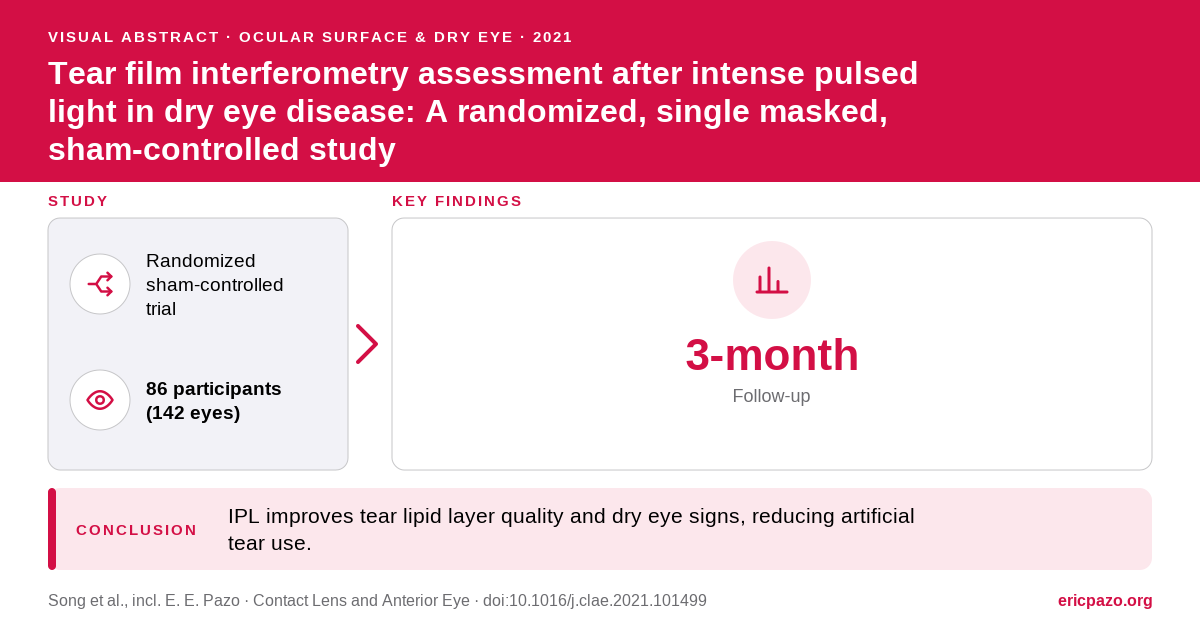
En bref
La LPI améliore la qualité de la couche lipidique lacrymale et les signes de sécheresse oculaire, et réduit l'usage de larmes artificielles.
- Type d'étude
- Essai randomisé contrôlé par simulation
- Échantillon
- 86 participants (142 yeux)
- Suivi
- 3-month
Résumé
Ce résumé est affiché dans sa langue d'origine, l'anglais, car la licence de l'article (CC BY-NC-ND) ne permet pas de publier des traductions.
BACKGROUND: Inadequate meibomian glands (MGs) secretion can lead to dry eye signs and symptoms. Tear film lipid layer (TFLL) secreted by MGs protects and prevents rapid evaporation of tear film. The purpose was to assess TFLL alteration and function in patients with evaporative dry eye (EDE) using tear interferometry after optimal pulse light technology (OPT) intense pulsed light (IPL). METHODS: This prospective randomized examiner-masked sham- controlled study included 86 participants (142 eyes) with DED. IPL or sham procedure was performed on day 0, 21, and 42. Ocular Surface Disease Index (OSDI), non-invasive breakup time (NITBUT), interferometric fringe pattern determined TFLL quality, fluorescein staining (FS), and meibum gland (MG) were assessed at day 0, 21, 42 and 3-month. RESULTS: At 3-month, TFLL, NITBUT, MG drop-out, MG quality, MG expressibility, FS and OSDI improved significantly (P < 0.05) in the IPL group, while the sham group had no significant improvements. Except for Meibo-score and FS, all parameters significantly correlated with the improvement in TFLL following IPL treatment. Additionally, artificial tears usage was significantly less in the IPL group from D-42 onwards. CONCLUSION: IPL treatment demonstrated the ability to improve TFLL quality and clinically reduced sign and symptoms of DED thereby reducing the frequency of artificial tears use.
Mots-clés : intense pulsed light; dry eye; evaporative dry eye; tear film lipid layer; meibomian glands; non-invasive tear break-up time; fluorescein staining; meibography
Accès
Comment citer
Afficher le BibTeX
@article{song2021tear,
  title = {{Tear film interferometry assessment after intense pulsed light in dry eye disease: A randomized, single masked, sham-controlled study}},
  author = {Song, Yilin and Yu, Sile and He, Xingru and Yang, Lanting and Wu, Yi and Qin, Guanghao and Zhang, Qing and Talwar, Gagan Deep Singh and Xu, Ling and Moore, Jonathan Edward and He, Wei and Pazo, Emmanuel Eric},
  journal = {Contact Lens and Anterior Eye},
  year = {2021},
  doi = {10.1016/j.clae.2021.101499},
  url = {https://doi.org/10.1016/j.clae.2021.101499},
}
Travaux liés
- Analyse de l'influence de l'espace au bord du volet sur la régénération des nerfs cornéens après LASIK assisté par laser femtoseconde (2026)
- Comparaison des effets de la lumière pulsée intense et de l'hygiène palpébrale sur le film lacrymal et la surface oculaire : une étude contrôlée randomisée (2026)
- Effects of 3% diquafosol sodium on tear film stability, corneal aberration parameters, and vision-related quality of life in pediatric orthokeratology-associated dry eye disease (2026)
- Association entre l'indice de masse corporelle maternel avant la grossesse et l'astigmatisme et la courbure cornéenne de l'enfant : une étude transversale (2025)
- Expression différentielle de la lymphotoxine α, de l'immunoglobuline E et de la métalloprotéinase matricielle 9 lacrymales dans la sécheresse oculaire associée à la conjonctivite allergique (2025)