
Tear film interferometry assessment after intense pulsed light in dry eye disease: A randomized, single masked, sham-controlled study
Yilin Song, Sile Yu, Xingru He, Lanting Yang, Yi Wu, Guanghao Qin, Qing Zhang, Gagan Deep Singh Talwar, Ling Xu, Jonathan Edward Moore, Wei He, Emmanuel Eric Pazo
 Contact Lens and Anterior Eye, 2021 · article · doi:10.1016/j.clae.2021.101499 · cited by 42 · Open access (CC BY-NC-ND)
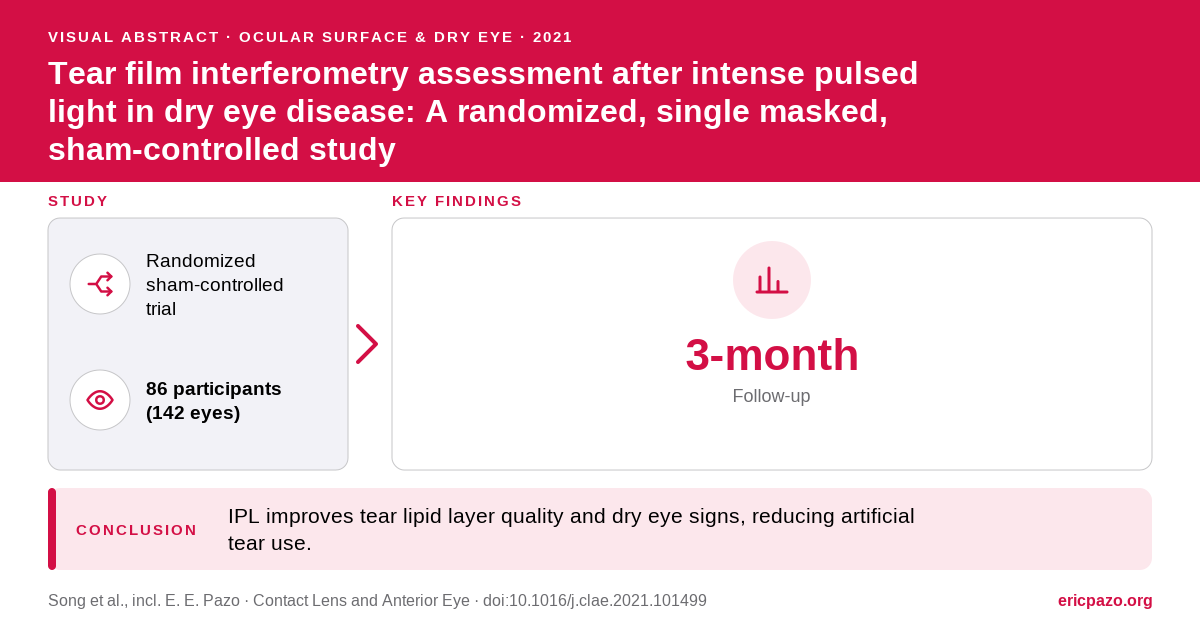
At a glance
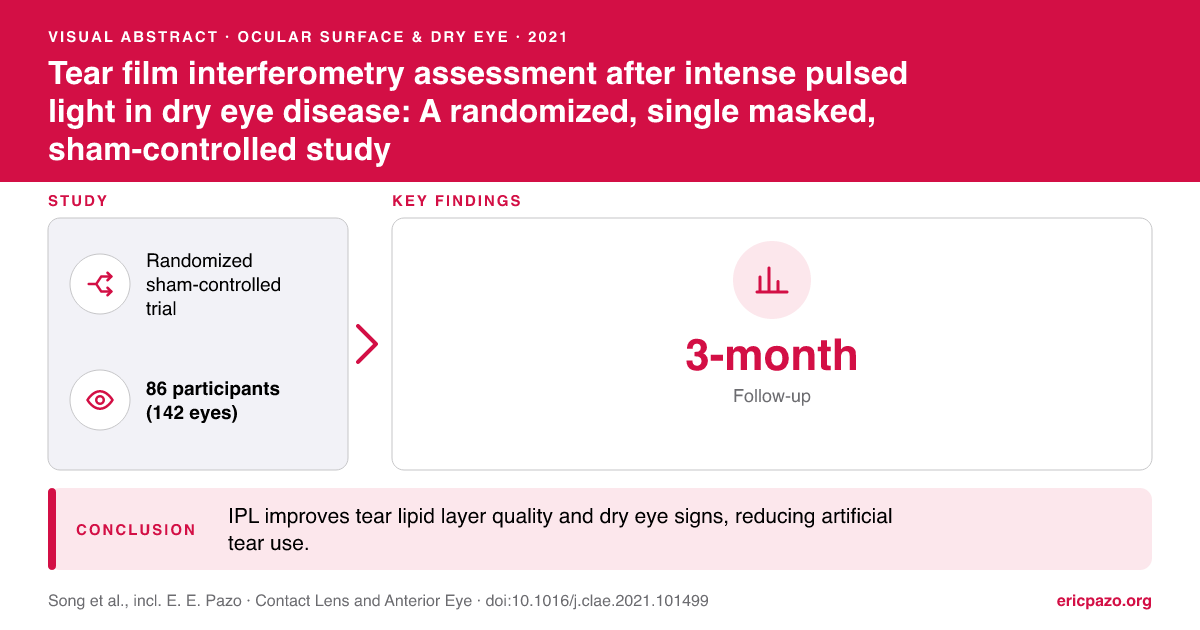
IPL improves tear lipid layer quality and dry eye signs, reducing artificial tear use.
- Design
- Randomized sham-controlled trial
- Sample
- 86 participants (142 eyes)
- Follow-up
- 3-month
Abstract
BACKGROUND: Inadequate meibomian glands (MGs) secretion can lead to dry eye signs and symptoms. Tear film lipid layer (TFLL) secreted by MGs protects and prevents rapid evaporation of tear film. The purpose was to assess TFLL alteration and function in patients with evaporative dry eye (EDE) using tear interferometry after optimal pulse light technology (OPT) intense pulsed light (IPL). METHODS: This prospective randomized examiner-masked sham- controlled study included 86 participants (142 eyes) with DED. IPL or sham procedure was performed on day 0, 21, and 42. Ocular Surface Disease Index (OSDI), non-invasive breakup time (NITBUT), interferometric fringe pattern determined TFLL quality, fluorescein staining (FS), and meibum gland (MG) were assessed at day 0, 21, 42 and 3-month. RESULTS: At 3-month, TFLL, NITBUT, MG drop-out, MG quality, MG expressibility, FS and OSDI improved significantly (P < 0.05) in the IPL group, while the sham group had no significant improvements. Except for Meibo-score and FS, all parameters significantly correlated with the improvement in TFLL following IPL treatment. Additionally, artificial tears usage was significantly less in the IPL group from D-42 onwards. CONCLUSION: IPL treatment demonstrated the ability to improve TFLL quality and clinically reduced sign and symptoms of DED thereby reducing the frequency of artificial tears use.
Keywords: intense pulsed light; dry eye; evaporative dry eye; tear film lipid layer; meibomian glands; non-invasive tear break-up time; fluorescein staining; meibography
Access
How to cite
Show BibTeX
@article{song2021tear,
  title = {{Tear film interferometry assessment after intense pulsed light in dry eye disease: A randomized, single masked, sham-controlled study}},
  author = {Song, Yilin and Yu, Sile and He, Xingru and Yang, Lanting and Wu, Yi and Qin, Guanghao and Zhang, Qing and Talwar, Gagan Deep Singh and Xu, Ling and Moore, Jonathan Edward and He, Wei and Pazo, Emmanuel Eric},
  journal = {Contact Lens and Anterior Eye},
  year = {2021},
  doi = {10.1016/j.clae.2021.101499},
  url = {https://doi.org/10.1016/j.clae.2021.101499},
}
Related work
- An Analysis of the Influence of Flap Margin Space on Corneal Nerve Regeneration After Femtosecond Laser–Assisted LASIK (2026)
- Comparison between the Effect of Intense Pulsed Light and Lid Hygiene on the Tear Film and Ocular Surface: A Randomized Controlled Study (2026)
- Effects of 3% diquafosol sodium on tear film stability, corneal aberration parameters, and vision-related quality of life in pediatric orthokeratology-associated dry eye disease (2026)
- Association Between Maternal Pre-Pregnancy Body Mass Index and Astigmatism and Corneal Curvature in Offspring: A Cross-Sectional Study (2025)
- Differential Expression of Tear Lymphotoxin-Α, Immunoglobulin E, and Matrix Metalloproteinase-9 in Allergic Conjunctivitis-Associated Dry Eye (2025)