
ドライアイにおける強パルス光治療後の涙液層干渉計測による評価:ランダム化単盲検シャム対照研究
原題: Tear film interferometry assessment after intense pulsed light in dry eye disease: A randomized, single masked, sham-controlled study
Yilin Song, Sile Yu, Xingru He, Lanting Yang, Yi Wu, Guanghao Qin, Qing Zhang, Gagan Deep Singh Talwar, Ling Xu, Jonathan Edward Moore, Wei He, Emmanuel Eric Pazo
 Contact Lens and Anterior Eye, 2021 · 原著論文 · doi:10.1016/j.clae.2021.101499 · 被引用 42 回 · オープンアクセス(CC BY-NC-ND)
要点
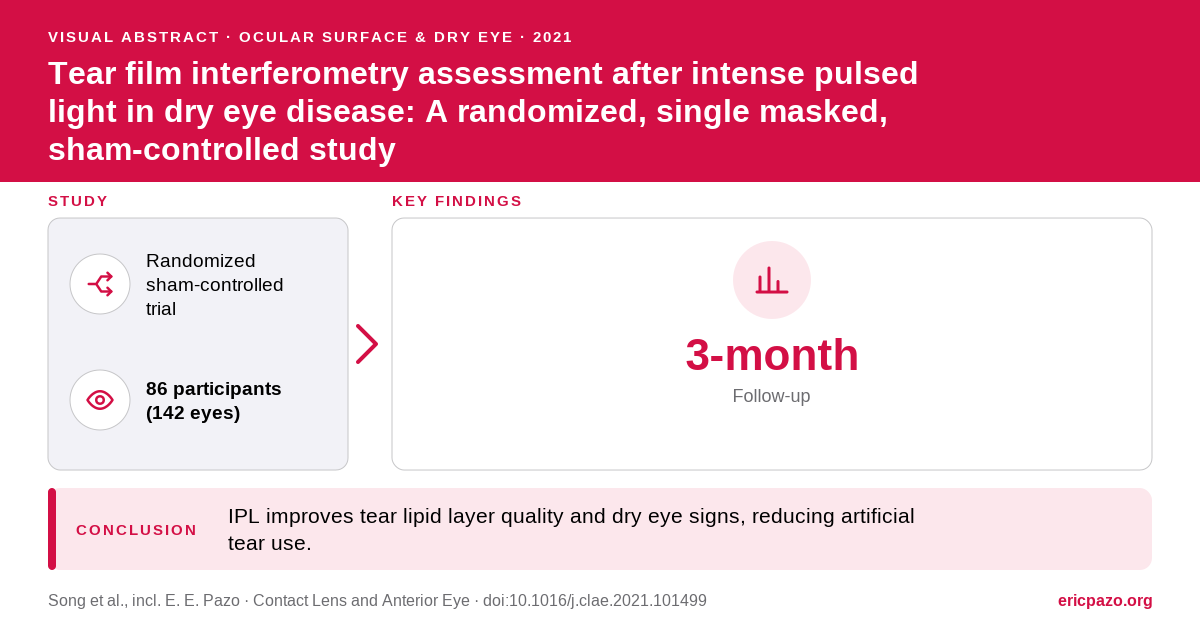
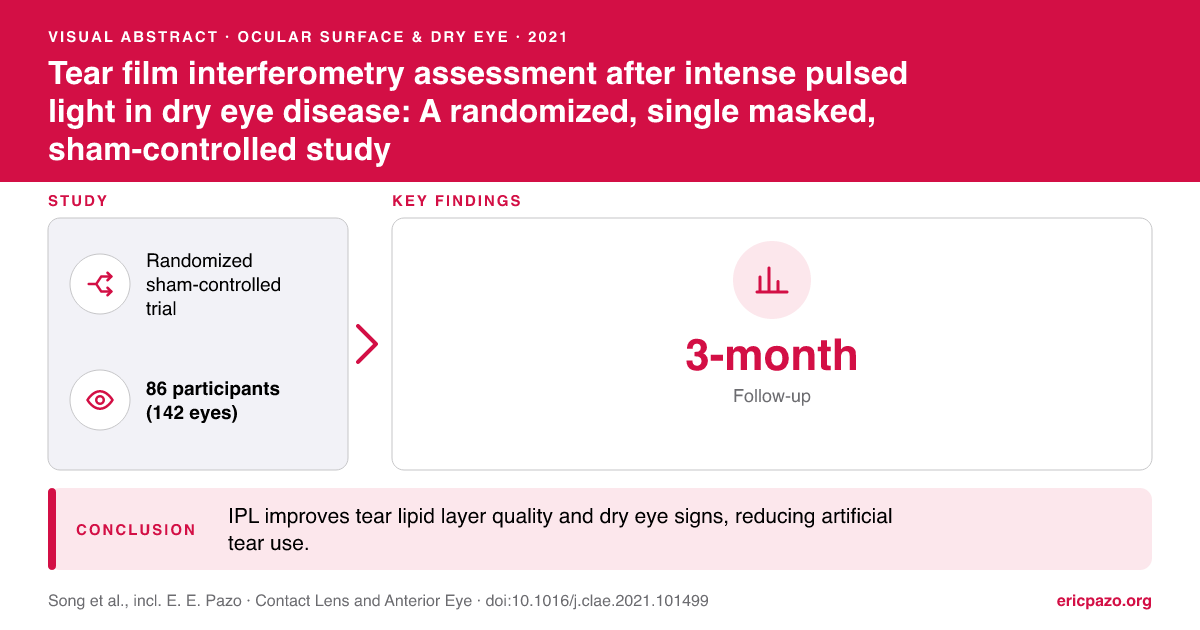
IPL は涙液脂質層の質とドライアイの徴候を改善し、人工涙液の使用を減らす。
- 研究デザイン
- ランダム化シャム対照試験
- 対象
- 参加者 86 人(142 眼)
- 経過観察期間
- 3-month
抄録
この抄録は原語(英語)で表示しています。論文のライセンス(CC BY-NC-ND)では翻訳の公開が認められていないためです。
BACKGROUND: Inadequate meibomian glands (MGs) secretion can lead to dry eye signs and symptoms. Tear film lipid layer (TFLL) secreted by MGs protects and prevents rapid evaporation of tear film. The purpose was to assess TFLL alteration and function in patients with evaporative dry eye (EDE) using tear interferometry after optimal pulse light technology (OPT) intense pulsed light (IPL). METHODS: This prospective randomized examiner-masked sham- controlled study included 86 participants (142 eyes) with DED. IPL or sham procedure was performed on day 0, 21, and 42. Ocular Surface Disease Index (OSDI), non-invasive breakup time (NITBUT), interferometric fringe pattern determined TFLL quality, fluorescein staining (FS), and meibum gland (MG) were assessed at day 0, 21, 42 and 3-month. RESULTS: At 3-month, TFLL, NITBUT, MG drop-out, MG quality, MG expressibility, FS and OSDI improved significantly (P < 0.05) in the IPL group, while the sham group had no significant improvements. Except for Meibo-score and FS, all parameters significantly correlated with the improvement in TFLL following IPL treatment. Additionally, artificial tears usage was significantly less in the IPL group from D-42 onwards. CONCLUSION: IPL treatment demonstrated the ability to improve TFLL quality and clinically reduced sign and symptoms of DED thereby reducing the frequency of artificial tears use.
キーワード: intense pulsed light; dry eye; evaporative dry eye; tear film lipid layer; meibomian glands; non-invasive tear break-up time; fluorescein staining; meibography
アクセス
引用方法
BibTeX を表示
@article{song2021tear,
  title = {{Tear film interferometry assessment after intense pulsed light in dry eye disease: A randomized, single masked, sham-controlled study}},
  author = {Song, Yilin and Yu, Sile and He, Xingru and Yang, Lanting and Wu, Yi and Qin, Guanghao and Zhang, Qing and Talwar, Gagan Deep Singh and Xu, Ling and Moore, Jonathan Edward and He, Wei and Pazo, Emmanuel Eric},
  journal = {Contact Lens and Anterior Eye},
  year = {2021},
  doi = {10.1016/j.clae.2021.101499},
  url = {https://doi.org/10.1016/j.clae.2021.101499},
}
関連する論文
- フェムトセカンドレーザー併用 LASIK 後の角膜神経再生に対するフラップ縁間隙の影響の解析 (2026)
- 強パルス光と眼瞼清拭が涙液層と眼表面に及ぼす効果の比較:ランダム化比較試験 (2026)
- Effects of 3% diquafosol sodium on tear film stability, corneal aberration parameters, and vision-related quality of life in pediatric orthokeratology-associated dry eye disease (2026)
- 母親の妊娠前 BMI と子の乱視および角膜曲率との関連:横断研究 (2025)
- アレルギー性結膜炎に伴うドライアイにおける涙液中リンホトキシン α、免疫グロブリン E、マトリックスメタロプロテイナーゼ-9 の発現の違い (2025)