
Dépistage de la sévérité de la sécheresse oculaire évaporative à l'aide d'une image infrarouge
Titre original : Screening Evaporative Dry Eyes Severity Using an Infrared Image
Qing Zhang, Yi Wu, Yilin Song, Guanghao Qin, Lanting Yang, Sumeet Singh Talwar, Tiezhu Lin, Gagan Deep Singh Talwar, Hongda Zhang, Ling Xu, Jonathan Edward Moore, Emmanuel Eric Pazo, Wei He
 Journal of Ophthalmology, 2021 · article · doi:10.1155/2021/8396503 · cité 26 fois · Accès libre (CC BY)
Surface oculaire et sécheresse oculaire
En bref
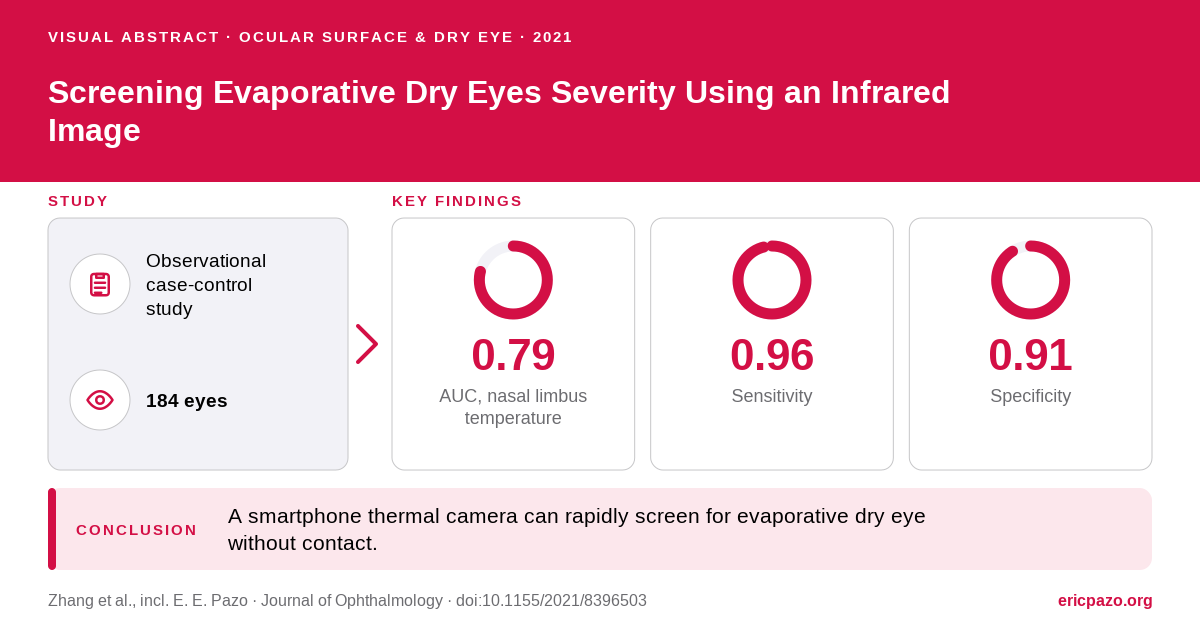
Une caméra thermique pour smartphone peut dépister rapidement et sans contact la sécheresse oculaire évaporative.
- Type d'étude
- Étude observationnelle cas-témoins
- Échantillon
- 184 yeux
- AUC, température du limbe nasal
- 0.79
- Sensibilité
- 0.96
- Spécificité
- 0.91
Résumé
Contexte. La sécheresse oculaire (SO) est multifactorielle et constitue l'un des problèmes les plus fréquemment traités en consultation d'ophtalmologie. En raison de la variabilité de sa présentation, son diagnostic associe des examens cliniques subjectifs et objectifs. Cette étude avait pour objectif d'évaluer l'efficacité d'une caméra thermique infrarouge (IRT) portable sur smartphone pour le dépistage de la SO évaporative symptomatique. Méthodes. Cette étude observationnelle avec témoins appariés sur le sexe a évalué les images IRT de 184 yeux droits (46 normaux et 138 avec SO) de 184 participants. La SO évaporative a été évaluée par le temps de rupture lacrymale non invasif, la coloration à la fluorescéine et la version chinoise du questionnaire d'indice de la maladie de la surface oculaire (C‐OSDI), et les participants ont été classés dans leur groupe de symptomatologie correspondant (aucune, légère, modérée ou sévère). La température de la surface oculaire (OST) a été mesurée et comparée en 8 régions anatomiques d'intérêt (ROI) (conjonctive nasale, limbe nasal, cornée nasale, cornée centrale, cornée inférieure, limbe temporal, cornée temporale et conjonctive temporale) avec la caméra IRT portable sur smartphone. L'efficacité de l'OST de ces 8 ROI pour détecter les différents degrés de sévérité de la SO a été évaluée par leurs corrélations avec la sévérité de la SO et par leur aire sous la courbe (AUC). Résultats. L'OST des 8 ROI anatomiques était significativement plus élevée chez les participants atteints de SO que dans le groupe sans SO ( p < 0.05), sauf pour la cornée inférieure, le limbe temporal et la conjonctive temporale (>0.05). L'analyse des 8 ROI anatomiques a montré que le limbe nasal avait la plus forte corrélation de Pearson avec la sévérité de la SO (0.64, p < 0.001). En outre, la ROI du limbe nasal a obtenu l'AUC la plus élevée, 0.79 (IC : 0.73–0.85 ; p < 0.05), ainsi que la meilleure sensibilité et spécificité (0.96 et 0.91) pour distinguer les yeux avec SO des yeux sans SO. Conclusions. Plutôt qu'un outil diagnostique, l'imagerie IRT portable sur smartphone peut être considérée comme un outil de dépistage rapide, non invasif et hygiénique pour distinguer SO et absence de SO, susceptible de limiter l'inconfort ressenti lors des examens conventionnels.
Traduit du résumé original en anglais (licence : CC BY).
Afficher le résumé original
Background . Dry eye disease (DED) is a multifactorial and one of the most common problems treated in an ophthalmic outpatient clinic. Due to the variability in presentation, diagnosis of DED consists of a combination of subjective and objective clinical tests. The purpose of this study was to assess the effectiveness of a handheld smartphone‐based infrared thermal (IRT) camera for screening symptomatic evaporative DED. Methods . This observational sex‐matched control study assessed IRT images of 184 right eyes (46 normal and 138 DED) of 184 participants. Evaporative DED was assessed using noninvasive tear breakup time, fluorescein staining, and the Chinese version of the ocular surface disease index (C‐OSDI) questionnaire and categorized into their respective dry eye symptomology group (none, mild, moderate, or severe). The ocular surface temperature (OST) at 8 anatomical regions of interest (ROI) (nasal conjunctiva, nasal limbus, nasal cornea, central cornea, inferior cornea, temporal limbus, temporal cornea, and temporal conjunctiva) were measured and compared using a handheld smartphone‐based IRT camera. The effectiveness of these 8 ROIs OST in detecting varying severity of DED was evaluated in terms of correlations with severity of DED and their area under the curve (AUC). Results . OST at the 8 anatomical ROI was significantly higher in DED participants than in the non‐DED group ( p < 0.05) except for inferior cornea, temporal limbus, and temporal conjunctival regions (>0.05). Analyzing 8 anatomical ROIs revealed that the nasal limbus had the highest Pearson correlation with the severity of DED (0.64, p < 0.001). Additionally, the nasal limbus ROI achieved the highest AUC of 0.79 (CI: 0.73–0.85; p < 0.05), sensitivity, and specificity (0.96 and 0.91) when comparing its ability to discriminated DED vs. non‐DED eyes. Conclusions . Rather than a diagnostic tool, handheld smartphone‐based IRT images can be considered as a rapid, noninvasive, and hygienic screening tool in discriminating DED and non‐DED and potentially alleviating inconvenience experienced during conventional tests.
Mots-clés : evaporative dry eye disease; infrared thermography; ocular surface temperature; tear film break-up time; fluorescein staining; Ocular Surface Disease Index; non-invasive diagnosis
Accès
Comment citer
Afficher le BibTeX
@article{zhang2021screening,
  title = {{Screening Evaporative Dry Eyes Severity Using an Infrared Image}},
  author = {Zhang, Qing and Wu, Yi and Song, Yilin and Qin, Guanghao and Yang, Lanting and Talwar, Sumeet Singh and Lin, Tiezhu and Talwar, Gagan Deep Singh and Zhang, Hongda and Xu, Ling and Moore, Jonathan Edward and Pazo, Emmanuel Eric and He, Wei},
  journal = {Journal of Ophthalmology},
  year = {2021},
  doi = {10.1155/2021/8396503},
  url = {https://doi.org/10.1155/2021/8396503},
}
Travaux liés
- Analyse de l'influence de l'espace au bord du volet sur la régénération des nerfs cornéens après LASIK assisté par laser femtoseconde (2026)
- Comparaison des effets de la lumière pulsée intense et de l'hygiène palpébrale sur le film lacrymal et la surface oculaire : une étude contrôlée randomisée (2026)
- Effects of 3% diquafosol sodium on tear film stability, corneal aberration parameters, and vision-related quality of life in pediatric orthokeratology-associated dry eye disease (2026)
- Association entre l'indice de masse corporelle maternel avant la grossesse et l'astigmatisme et la courbure cornéenne de l'enfant : une étude transversale (2025)
- Expression différentielle de la lymphotoxine α, de l'immunoglobuline E et de la métalloprotéinase matricielle 9 lacrymales dans la sécheresse oculaire associée à la conjonctivite allergique (2025)