
赤外線画像を用いた蒸発亢進型ドライアイの重症度スクリーニング
原題: Screening Evaporative Dry Eyes Severity Using an Infrared Image
Qing Zhang, Yi Wu, Yilin Song, Guanghao Qin, Lanting Yang, Sumeet Singh Talwar, Tiezhu Lin, Gagan Deep Singh Talwar, Hongda Zhang, Ling Xu, Jonathan Edward Moore, Emmanuel Eric Pazo, Wei He
 Journal of Ophthalmology, 2021 · 原著論文 · doi:10.1155/2021/8396503 · 被引用 26 回 · オープンアクセス(CC BY)
要点
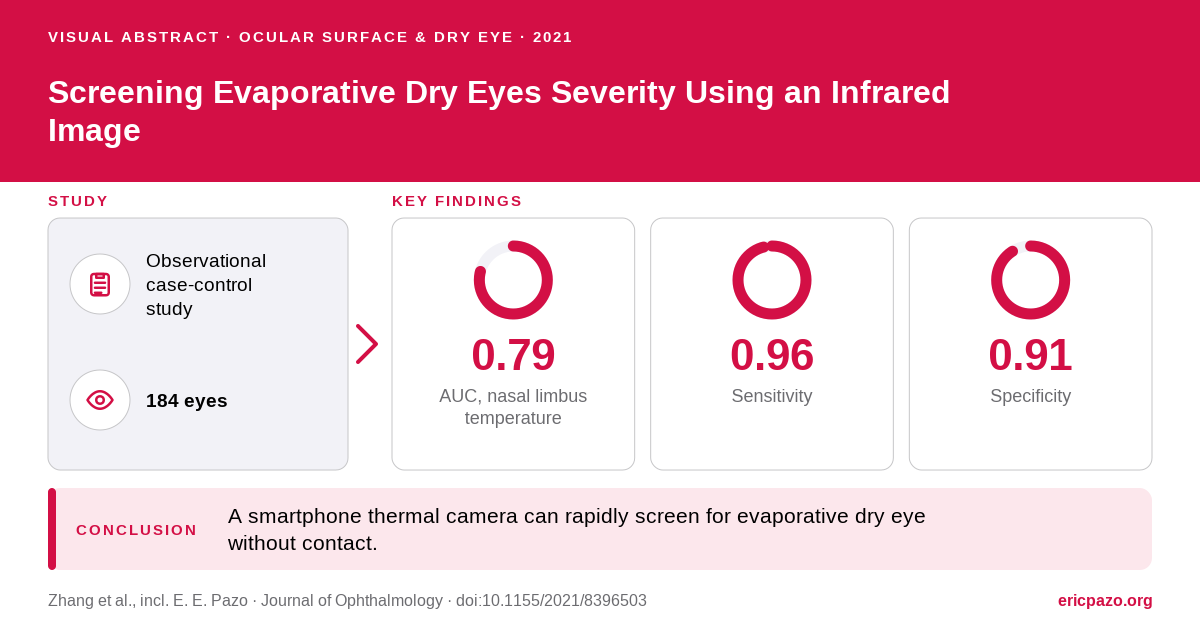
スマートフォン用サーモグラフィカメラにより、非接触で迅速に蒸発亢進型ドライアイをスクリーニングできる。
- 研究デザイン
- 観察的症例対照研究
- 対象
- 184 眼
- AUC(鼻側輪部温度)
- 0.79
- 感度
- 0.96
- 特異度
- 0.91
抄録
背景。ドライアイ(DED)は多因子性の疾患であり、眼科外来で治療される最も一般的な問題の一つである。症状の現れ方が多様であるため、DED の診断は主観的・客観的な臨床検査の組み合わせによって行われる。本研究の目的は、症候性の蒸発亢進型 DED のスクリーニングにおける携帯型スマートフォン赤外線サーモグラフィ(IRT)カメラの有効性を評価することであった。方法。本性別一致観察的対照研究では、参加者 184 人の右眼 184 眼(正常 46 眼、DED 138 眼)の IRT 画像を評価した。蒸発亢進型 DED は、非侵襲的涙液層破壊時間、フルオレセイン染色、中国語版 Ocular Surface Disease Index(C‐OSDI)質問票で評価し、該当するドライアイ症状群(なし、軽度、中等度、重度)に分類した。携帯型スマートフォン IRT カメラを用いて、8 つの解剖学的関心領域(ROI)(鼻側結膜、鼻側輪部、鼻側角膜、中央角膜、下方角膜、耳側輪部、耳側角膜、耳側結膜)の眼表面温度(OST)を測定・比較した。さまざまな重症度の DED を検出する 8 つの ROI の OST の有効性を、DED 重症度との相関と曲線下面積(AUC)で評価した。結果。8 つの解剖学的 ROI の OST は、下方角膜、耳側輪部、耳側結膜領域(>0.05)を除き、DED の参加者で非 DED 群より有意に高かった( p < 0.05)。8 つの解剖学的 ROI の解析により、鼻側輪部が DED の重症度と最も高い Pearson 相関を示した(0.64、p < 0.001)。さらに、DED 眼と非 DED 眼の識別能を比較すると、鼻側輪部 ROI が最も高い AUC 0.79(CI:0.73–0.85;p < 0.05)と、最も高い感度・特異度(0.96 と 0.91)を示した。結論。携帯型スマートフォン IRT 画像は、診断ツールというよりも、DED と非 DED を識別する迅速・非侵襲的・衛生的なスクリーニングツールとみなすことができ、従来の検査に伴う不快感を軽減できる可能性がある。
英語の原文抄録からの翻訳です(ライセンス:CC BY)。
原文の抄録を表示
Background . Dry eye disease (DED) is a multifactorial and one of the most common problems treated in an ophthalmic outpatient clinic. Due to the variability in presentation, diagnosis of DED consists of a combination of subjective and objective clinical tests. The purpose of this study was to assess the effectiveness of a handheld smartphone‐based infrared thermal (IRT) camera for screening symptomatic evaporative DED. Methods . This observational sex‐matched control study assessed IRT images of 184 right eyes (46 normal and 138 DED) of 184 participants. Evaporative DED was assessed using noninvasive tear breakup time, fluorescein staining, and the Chinese version of the ocular surface disease index (C‐OSDI) questionnaire and categorized into their respective dry eye symptomology group (none, mild, moderate, or severe). The ocular surface temperature (OST) at 8 anatomical regions of interest (ROI) (nasal conjunctiva, nasal limbus, nasal cornea, central cornea, inferior cornea, temporal limbus, temporal cornea, and temporal conjunctiva) were measured and compared using a handheld smartphone‐based IRT camera. The effectiveness of these 8 ROIs OST in detecting varying severity of DED was evaluated in terms of correlations with severity of DED and their area under the curve (AUC). Results . OST at the 8 anatomical ROI was significantly higher in DED participants than in the non‐DED group ( p < 0.05) except for inferior cornea, temporal limbus, and temporal conjunctival regions (>0.05). Analyzing 8 anatomical ROIs revealed that the nasal limbus had the highest Pearson correlation with the severity of DED (0.64, p < 0.001). Additionally, the nasal limbus ROI achieved the highest AUC of 0.79 (CI: 0.73–0.85; p < 0.05), sensitivity, and specificity (0.96 and 0.91) when comparing its ability to discriminated DED vs. non‐DED eyes. Conclusions . Rather than a diagnostic tool, handheld smartphone‐based IRT images can be considered as a rapid, noninvasive, and hygienic screening tool in discriminating DED and non‐DED and potentially alleviating inconvenience experienced during conventional tests.
キーワード: evaporative dry eye disease; infrared thermography; ocular surface temperature; tear film break-up time; fluorescein staining; Ocular Surface Disease Index; non-invasive diagnosis
アクセス
引用方法
BibTeX を表示
@article{zhang2021screening,
  title = {{Screening Evaporative Dry Eyes Severity Using an Infrared Image}},
  author = {Zhang, Qing and Wu, Yi and Song, Yilin and Qin, Guanghao and Yang, Lanting and Talwar, Sumeet Singh and Lin, Tiezhu and Talwar, Gagan Deep Singh and Zhang, Hongda and Xu, Ling and Moore, Jonathan Edward and Pazo, Emmanuel Eric and He, Wei},
  journal = {Journal of Ophthalmology},
  year = {2021},
  doi = {10.1155/2021/8396503},
  url = {https://doi.org/10.1155/2021/8396503},
}
関連する論文
- フェムトセカンドレーザー併用 LASIK 後の角膜神経再生に対するフラップ縁間隙の影響の解析 (2026)
- 強パルス光と眼瞼清拭が涙液層と眼表面に及ぼす効果の比較:ランダム化比較試験 (2026)
- Effects of 3% diquafosol sodium on tear film stability, corneal aberration parameters, and vision-related quality of life in pediatric orthokeratology-associated dry eye disease (2026)
- 母親の妊娠前 BMI と子の乱視および角膜曲率との関連:横断研究 (2025)
- アレルギー性結膜炎に伴うドライアイにおける涙液中リンホトキシン α、免疫グロブリン E、マトリックスメタロプロテイナーゼ-9 の発現の違い (2025)