
Luz pulsada intensa para el tratamiento de la enfermedad de ojo seco: un análisis bibliométrico y visualizado
Título original: Intense Pulsed Light for the Treatment of Dry Eye Disease: A Bibliometric and Visualized Analysis
Junran Li, Bo Yu, Muyao Xin, Yu Sun, Emmanuel Eric Pazo, Xiaoli Xing
 Photobiomodulation Photomedicine and Laser Surgery, 2025 · revisión · doi:10.1089/photob.2024.0144 · citado 5 veces
De un vistazo
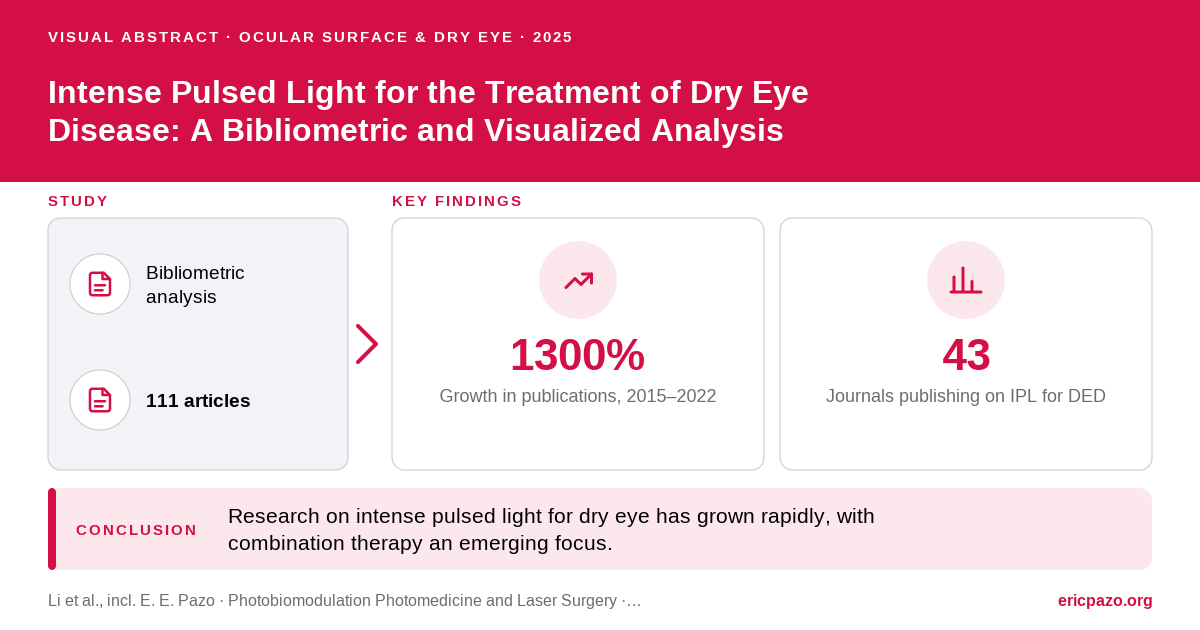
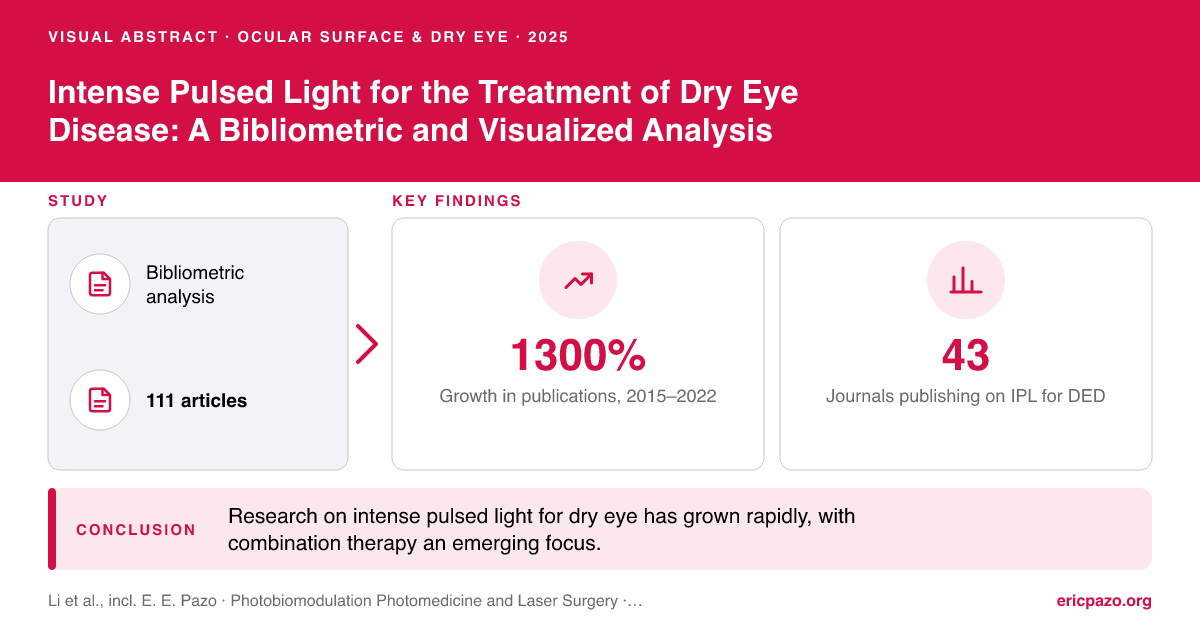
La investigación sobre la luz pulsada intensa para el ojo seco ha crecido rápidamente, y la terapia combinada es un foco emergente.
- Diseño
- Análisis bibliométrico
- Muestra
- 111 artículos
- Crecimiento de las publicaciones, 2015–2022
- 1300%
- Revistas que publican sobre IPL para EOS
- 43
Resumen
Este resumen se muestra en su idioma original, el inglés, porque el artículo no tiene una licencia abierta que permita traducciones.
Objective:Bibliometric study of intense pulsed light (IPL) for dry eye disease (DED) and meibomian gland dysfunction (MGD) to characterize current worldwide patterns and offer visual representations of previous and emerging trends. Background:DED is a prevalent eye condition and IPL has been reported to be an effective therapy for dry eyes. Method:This cross-sectional study examined IPL for DED research evolution and theme trends from 2015 to 2024, using bibliometric analysis of WoSCC data. We examined 4334 IPL articles for publication year, journals, authors, institutions, countries/regions, references, and keywords. Results:We found 111 articles from 2015 to 2024 articles and the annual publication rate was less than 10 from 2015 to 2017, but has steadily increased after 2018. Global publication volumes have increased by 1300% in the past decade, from 2 in 2015 to 28 in 2022. Currently, the number of articles stands at 10 in 2024. IPL for DED was published in 43 journals. Currently, the top journals publishing on this topic according to volume include Photobiomodulation, Photomedicine, and Laser Surgery, Journal of Clinical Medicine, and Cornea. Conclusions:The number of publications and citations on research related to IPL for DED treatment has steadily increased across numerous countries, institutions, and authors over the past decade. The current study illuminates the current trends, global collaboration patterns, fundamental knowledge, research hotspots, and emerging frontiers of IPL treatment. The primary focus now has been the development of innovative solutions for the treatment of DED and MGD by combining IPL with presenting DED treatment regime.
Palabras clave: intense pulsed light; dry eye; meibomian gland dysfunction; low-level laser therapy; research trends; publication growth; research collaboration patterns
Acceso
Cómo citar
Mostrar BibTeX
@article{li2025intense,
  title = {{Intense Pulsed Light for the Treatment of Dry Eye Disease: A Bibliometric and Visualized Analysis}},
  author = {Li, Junran and Yu, Bo and Xin, Muyao and Sun, Yu and Pazo, Emmanuel Eric and Xing, Xiaoli},
  journal = {Photobiomodulation Photomedicine and Laser Surgery},
  year = {2025},
  doi = {10.1089/photob.2024.0144},
  url = {https://doi.org/10.1089/photob.2024.0144},
}
Trabajos relacionados
- Análisis de la influencia del espacio del margen del colgajo en la regeneración de los nervios corneales tras LASIK asistido por láser de femtosegundo (2026)
- Comparación entre el efecto de la luz pulsada intensa y la higiene palpebral sobre la película lagrimal y la superficie ocular: un estudio controlado aleatorizado (2026)
- Effects of 3% diquafosol sodium on tear film stability, corneal aberration parameters, and vision-related quality of life in pediatric orthokeratology-associated dry eye disease (2026)
- Asociación entre el índice de masa corporal materno previo al embarazo y el astigmatismo y la curvatura corneal de la descendencia: un estudio transversal (2025)
- Expresión diferencial de linfotoxina α, inmunoglobulina E y metaloproteinasa de matriz 9 en lágrimas en el ojo seco asociado a conjuntivitis alérgica (2025)