
La lumière pulsée intense dans le traitement de la sécheresse oculaire : une analyse bibliométrique et visualisée
Titre original : Intense Pulsed Light for the Treatment of Dry Eye Disease: A Bibliometric and Visualized Analysis
Junran Li, Bo Yu, Muyao Xin, Yu Sun, Emmanuel Eric Pazo, Xiaoli Xing
 Photobiomodulation Photomedicine and Laser Surgery, 2025 · revue · doi:10.1089/photob.2024.0144 · cité 5 fois
Surface oculaire et sécheresse oculaire
En bref
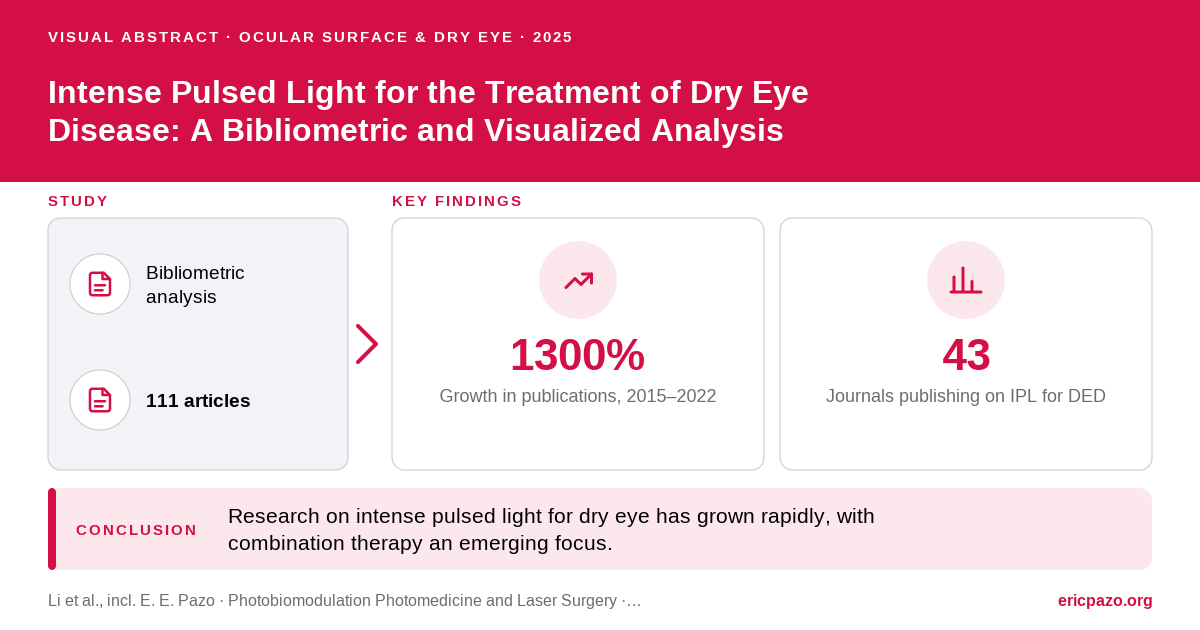
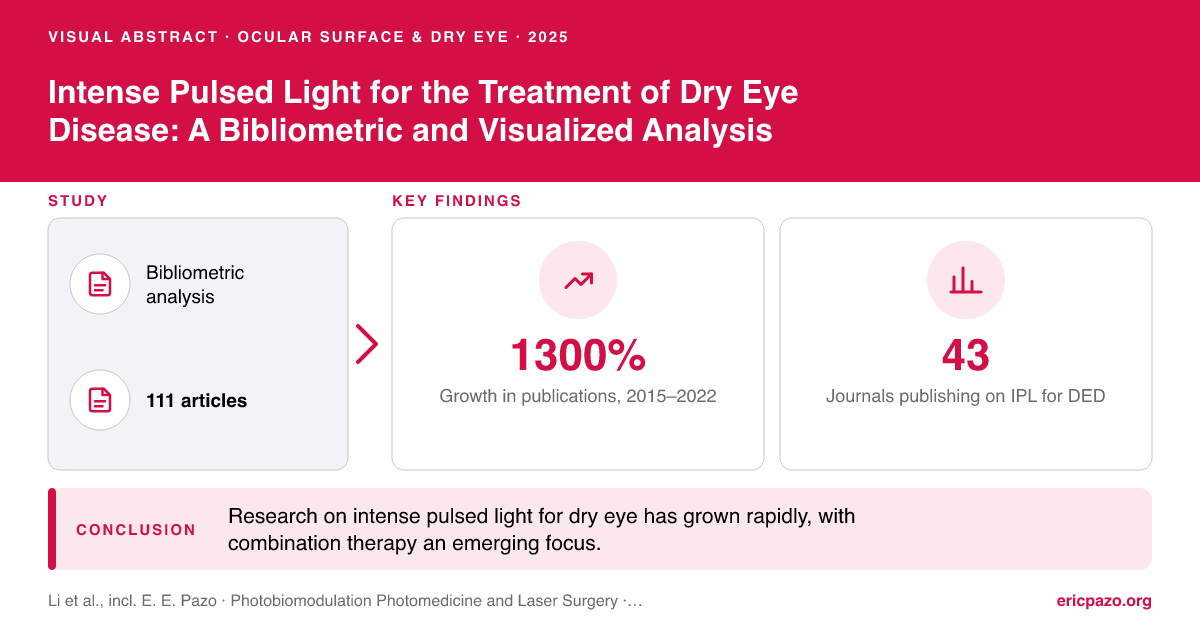
La recherche sur la lumière pulsée intense dans la sécheresse oculaire a crû rapidement, les traitements combinés constituant un axe émergent.
- Type d'étude
- Analyse bibliométrique
- Échantillon
- 111 articles
- Croissance des publications, 2015–2022
- 1300%
- Revues publiant sur la LPI dans la SO
- 43
Résumé
Ce résumé est affiché dans sa langue d'origine, l'anglais, car l'article n'est pas publié sous une licence ouverte autorisant les traductions.
Objective:Bibliometric study of intense pulsed light (IPL) for dry eye disease (DED) and meibomian gland dysfunction (MGD) to characterize current worldwide patterns and offer visual representations of previous and emerging trends. Background:DED is a prevalent eye condition and IPL has been reported to be an effective therapy for dry eyes. Method:This cross-sectional study examined IPL for DED research evolution and theme trends from 2015 to 2024, using bibliometric analysis of WoSCC data. We examined 4334 IPL articles for publication year, journals, authors, institutions, countries/regions, references, and keywords. Results:We found 111 articles from 2015 to 2024 articles and the annual publication rate was less than 10 from 2015 to 2017, but has steadily increased after 2018. Global publication volumes have increased by 1300% in the past decade, from 2 in 2015 to 28 in 2022. Currently, the number of articles stands at 10 in 2024. IPL for DED was published in 43 journals. Currently, the top journals publishing on this topic according to volume include Photobiomodulation, Photomedicine, and Laser Surgery, Journal of Clinical Medicine, and Cornea. Conclusions:The number of publications and citations on research related to IPL for DED treatment has steadily increased across numerous countries, institutions, and authors over the past decade. The current study illuminates the current trends, global collaboration patterns, fundamental knowledge, research hotspots, and emerging frontiers of IPL treatment. The primary focus now has been the development of innovative solutions for the treatment of DED and MGD by combining IPL with presenting DED treatment regime.
Mots-clés : intense pulsed light; dry eye; meibomian gland dysfunction; low-level laser therapy; research trends; publication growth; research collaboration patterns
Accès
Comment citer
Afficher le BibTeX
@article{li2025intense,
  title = {{Intense Pulsed Light for the Treatment of Dry Eye Disease: A Bibliometric and Visualized Analysis}},
  author = {Li, Junran and Yu, Bo and Xin, Muyao and Sun, Yu and Pazo, Emmanuel Eric and Xing, Xiaoli},
  journal = {Photobiomodulation Photomedicine and Laser Surgery},
  year = {2025},
  doi = {10.1089/photob.2024.0144},
  url = {https://doi.org/10.1089/photob.2024.0144},
}
Travaux liés
- Analyse de l'influence de l'espace au bord du volet sur la régénération des nerfs cornéens après LASIK assisté par laser femtoseconde (2026)
- Comparaison des effets de la lumière pulsée intense et de l'hygiène palpébrale sur le film lacrymal et la surface oculaire : une étude contrôlée randomisée (2026)
- Effects of 3% diquafosol sodium on tear film stability, corneal aberration parameters, and vision-related quality of life in pediatric orthokeratology-associated dry eye disease (2026)
- Association entre l'indice de masse corporelle maternel avant la grossesse et l'astigmatisme et la courbure cornéenne de l'enfant : une étude transversale (2025)
- Expression différentielle de la lymphotoxine α, de l'immunoglobuline E et de la métalloprotéinase matricielle 9 lacrymales dans la sécheresse oculaire associée à la conjonctivite allergique (2025)