
Análisis comparativo de las versiones en papel y web del cuestionario National Comprehensive Cancer Network-Functional Assessment of Cancer Therapy-Breast Cancer Symptom Index (NFBSI-16) en pacientes con cáncer de mama: estudio aleatorizado cruzado
Título original: Comparative Analysis of Paper-Based and Web-Based Versions of the National Comprehensive Cancer Network-Functional Assessment of Cancer Therapy-Breast Cancer Symptom Index (NFBSI-16) Questionnaire in Breast Cancer Patients: Randomized Crossover Study
Jinfei Ma, Zihao Zou, Emmanuel Eric Pazo, Salissou Moutari, Ye Liu, Feng Jin
 JMIR Medical Informatics, 2021 · artículo · doi:10.2196/18269 · citado 4 veces · Acceso abierto (CC BY)
De un vistazo
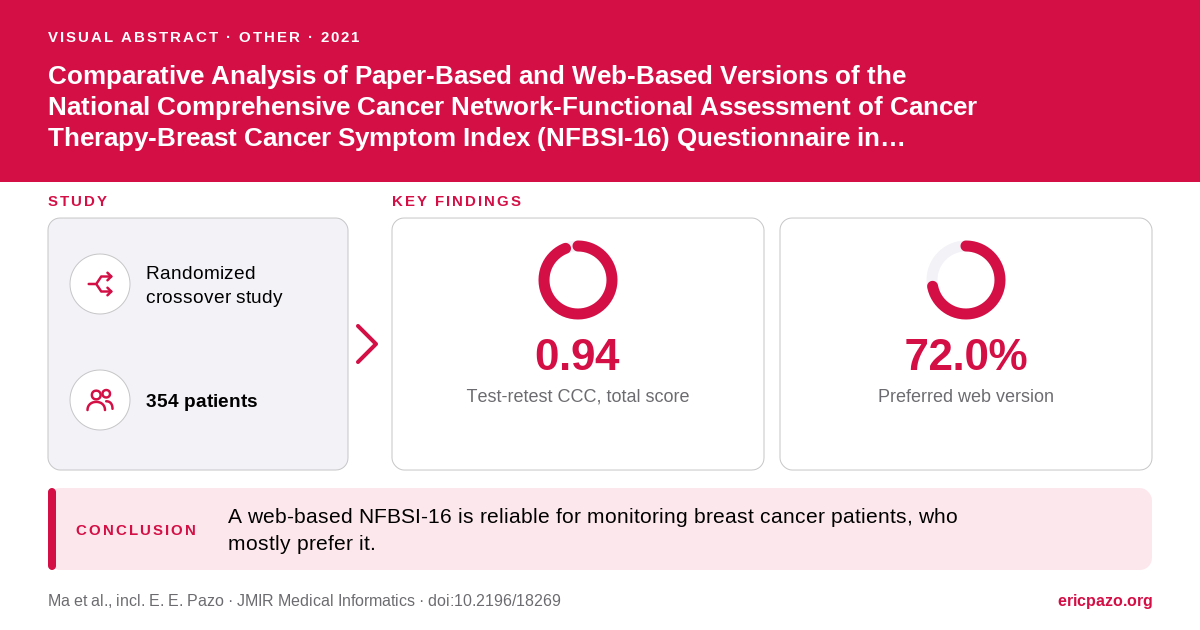
Un NFBSI-16 en versión web es fiable para el seguimiento de las pacientes con cáncer de mama, que en su mayoría lo prefieren.
- Diseño
- Estudio aleatorizado cruzado
- Muestra
- 354 pacientes
- CCC test-retest, puntuación total
- 0.94
- Prefirieron la versión web
- 72.0%
Resumen
ANTECEDENTES: El cáncer de mama sigue siendo la neoplasia más diagnosticada en las mujeres en China y en el mundo. Las evaluaciones mediante cuestionarios de salud han ganado importancia en la investigación y en la oncología clínica. El National Comprehensive Cancer Network-Functional Assessment of Cancer Therapy-Breast Cancer Symptom Index (NFBSI-16) es una herramienta rápida y potente que ayuda a evaluar, con fines clínicos y de investigación, los síntomas físicos y emocionales relacionados con la enfermedad o el tratamiento en pacientes con cáncer de mama. La extensión de los teléfonos inteligentes personales ofrece una posible vía web para administrar el cuestionario; sin embargo, no se ha evaluado la fiabilidad del NFBSI-16 en formato electrónico. OBJETIVO: Este estudio tuvo como objetivo evaluar la fiabilidad de un cuestionario NFBSI-16 en versión web en pacientes con cáncer de mama en tratamiento sistémico, mediante un diseño prospectivo, abierto, aleatorizado y cruzado. MÉTODOS: Se reclutaron al azar, a partir del registro central del hospital, pacientes con cáncer de mama en tratamiento sistémico para completar las versiones en papel y web de los cuestionarios. Ambas versiones fueron autoadministradas. Las pacientes se asignaron aleatoriamente al grupo A (primero en papel y después en web) o al grupo B (primero en web y después en papel). Se incluyeron en el análisis 354 pacientes (grupo A: n=177, grupo B: n=177). Las características sociodemográficas descriptivas, la fiabilidad y las tasas de concordancia de los ítems individuales, las subescalas y la puntuación total se analizaron con la prueba de Wilcoxon. Para evaluar la fiabilidad test-retest se utilizaron el coeficiente de correlación de concordancia (CCC) de Lin y las correlaciones de rangos de Spearman y τ de Kendall. RESULTADOS: La fiabilidad test-retest medida con el CCC fue de 0.94 para la puntuación total del NFBSI-16. Se documentaron correlaciones significativas (ρ de Spearman) en las 4 subescalas —síntomas relacionados con la enfermedad, físicos (ρ=0.93); síntomas relacionados con la enfermedad, emocionales (ρ=0.85); efectos secundarios del tratamiento (ρ=0.95), y función y bienestar (ρ=0.91)— y en la puntuación total del NFBSI-16 (ρ=0.94). Las diferencias medias entre test y retest fueron todas cercanas a cero (≤0.06). En la fiabilidad test-retest en paralelo de las subescalas, la prueba de Wilcoxon que comparaba los ítems individuales mostró una diferencia significativa en el GP3 (ítem 5) (P=.02). La mayoría de las participantes en este estudio (255/354, 72.0%) prefirieron la versión web a la de papel. CONCLUSIONES: La versión web del cuestionario NFBSI-16 es una herramienta excelente para el seguimiento individual de las pacientes con cáncer de mama en tratamiento, y la mayoría de las participantes la prefieren a la versión en papel.
Traducido del resumen original en inglés (licencia: CC BY).
Mostrar el resumen original
BACKGROUND: Breast cancer remains the most common neoplasm diagnosed among women in China and globally. Health-related questionnaire assessments in research and clinical oncology settings have gained prominence. The National Comprehensive Cancer Network-Functional Assessment of Cancer Therapy-Breast Cancer Symptom Index (NFBSI-16) is a rapid and powerful tool to help evaluate disease- or treatment-related symptoms, both physical and emotional, in patients with breast cancer for clinical and research purposes. Prevalence of individual smartphones provides a potential web-based approach to administrating the questionnaire; however, the reliability of the NFBSI-16 in electronic format has not been assessed. OBJECTIVE: This study aimed to assess the reliability of a web-based NFBSI-16 questionnaire in breast cancer patients undergoing systematic treatment with a prospective open-label randomized crossover study design. METHODS: We recruited random patients with breast cancer under systematic treatment from the central hospital registry to complete both paper- and web-based versions of the questionnaires. Both versions of the questionnaires were self-assessed. Patients were randomly assigned to group A (paper-based first and web-based second) or group B (web-based first and paper-based second). A total of 354 patients were included in the analysis (group A: n=177, group B: n=177). Descriptive sociodemographic characteristics, reliability and agreement rates for single items, subscales, and total score were analyzed using the Wilcoxon test. The Lin concordance correlation coefficient (CCC) and Spearman and Kendall τ rank correlations were used to assess test-retest reliability. RESULTS: Test-retest reliability measured with CCCs was 0.94 for the total NFBSI-16 score. Significant correlations (Spearman ρ) were documented for all 4 subscales-Disease-Related Symptoms Subscale-Physical (ρ=0.93), Disease-Related Symptoms Subscale-Emotional (ρ=0.85), Treatment Side Effects Subscale (ρ=0.95), and Function and Well-Being Subscale (ρ=0.91)-and total NFBSI-16 score (ρ=0.94). Mean differences of the test and retest were all close to zero (≤0.06). The parallel test-retest reliability of subscales with the Wilcoxon test comparing individual items found GP3 (item 5) to be significantly different (P=.02). A majority of the participants in this study (255/354, 72.0%) preferred the web-based over the paper-based version. CONCLUSIONS: The web-based version of the NFBSI-16 questionnaire is an excellent tool for monitoring individual breast cancer patients under treatment, with the majority of participants preferring it over the paper-based version.
Palabras clave: breast cancer; web-based questionnaire; paper-based questionnaires; test-retest reliability; questionnaire agreement; treatment-related symptoms; disease-related symptoms; emotional symptoms
Acceso
Cómo citar
Mostrar BibTeX
@article{ma2021comparative,
  title = {{Comparative Analysis of Paper-Based and Web-Based Versions of the National Comprehensive Cancer Network-Functional Assessment of Cancer Therapy-Breast Cancer Symptom Index (NFBSI-16) Questionnaire in Breast Cancer Patients: Randomized Crossover Study}},
  author = {Ma, Jinfei and Zou, Zihao and Pazo, Emmanuel Eric and Moutari, Salissou and Liu, Ye and Jin, Feng},
  journal = {JMIR Medical Informatics},
  year = {2021},
  doi = {10.2196/18269},
  url = {https://doi.org/10.2196/18269},
}
Trabajos relacionados
- Ocular Function Measures and Neurological Severity in Neurodegenerative Disease: A Systematic Review (2026)
- Análisis clinicopatológico y genético de los tumores fibrosos solitarios orbitarios (2025)
- Impacto del hidroxibutil quitosano y del 5-fluorouracilo en la dacriocistorrinostomía endoscópica endonasal (2024)