
Prevalencia del ojo seco en personas mayores de 50 años en el distrito de Beichen, ciudad de Tianjin: una encuesta transversal poblacional
Título original: Prevalence of dry eye in people over 50 years old in Beichen district, Tianjin city: a cross-sectional population-based survey
Lianqing Chang, Qian Guo, Emmanuel Eric Pazo, Fei Ran Li, Zhongfang Zhang, Zijie Fang, Yue Huang, Ruibo Yang, Hui Liu, Xiaorong Li, Chen Zhang, Shaozhen Zhao
 BMC Public Health, 2024 · artículo · doi:10.1186/s12889-024-19616-1 · citado 10 veces · Acceso abierto (CC BY-NC-ND)
De un vistazo
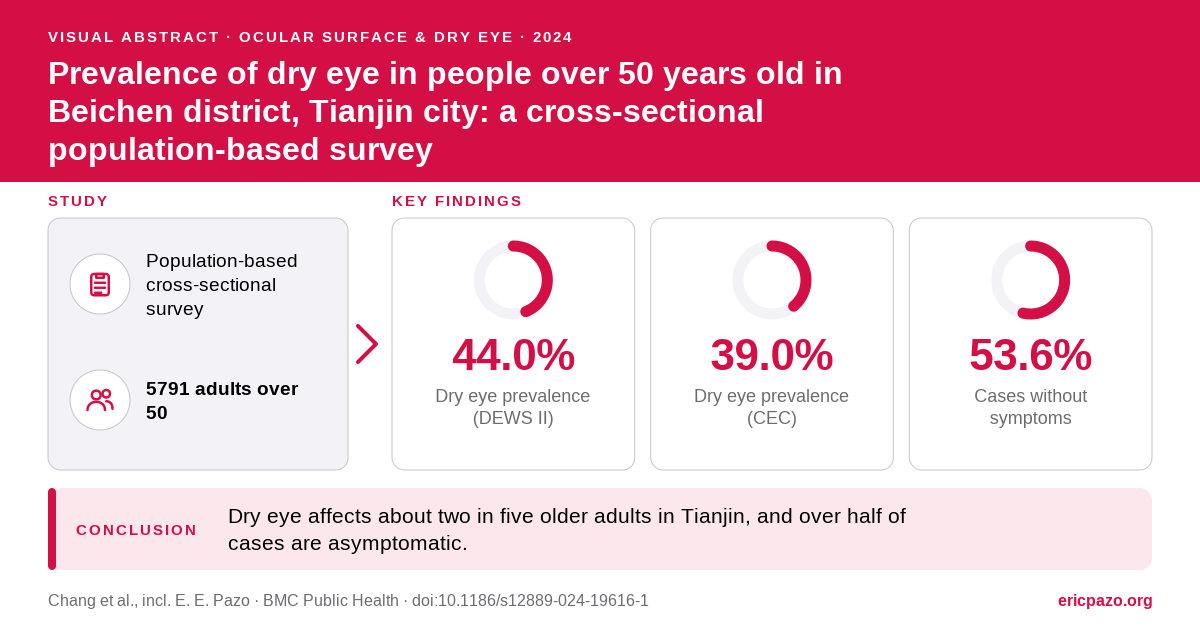
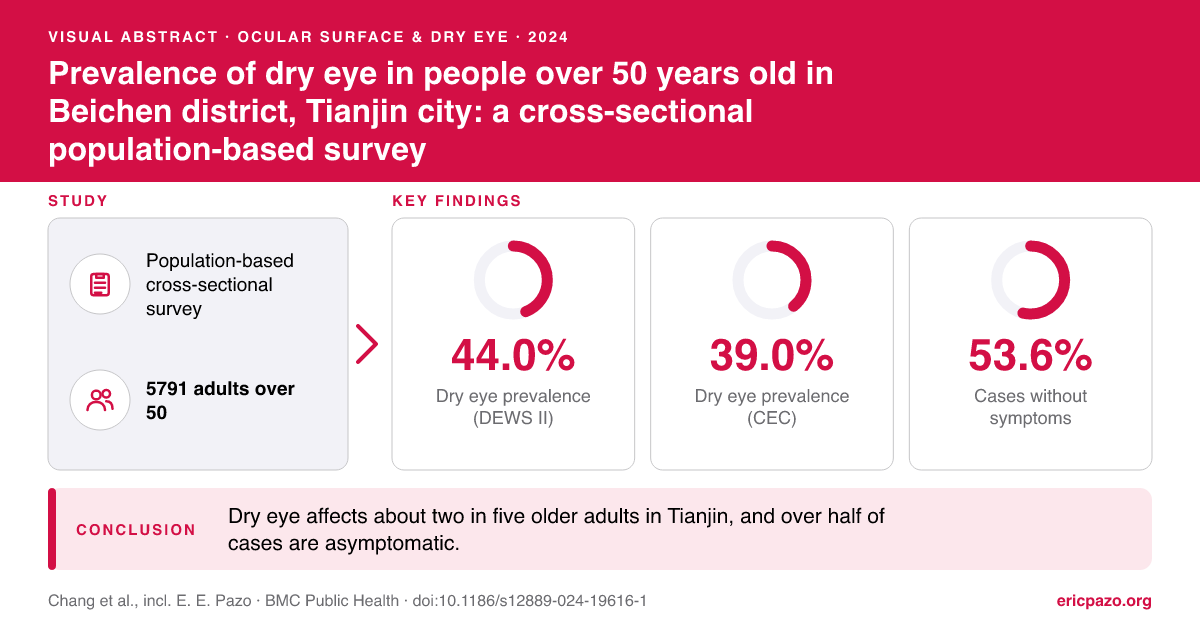
El ojo seco afecta a cerca de dos de cada cinco adultos mayores en Tianjin, y más de la mitad de los casos son asintomáticos.
- Diseño
- Encuesta transversal poblacional
- Muestra
- 5791 adultos mayores de 50 años
- Prevalencia de ojo seco (DEWS II)
- 44.0%
- Prevalencia de ojo seco (CEC)
- 39.0%
- Casos sin síntomas
- 53.6%
Resumen
Este resumen se muestra en su idioma original, el inglés, porque la licencia del artículo (CC BY-NC-ND) no permite publicar traducciones.
BACKGROUND: A cross-sectional population-based survey in the Beichen district of Tianjin was conducted to estimate the prevalence of dry eye disease (DED) among the population over 50 years old with Dry Eye Workshop (DEWS) II and Chinese expert consensus (CEC) criteria. METHODS: A total of 5791 subjects over 50 years old were enrolled. Ocular surface disease index (OSDI) questionnaire, lipid layer thickness (LLT), partial blink ratio (PBR), fluorescein tear film breakup time (FBUT), Schirmer I test (SIT), fluorescein staining, meibomian gland dropout, meibomian gland expression scores (MES) and quantity scores (MQS) was assessed. Additionally, basic information, weight, disease history, living habits, anxiety, and depression condition were collected. RESULTS: According to the CEC, the prevalence of DED was 39.0%, whereas 44.0% based on DEWS II. The prevalence of DED increased with age and was substantially greater among women (41.1%, 95% CI, 39.5-42.6%) than males (35.1%, 95% CI, 33.1 -37.2%) (p < 0.001). Furthermore, the severity of DED was more severe in women (p = 0.006). The associated risk factors were age, female, depression, smoking, insomnia, and glaucoma. On the other hand, 53.6% of these populations were diagnosed as asymptomatic DED, and the morbidity was higher in males (p = 0.007). CONCLUSIONS: The prevalence of DED in China was relatively high, which was associated with aging, female(sex), depression, smoking and sleep problems. Hence, it is crucial for clinicians and caregivers to be aware of the existence of asymptomatic DED within the susceptible population.
Palabras clave: dry eye; prevalence; older adults; meibomian gland dysfunction; meibomian gland dropout; meibomian gland expression; tear film break-up time; Schirmer test
Acceso
Cómo citar
Mostrar BibTeX
@article{chang2024prevalence,
  title = {{Prevalence of dry eye in people over 50 years old in Beichen district, Tianjin city: a cross-sectional population-based survey}},
  author = {Chang, Lianqing and Guo, Qian and Pazo, Emmanuel Eric and Li, Fei Ran and Zhang, Zhongfang and Fang, Zijie and Huang, Yue and Yang, Ruibo and Liu, Hui and Li, Xiaorong and Zhang, Chen and Zhao, Shaozhen},
  journal = {BMC Public Health},
  year = {2024},
  doi = {10.1186/s12889-024-19616-1},
  url = {https://doi.org/10.1186/s12889-024-19616-1},
}
Trabajos relacionados
- Análisis de la influencia del espacio del margen del colgajo en la regeneración de los nervios corneales tras LASIK asistido por láser de femtosegundo (2026)
- Comparación entre el efecto de la luz pulsada intensa y la higiene palpebral sobre la película lagrimal y la superficie ocular: un estudio controlado aleatorizado (2026)
- Effects of 3% diquafosol sodium on tear film stability, corneal aberration parameters, and vision-related quality of life in pediatric orthokeratology-associated dry eye disease (2026)
- Asociación entre el índice de masa corporal materno previo al embarazo y el astigmatismo y la curvatura corneal de la descendencia: un estudio transversal (2025)
- Expresión diferencial de linfotoxina α, inmunoglobulina E y metaloproteinasa de matriz 9 en lágrimas en el ojo seco asociado a conjuntivitis alérgica (2025)