
Prévalence de la sécheresse oculaire chez les personnes de plus de 50 ans dans le district de Beichen, ville de Tianjin : une enquête transversale en population
Titre original : Prevalence of dry eye in people over 50 years old in Beichen district, Tianjin city: a cross-sectional population-based survey
Lianqing Chang, Qian Guo, Emmanuel Eric Pazo, Fei Ran Li, Zhongfang Zhang, Zijie Fang, Yue Huang, Ruibo Yang, Hui Liu, Xiaorong Li, Chen Zhang, Shaozhen Zhao
 BMC Public Health, 2024 · article · doi:10.1186/s12889-024-19616-1 · cité 10 fois · Accès libre (CC BY-NC-ND)
Surface oculaire et sécheresse oculaire
En bref
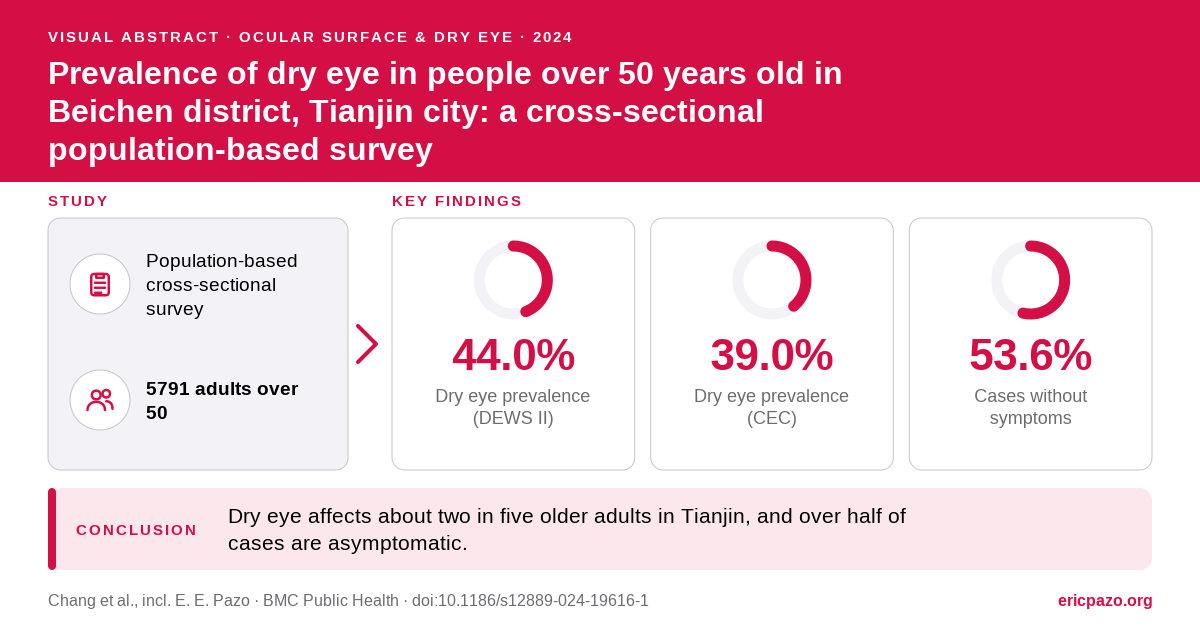
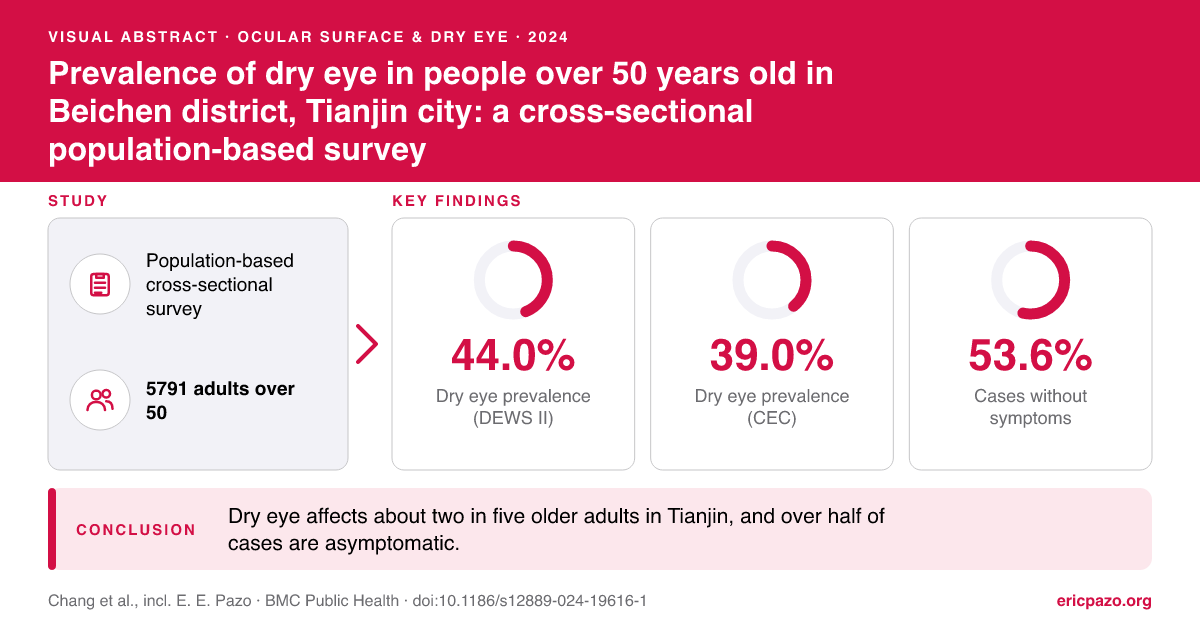
La sécheresse oculaire touche environ deux personnes âgées sur cinq à Tianjin, et plus de la moitié des cas sont asymptomatiques.
- Type d'étude
- Enquête transversale en population
- Échantillon
- 5791 adultes de plus de 50 ans
- Prévalence de la SO (DEWS II)
- 44.0%
- Prévalence de la SO (CEC)
- 39.0%
- Cas sans symptômes
- 53.6%
Résumé
Ce résumé est affiché dans sa langue d'origine, l'anglais, car la licence de l'article (CC BY-NC-ND) ne permet pas de publier des traductions.
BACKGROUND: A cross-sectional population-based survey in the Beichen district of Tianjin was conducted to estimate the prevalence of dry eye disease (DED) among the population over 50 years old with Dry Eye Workshop (DEWS) II and Chinese expert consensus (CEC) criteria. METHODS: A total of 5791 subjects over 50 years old were enrolled. Ocular surface disease index (OSDI) questionnaire, lipid layer thickness (LLT), partial blink ratio (PBR), fluorescein tear film breakup time (FBUT), Schirmer I test (SIT), fluorescein staining, meibomian gland dropout, meibomian gland expression scores (MES) and quantity scores (MQS) was assessed. Additionally, basic information, weight, disease history, living habits, anxiety, and depression condition were collected. RESULTS: According to the CEC, the prevalence of DED was 39.0%, whereas 44.0% based on DEWS II. The prevalence of DED increased with age and was substantially greater among women (41.1%, 95% CI, 39.5-42.6%) than males (35.1%, 95% CI, 33.1 -37.2%) (p < 0.001). Furthermore, the severity of DED was more severe in women (p = 0.006). The associated risk factors were age, female, depression, smoking, insomnia, and glaucoma. On the other hand, 53.6% of these populations were diagnosed as asymptomatic DED, and the morbidity was higher in males (p = 0.007). CONCLUSIONS: The prevalence of DED in China was relatively high, which was associated with aging, female(sex), depression, smoking and sleep problems. Hence, it is crucial for clinicians and caregivers to be aware of the existence of asymptomatic DED within the susceptible population.
Mots-clés : dry eye; prevalence; older adults; meibomian gland dysfunction; meibomian gland dropout; meibomian gland expression; tear film break-up time; Schirmer test
Accès
Comment citer
Afficher le BibTeX
@article{chang2024prevalence,
  title = {{Prevalence of dry eye in people over 50 years old in Beichen district, Tianjin city: a cross-sectional population-based survey}},
  author = {Chang, Lianqing and Guo, Qian and Pazo, Emmanuel Eric and Li, Fei Ran and Zhang, Zhongfang and Fang, Zijie and Huang, Yue and Yang, Ruibo and Liu, Hui and Li, Xiaorong and Zhang, Chen and Zhao, Shaozhen},
  journal = {BMC Public Health},
  year = {2024},
  doi = {10.1186/s12889-024-19616-1},
  url = {https://doi.org/10.1186/s12889-024-19616-1},
}
Travaux liés
- Analyse de l'influence de l'espace au bord du volet sur la régénération des nerfs cornéens après LASIK assisté par laser femtoseconde (2026)
- Comparaison des effets de la lumière pulsée intense et de l'hygiène palpébrale sur le film lacrymal et la surface oculaire : une étude contrôlée randomisée (2026)
- Effects of 3% diquafosol sodium on tear film stability, corneal aberration parameters, and vision-related quality of life in pediatric orthokeratology-associated dry eye disease (2026)
- Association entre l'indice de masse corporelle maternel avant la grossesse et l'astigmatisme et la courbure cornéenne de l'enfant : une étude transversale (2025)
- Expression différentielle de la lymphotoxine α, de l'immunoglobuline E et de la métalloprotéinase matricielle 9 lacrymales dans la sécheresse oculaire associée à la conjonctivite allergique (2025)