
Cambios en la capa lipídica de la película lagrimal tras el efecto combinado de una mascarilla ocular térmica y la terapia con luz pulsada intensa en el ojo seco evaporativo: un estudio controlado aleatorizado
Título original: Tear Film Lipid Layer Changes Following Combined Effect of Heated Eye Mask with Intense Pulsed Light Therapy for Evaporative Dry Eye: A Randomized Control Study
Liangzhe Li, Jiayan Chen, Guanghao Qin, Yifan Qi, Yimeng Chen, Mingze Li, Qing Zhang, Yuan Cheng, Naici Guo, Salissou Moutari, Jonathan Edward Moore, Sile Yu, Xingru He, Emmanuel Eric Pazo
 Photobiomodulation Photomedicine and Laser Surgery, 2023 · artículo · doi:10.1089/photob.2023.0051 · citado 15 veces · Acceso abierto (CC BY)
De un vistazo
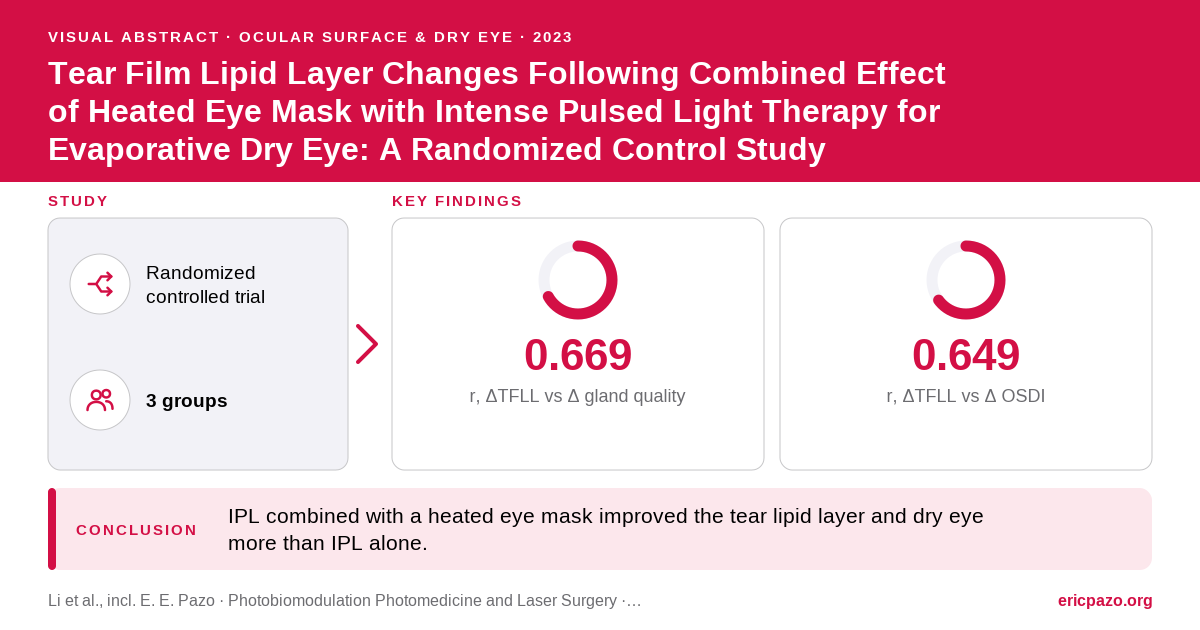
La IPL combinada con una mascarilla ocular térmica mejoró la capa lipídica lagrimal y el ojo seco más que la IPL sola.
- Diseño
- Ensayo controlado aleatorizado
- Muestra
- 3 grupos
- r, ΔTFLL frente a Δ calidad glandular
- 0.669
- r, ΔTFLL frente a Δ OSDI
- 0.649
Resumen
Antecedentes: La enfermedad de ojo seco (EOS) es un trastorno inflamatorio complejo de la superficie ocular de etiología multifactorial. Se ha descrito que terapias como la luz pulsada intensa (IPL) y la mascarilla ocular térmica (HEM) mejoran la capa lipídica de la película lagrimal (TFLL) y los signos y síntomas de la EOS. Métodos: Este estudio aleatorizado tuvo como objetivo comparar los efectos de la IPL combinada con HEM (grupo IPL+HEM), del grupo IPL y del grupo control en participantes con EOS evaporativa. Todos los participantes se examinaron al inicio (D0), el día 21 (D21), el día 42 (D42) y el día 84 (D84) para valorar el tiempo de ruptura lagrimal no invasivo (NITBUT), la TFLL, la tinción corneoconjuntival (CS), la calidad de las glándulas de Meibomio (MGQ), la expresibilidad de las glándulas de Meibomio (MGEx) y el Ocular Surface Disease Index (OSDI). Resultados: La edad media de los participantes fue de 28.06 ± 3.88 años en el grupo IPL+HEM, 29.88 ± 4.68 años en el grupo IPL y 28.52 ± 3.77 años en el grupo control. En D84 se observaron mejoras significativas de la TFLL ( p < 0.05), el tiempo de ruptura lagrimal no invasivo (NITBUT) ( p < 0.05), la tinción corneoconjuntival (CS) ( p < 0.05), la MGQ ( p < 0.05), la MGEx ( p < 0.05) y el OSDI ( p < 0.05) en los grupos IPL+HEM e IPL, mientras que el grupo control no mostró mejoras significativas. Además, el ΔTFLL se correlacionó significativamente con el ΔNITBUT ( r = −0.678, p < 0.001), el ΔCS ( r = 0.321, p < 0.001), el ΔMGQ ( r = 0.669, p < 0.001), el ΔMGEx ( r = 0.598, p < 0.001) y la puntuación ΔOSDI ( r = 0.649, p < 0.001). Conclusiones: Tanto la terapia IPL combinada con HEM como la terapia IPL sola pueden mejorar significativamente la calidad de la TFLL y reducir clínicamente los signos y síntomas de la EOS evaporativa. No obstante, la terapia IPL combinada con HEM resultó más eficaz que la terapia IPL sola.
Traducido del resumen original en inglés (licencia: CC BY).
Mostrar el resumen original
Background: Dry eye disease (DED) is a complex ocular surface inflammatory disorder with a multifactorial etiology. Therapies such as intense pulsed light (IPL) and heated eye mask (HEM) have been reported to improve the tear film lipid layer (TFLL) and signs and symptoms of DED. Methods: This randomized study aimed to compare the effects of IPL combined with HEM (IPL+HEM) group, IPL group, and control group in participants with evaporative DED. All participants were examined at baseline (D0), day 21 (D21), day 42 (D42), and day 84 (D84) for noninvasive tear breakup time (NITBUT), TFLL, corneal conjunctival staining (CS), meibomian gland quality (MGQ), meibomian gland expressibility (MGEx), and Ocular Surface Disease Index (OSDI). Results: The mean age of participants was IPL+HEM: 28.06 ± 3.88 years, IPL: 29.88 ± 4.68 years, and control: 28.52 ± 3.77 years. At D84, significant improvements in TFLL ( p < 0.05), noninvasive tear breakup time (NITBUT) ( p < 0.05), corneoconjunctival staining (CS) ( p < 0.05), MGQ ( p < 0.05), MGEx ( p < 0.05), and OSDI ( p < 0.05) were found in the IPL+HEM and IPL groups, whereas the control group had no significant improvements. Furthermore, ΔTFLL significantly correlated with ΔNITBUT ( r = −0.678, p < 0.001), ΔCS ( r = 0.321, p < 0.001), ΔMGQ ( r = 0.669, p < 0.001), ΔMGEx ( r = 0.598, p < 0.001), and ΔOSDI score ( r = 0.649, p < 0.001). Conclusions: IPL therapy in combination with HEM and IPL therapy only can significantly improve the quality of TFLL and clinically reduce the sign and symptoms of evaporative DED. However, IPL therapy in combination with HEM was found to be more effective than IPL therapy alone.
Palabras clave: evaporative dry eye disease; tear film lipid layer; intense pulsed light therapy; meibomian gland dysfunction; meibomian gland expressibility; Ocular Surface Disease Index; combination therapy; ocular surface inflammation
Acceso
Cómo citar
Mostrar BibTeX
@article{li2023tear,
  title = {{Tear Film Lipid Layer Changes Following Combined Effect of Heated Eye Mask with Intense Pulsed Light Therapy for Evaporative Dry Eye: A Randomized Control Study}},
  author = {Li, Liangzhe and Chen, Jiayan and Qin, Guanghao and Qi, Yifan and Chen, Yimeng and Li, Mingze and Zhang, Qing and Cheng, Yuan and Guo, Naici and Moutari, Salissou and Moore, Jonathan Edward and Yu, Sile and He, Xingru and Pazo, Emmanuel Eric},
  journal = {Photobiomodulation Photomedicine and Laser Surgery},
  year = {2023},
  doi = {10.1089/photob.2023.0051},
  url = {https://doi.org/10.1089/photob.2023.0051},
}
Trabajos relacionados
- Análisis de la influencia del espacio del margen del colgajo en la regeneración de los nervios corneales tras LASIK asistido por láser de femtosegundo (2026)
- Comparación entre el efecto de la luz pulsada intensa y la higiene palpebral sobre la película lagrimal y la superficie ocular: un estudio controlado aleatorizado (2026)
- Effects of 3% diquafosol sodium on tear film stability, corneal aberration parameters, and vision-related quality of life in pediatric orthokeratology-associated dry eye disease (2026)
- Asociación entre el índice de masa corporal materno previo al embarazo y el astigmatismo y la curvatura corneal de la descendencia: un estudio transversal (2025)
- Expresión diferencial de linfotoxina α, inmunoglobulina E y metaloproteinasa de matriz 9 en lágrimas en el ojo seco asociado a conjuntivitis alérgica (2025)