
Modifications de la couche lipidique du film lacrymal après l'effet combiné d'un masque oculaire chauffant et de la lumière pulsée intense dans la sécheresse oculaire évaporative : une étude contrôlée randomisée
Titre original : Tear Film Lipid Layer Changes Following Combined Effect of Heated Eye Mask with Intense Pulsed Light Therapy for Evaporative Dry Eye: A Randomized Control Study
Liangzhe Li, Jiayan Chen, Guanghao Qin, Yifan Qi, Yimeng Chen, Mingze Li, Qing Zhang, Yuan Cheng, Naici Guo, Salissou Moutari, Jonathan Edward Moore, Sile Yu, Xingru He, Emmanuel Eric Pazo
 Photobiomodulation Photomedicine and Laser Surgery, 2023 · article · doi:10.1089/photob.2023.0051 · cité 15 fois · Accès libre (CC BY)
Surface oculaire et sécheresse oculaire
En bref
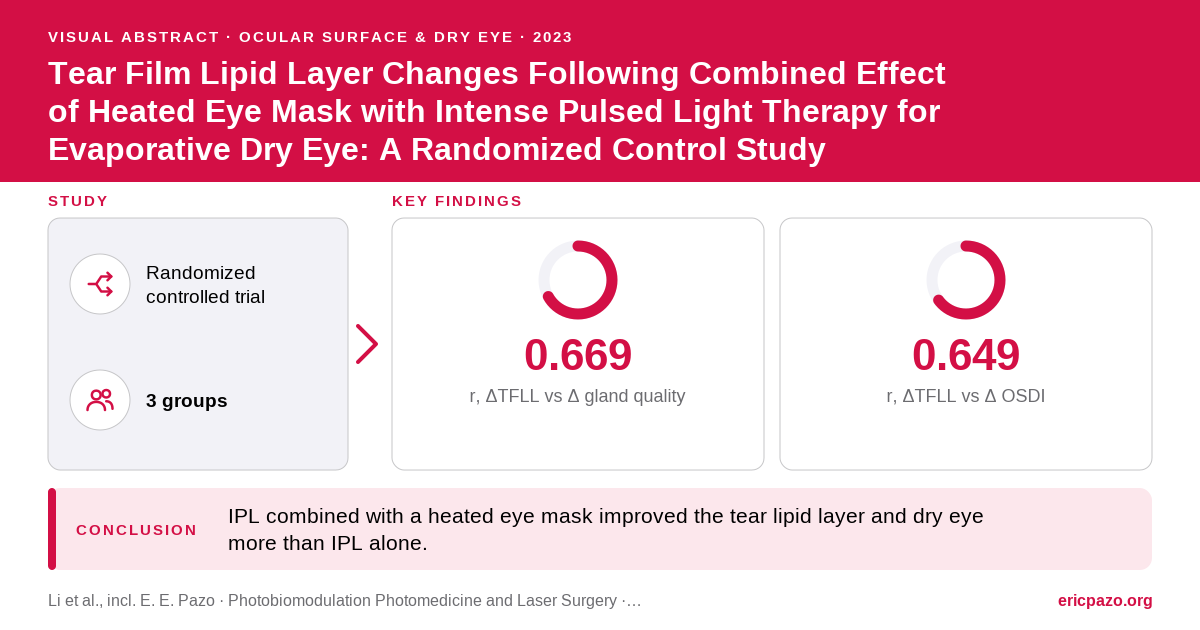
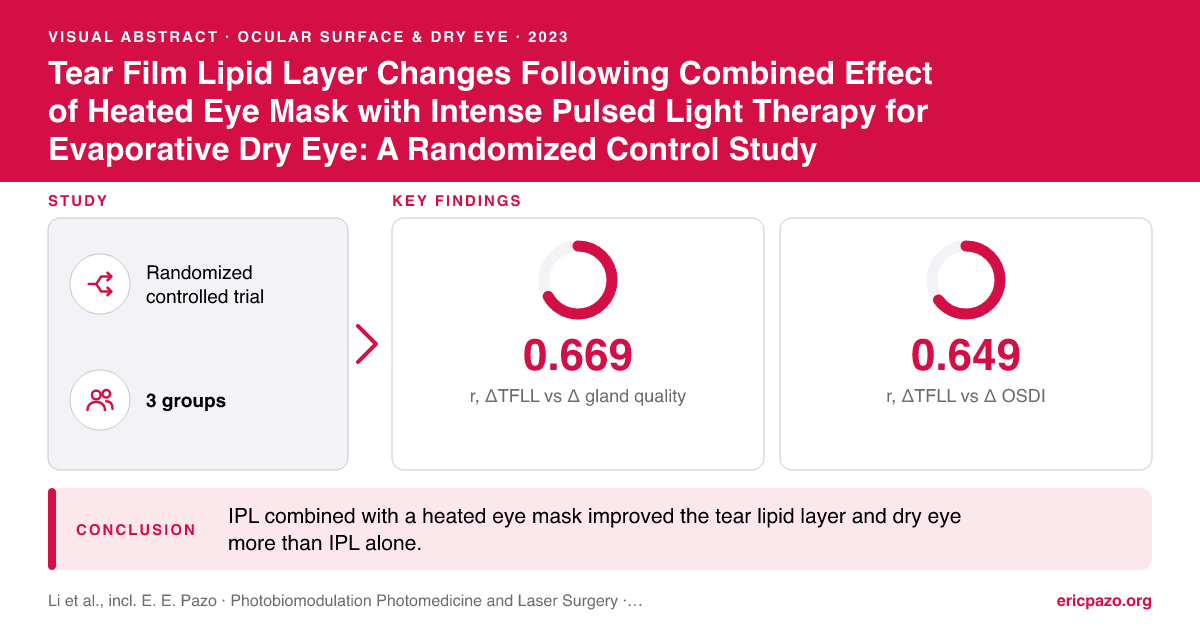
La LPI associée à un masque oculaire chauffant a davantage amélioré la couche lipidique lacrymale et la sécheresse oculaire que la LPI seule.
- Type d'étude
- Essai contrôlé randomisé
- Échantillon
- 3 groupes
- r, ΔTFLL contre Δ qualité glandulaire
- 0.669
- r, ΔTFLL contre Δ OSDI
- 0.649
Résumé
Contexte : La sécheresse oculaire (SO) est une affection inflammatoire complexe de la surface oculaire d'étiologie multifactorielle. Des traitements comme la lumière pulsée intense (LPI) et le masque oculaire chauffant (HEM) amélioreraient la couche lipidique du film lacrymal (TFLL) ainsi que les signes et symptômes de la SO. Méthodes : Cette étude randomisée visait à comparer les effets de la LPI associée au HEM (groupe LPI+HEM), du groupe LPI et du groupe témoin chez des participants atteints de SO évaporative. Tous les participants ont été examinés à l'inclusion (J0), au jour 21 (J21), au jour 42 (J42) et au jour 84 (J84) pour le temps de rupture lacrymale non invasif (NITBUT), la TFLL, la coloration cornéo-conjonctivale (CS), la qualité des glandes de Meibomius (MGQ), l'expressibilité des glandes de Meibomius (MGEx) et l'Ocular Surface Disease Index (OSDI). Résultats : L'âge moyen des participants était de 28.06 ± 3.88 ans dans le groupe LPI+HEM, 29.88 ± 4.68 ans dans le groupe LPI et 28.52 ± 3.77 ans dans le groupe témoin. À J84, des améliorations significatives de la TFLL ( p < 0.05), du temps de rupture lacrymale non invasif (NITBUT) ( p < 0.05), de la coloration cornéo-conjonctivale (CS) ( p < 0.05), de la MGQ ( p < 0.05), de la MGEx ( p < 0.05) et de l'OSDI ( p < 0.05) ont été observées dans les groupes LPI+HEM et LPI, tandis que le groupe témoin n'a montré aucune amélioration significative. En outre, la ΔTFLL était significativement corrélée à la ΔNITBUT ( r = −0.678, p < 0.001), à la ΔCS ( r = 0.321, p < 0.001), à la ΔMGQ ( r = 0.669, p < 0.001), à la ΔMGEx ( r = 0.598, p < 0.001) et au score ΔOSDI ( r = 0.649, p < 0.001). Conclusions : La LPI associée au HEM comme la LPI seule peuvent améliorer significativement la qualité de la TFLL et réduire cliniquement les signes et symptômes de la SO évaporative. La LPI associée au HEM s'est toutefois révélée plus efficace que la LPI seule.
Traduit du résumé original en anglais (licence : CC BY).
Afficher le résumé original
Background: Dry eye disease (DED) is a complex ocular surface inflammatory disorder with a multifactorial etiology. Therapies such as intense pulsed light (IPL) and heated eye mask (HEM) have been reported to improve the tear film lipid layer (TFLL) and signs and symptoms of DED. Methods: This randomized study aimed to compare the effects of IPL combined with HEM (IPL+HEM) group, IPL group, and control group in participants with evaporative DED. All participants were examined at baseline (D0), day 21 (D21), day 42 (D42), and day 84 (D84) for noninvasive tear breakup time (NITBUT), TFLL, corneal conjunctival staining (CS), meibomian gland quality (MGQ), meibomian gland expressibility (MGEx), and Ocular Surface Disease Index (OSDI). Results: The mean age of participants was IPL+HEM: 28.06 ± 3.88 years, IPL: 29.88 ± 4.68 years, and control: 28.52 ± 3.77 years. At D84, significant improvements in TFLL ( p < 0.05), noninvasive tear breakup time (NITBUT) ( p < 0.05), corneoconjunctival staining (CS) ( p < 0.05), MGQ ( p < 0.05), MGEx ( p < 0.05), and OSDI ( p < 0.05) were found in the IPL+HEM and IPL groups, whereas the control group had no significant improvements. Furthermore, ΔTFLL significantly correlated with ΔNITBUT ( r = −0.678, p < 0.001), ΔCS ( r = 0.321, p < 0.001), ΔMGQ ( r = 0.669, p < 0.001), ΔMGEx ( r = 0.598, p < 0.001), and ΔOSDI score ( r = 0.649, p < 0.001). Conclusions: IPL therapy in combination with HEM and IPL therapy only can significantly improve the quality of TFLL and clinically reduce the sign and symptoms of evaporative DED. However, IPL therapy in combination with HEM was found to be more effective than IPL therapy alone.
Mots-clés : evaporative dry eye disease; tear film lipid layer; intense pulsed light therapy; meibomian gland dysfunction; meibomian gland expressibility; Ocular Surface Disease Index; combination therapy; ocular surface inflammation
Accès
Comment citer
Afficher le BibTeX
@article{li2023tear,
  title = {{Tear Film Lipid Layer Changes Following Combined Effect of Heated Eye Mask with Intense Pulsed Light Therapy for Evaporative Dry Eye: A Randomized Control Study}},
  author = {Li, Liangzhe and Chen, Jiayan and Qin, Guanghao and Qi, Yifan and Chen, Yimeng and Li, Mingze and Zhang, Qing and Cheng, Yuan and Guo, Naici and Moutari, Salissou and Moore, Jonathan Edward and Yu, Sile and He, Xingru and Pazo, Emmanuel Eric},
  journal = {Photobiomodulation Photomedicine and Laser Surgery},
  year = {2023},
  doi = {10.1089/photob.2023.0051},
  url = {https://doi.org/10.1089/photob.2023.0051},
}
Travaux liés
- Analyse de l'influence de l'espace au bord du volet sur la régénération des nerfs cornéens après LASIK assisté par laser femtoseconde (2026)
- Comparaison des effets de la lumière pulsée intense et de l'hygiène palpébrale sur le film lacrymal et la surface oculaire : une étude contrôlée randomisée (2026)
- Effects of 3% diquafosol sodium on tear film stability, corneal aberration parameters, and vision-related quality of life in pediatric orthokeratology-associated dry eye disease (2026)
- Association entre l'indice de masse corporelle maternel avant la grossesse et l'astigmatisme et la courbure cornéenne de l'enfant : une étude transversale (2025)
- Expression différentielle de la lymphotoxine α, de l'immunoglobuline E et de la métalloprotéinase matricielle 9 lacrymales dans la sécheresse oculaire associée à la conjonctivite allergique (2025)