
Comparación entre la mascarilla ocular térmica y el tratamiento con luz pulsada intensa para el ojo seco relacionado con las lentes de contacto
Título original: Comparison Between Heated Eye Mask and Intense Pulsed Light Treatment for Contact Lens-Related Dry Eye
Ling Xu, Yi Wu, Yilin Song, Qing Zhang, Guanghao Qin, Lanting Yang, Jinfei Ma, Christoph Palme, Jonathan Edward Moore, Emmanuel Eric Pazo, Wei He
 Photobiomodulation Photomedicine and Laser Surgery, 2022 · artículo · doi:10.1089/photob.2021.0094 · citado 21 veces
De un vistazo
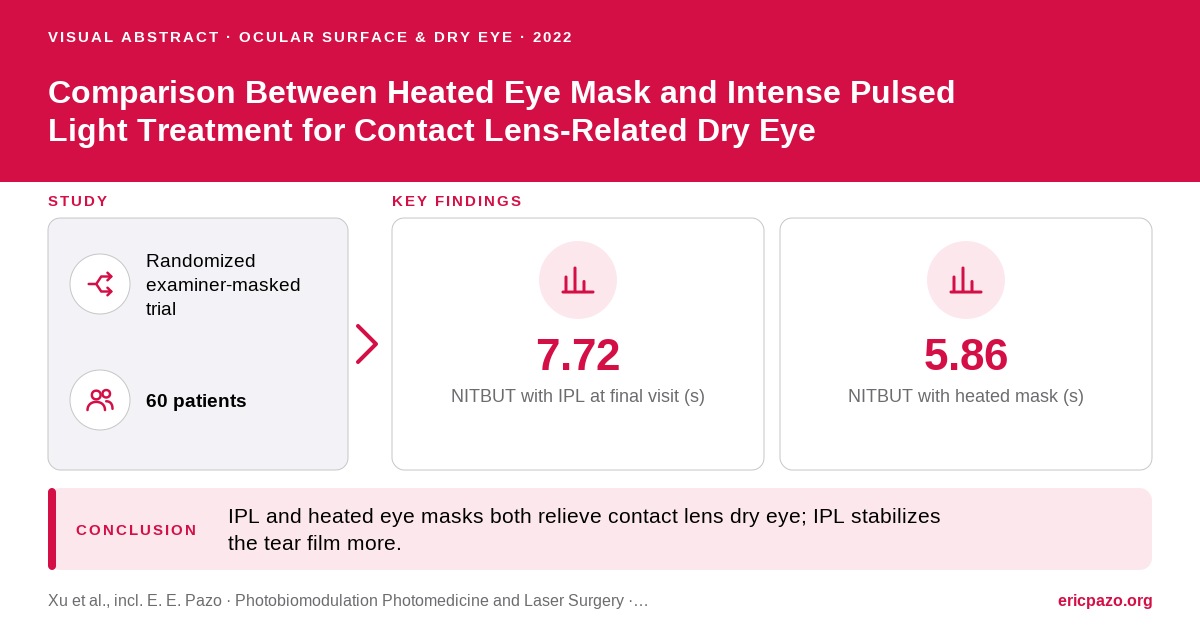
Tanto la IPL como la mascarilla ocular térmica alivian el ojo seco por lentes de contacto; la IPL estabiliza más la película lagrimal.
- Diseño
- Ensayo aleatorizado con evaluador enmascarado
- Muestra
- 60 pacientes
- NITBUT con IPL en la visita final (s)
- 7.72
- NITBUT con mascarilla térmica (s)
- 5.86
Resumen
Este resumen se muestra en su idioma original, el inglés, porque el artículo no tiene una licencia abierta que permita traducciones.
Background: Contact lens-related dry eye (CLDE) is common in contact lens (CL) wearers and can lead to ocular pain, decreased visual quality, and reduced quality of life. Objective: The purpose of this prospective, randomized, examiner masked study was to compare the effectiveness of intense pulsed light (IPL) and heated eye mask (HEM) for relieving CLDE. Methods: The final analysis included 60 patients (30 in the IPL group and 30 in the HEM group) who were using CL and had been suffering contact lens discomfort for more than a year. The IPL treatment group had two IPL treatments spaced 3 weeks apart, whereas the HEM group received HEM daily for 6 weeks (42 days). Non-invasive tear break-up time (NITBUT), tear-film lipid layer (TFLL), conjunctival fluorescein staining, meibum gland quality and expression, conjunctival redness score, ocular surface disease index (OSDI), best-corrected visual acuity, endothelial cell count, and intraocular pressure were assessed at baseline: first visit (V1), second visit (V2), and third visit (V3). Results: The mean age of the IPL group was 28.6 ± 4.3 years (16 females, 53%) and that of the HEM group was 28.6 ± 4.2 years (16 females, 53%). Mean NITBUT for the IPL group at V2 was 5.53 ± 0.77 sec (p < 0.001) and at V3 was 7.72 ± 0.88 sec (p < 0.001); the IPL group demonstrated a clinically and statistically significant improvement in mean NITBUT. In addition, the HEM group showed a clinically and statistically significant improvement in mean NITBUT at V3 (5.86 ± 0.76 sec, p < 0.001). At V3, the C-OSDI, TFLL score, and meibum gland quality and expressibility all increased considerably (p < 0.05) in both groups. Conclusions: Our results imply that IPL or HEM treatment of CLDE can be safely used to relieve symptoms of CLDE. In addition, IPL treatment is more effective in improving the general stability of the tear-film and decreasing the need for artificial tears in CLDE.
Palabras clave: intense pulsed light; meibography; tear film break-up time; tear film lipid layer; Ocular Surface Disease Index; contact lens discomfort; meibography-guided treatment; artificial tears
Acceso
Cómo citar
Mostrar BibTeX
@article{xu2022comparison,
  title = {{Comparison Between Heated Eye Mask and Intense Pulsed Light Treatment for Contact Lens-Related Dry Eye}},
  author = {Xu, Ling and Wu, Yi and Song, Yilin and Zhang, Qing and Qin, Guanghao and Yang, Lanting and Ma, Jinfei and Palme, Christoph and Moore, Jonathan Edward and Pazo, Emmanuel Eric and He, Wei},
  journal = {Photobiomodulation Photomedicine and Laser Surgery},
  year = {2022},
  doi = {10.1089/photob.2021.0094},
  url = {https://doi.org/10.1089/photob.2021.0094},
}
Trabajos relacionados
- Análisis de la influencia del espacio del margen del colgajo en la regeneración de los nervios corneales tras LASIK asistido por láser de femtosegundo (2026)
- Comparación entre el efecto de la luz pulsada intensa y la higiene palpebral sobre la película lagrimal y la superficie ocular: un estudio controlado aleatorizado (2026)
- Effects of 3% diquafosol sodium on tear film stability, corneal aberration parameters, and vision-related quality of life in pediatric orthokeratology-associated dry eye disease (2026)
- Asociación entre el índice de masa corporal materno previo al embarazo y el astigmatismo y la curvatura corneal de la descendencia: un estudio transversal (2025)
- Expresión diferencial de linfotoxina α, inmunoglobulina E y metaloproteinasa de matriz 9 en lágrimas en el ojo seco asociado a conjuntivitis alérgica (2025)