
Comparaison entre le masque oculaire chauffant et la lumière pulsée intense dans la sécheresse oculaire liée aux lentilles de contact
Titre original : Comparison Between Heated Eye Mask and Intense Pulsed Light Treatment for Contact Lens-Related Dry Eye
Ling Xu, Yi Wu, Yilin Song, Qing Zhang, Guanghao Qin, Lanting Yang, Jinfei Ma, Christoph Palme, Jonathan Edward Moore, Emmanuel Eric Pazo, Wei He
 Photobiomodulation Photomedicine and Laser Surgery, 2022 · article · doi:10.1089/photob.2021.0094 · cité 21 fois
Surface oculaire et sécheresse oculaire
En bref
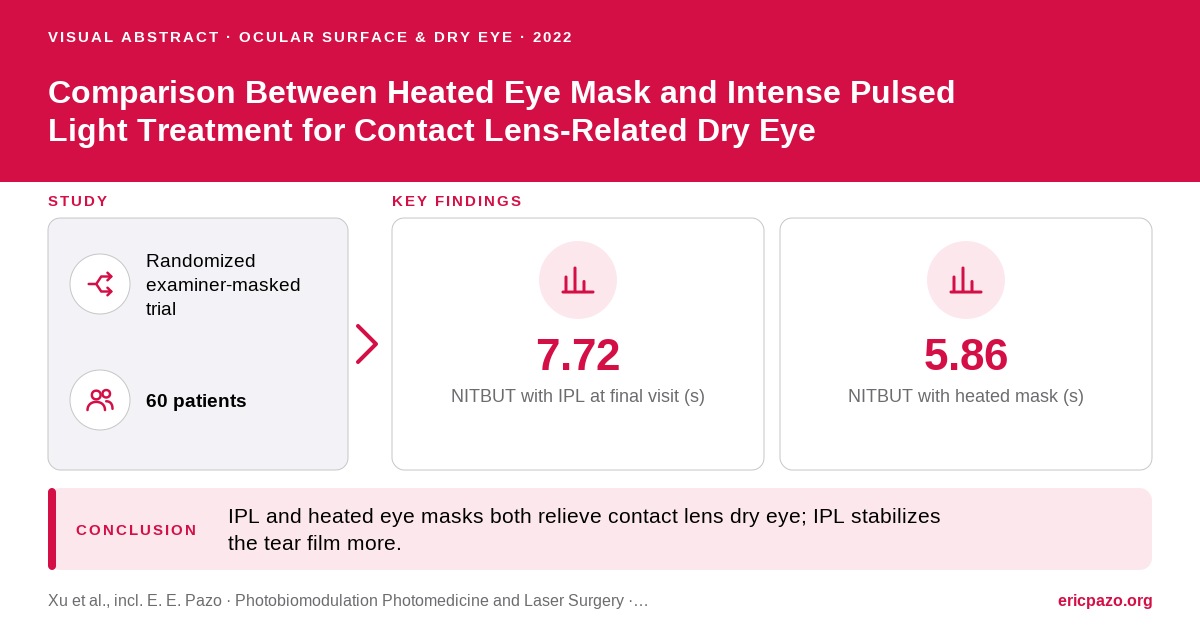
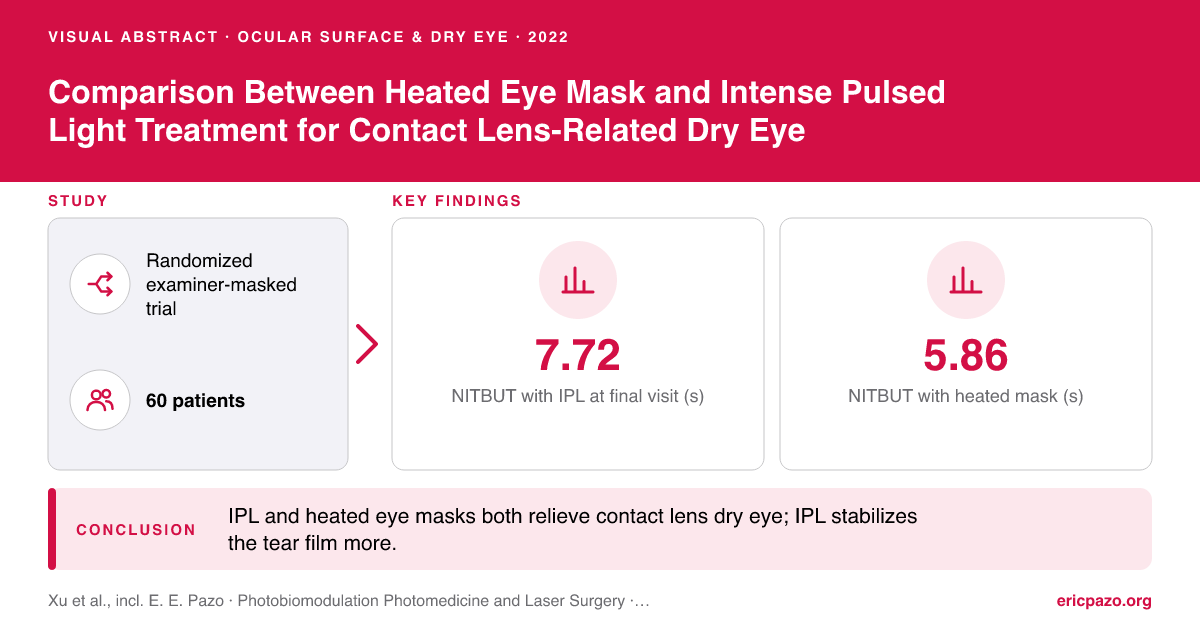
La LPI et le masque chauffant soulagent tous deux la sécheresse oculaire liée aux lentilles ; la LPI stabilise davantage le film lacrymal.
- Type d'étude
- Essai randomisé avec examinateur en aveugle
- Échantillon
- 60 patients
- NITBUT avec LPI à la dernière visite (s)
- 7.72
- NITBUT avec masque chauffant (s)
- 5.86
Résumé
Ce résumé est affiché dans sa langue d'origine, l'anglais, car l'article n'est pas publié sous une licence ouverte autorisant les traductions.
Background: Contact lens-related dry eye (CLDE) is common in contact lens (CL) wearers and can lead to ocular pain, decreased visual quality, and reduced quality of life. Objective: The purpose of this prospective, randomized, examiner masked study was to compare the effectiveness of intense pulsed light (IPL) and heated eye mask (HEM) for relieving CLDE. Methods: The final analysis included 60 patients (30 in the IPL group and 30 in the HEM group) who were using CL and had been suffering contact lens discomfort for more than a year. The IPL treatment group had two IPL treatments spaced 3 weeks apart, whereas the HEM group received HEM daily for 6 weeks (42 days). Non-invasive tear break-up time (NITBUT), tear-film lipid layer (TFLL), conjunctival fluorescein staining, meibum gland quality and expression, conjunctival redness score, ocular surface disease index (OSDI), best-corrected visual acuity, endothelial cell count, and intraocular pressure were assessed at baseline: first visit (V1), second visit (V2), and third visit (V3). Results: The mean age of the IPL group was 28.6 ± 4.3 years (16 females, 53%) and that of the HEM group was 28.6 ± 4.2 years (16 females, 53%). Mean NITBUT for the IPL group at V2 was 5.53 ± 0.77 sec (p < 0.001) and at V3 was 7.72 ± 0.88 sec (p < 0.001); the IPL group demonstrated a clinically and statistically significant improvement in mean NITBUT. In addition, the HEM group showed a clinically and statistically significant improvement in mean NITBUT at V3 (5.86 ± 0.76 sec, p < 0.001). At V3, the C-OSDI, TFLL score, and meibum gland quality and expressibility all increased considerably (p < 0.05) in both groups. Conclusions: Our results imply that IPL or HEM treatment of CLDE can be safely used to relieve symptoms of CLDE. In addition, IPL treatment is more effective in improving the general stability of the tear-film and decreasing the need for artificial tears in CLDE.
Mots-clés : intense pulsed light; meibography; tear film break-up time; tear film lipid layer; Ocular Surface Disease Index; contact lens discomfort; meibography-guided treatment; artificial tears
Accès
Comment citer
Afficher le BibTeX
@article{xu2022comparison,
  title = {{Comparison Between Heated Eye Mask and Intense Pulsed Light Treatment for Contact Lens-Related Dry Eye}},
  author = {Xu, Ling and Wu, Yi and Song, Yilin and Zhang, Qing and Qin, Guanghao and Yang, Lanting and Ma, Jinfei and Palme, Christoph and Moore, Jonathan Edward and Pazo, Emmanuel Eric and He, Wei},
  journal = {Photobiomodulation Photomedicine and Laser Surgery},
  year = {2022},
  doi = {10.1089/photob.2021.0094},
  url = {https://doi.org/10.1089/photob.2021.0094},
}
Travaux liés
- Analyse de l'influence de l'espace au bord du volet sur la régénération des nerfs cornéens après LASIK assisté par laser femtoseconde (2026)
- Comparaison des effets de la lumière pulsée intense et de l'hygiène palpébrale sur le film lacrymal et la surface oculaire : une étude contrôlée randomisée (2026)
- Effects of 3% diquafosol sodium on tear film stability, corneal aberration parameters, and vision-related quality of life in pediatric orthokeratology-associated dry eye disease (2026)
- Association entre l'indice de masse corporelle maternel avant la grossesse et l'astigmatisme et la courbure cornéenne de l'enfant : une étude transversale (2025)
- Expression différentielle de la lymphotoxine α, de l'immunoglobuline E et de la métalloprotéinase matricielle 9 lacrymales dans la sécheresse oculaire associée à la conjonctivite allergique (2025)