
Fiabilidad del cuestionario web chino del índice de enfermedad de la superficie ocular en pacientes con ojo seco: un estudio aleatorizado cruzado
Título original: Reliability of Chinese web-based ocular surface disease index questionnaire in dry eye patients: a randomized, crossover study
Xinmei Zhang, Qing Zhang, Qing-Xia Fan, Can Zhang, Yue You, Chenguang Zhang, Tiezhu Lin, Ling Xu, Salissou Moutari, Jonathan E. Moore, Emmanuel Eric Pazo, Wei He
 International Journal of Ophthalmology, 2021 · artículo · doi:10.18240/ijo.2021.06.07 · citado 57 veces · Acceso abierto (CC BY-NC-ND)
De un vistazo
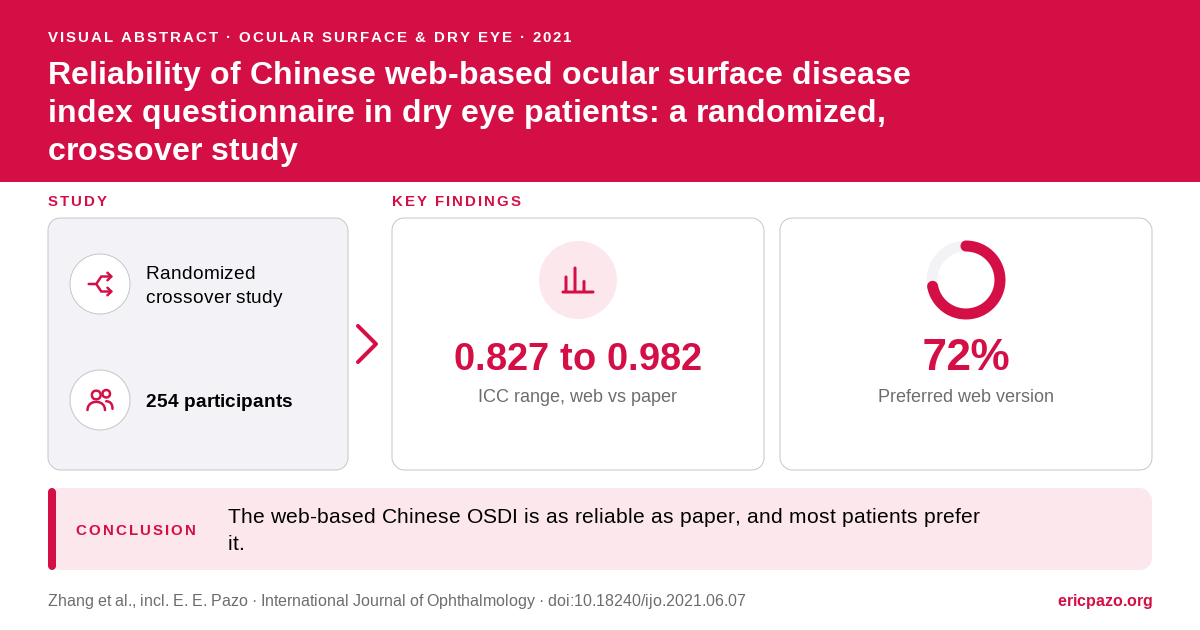
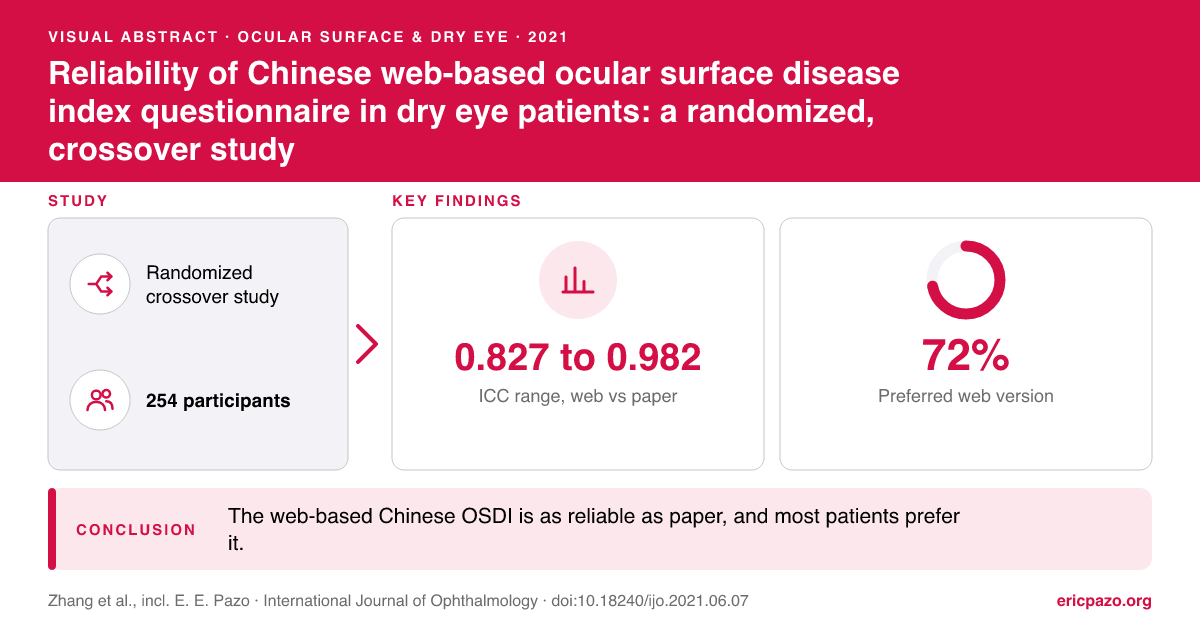
El OSDI chino en versión web es tan fiable como el de papel, y la mayoría de los pacientes lo prefieren.
- Diseño
- Estudio aleatorizado cruzado
- Muestra
- 254 participantes
- Rango de ICC, web frente a papel
- 0.827 to 0.982
- Prefirieron la versión web
- 72%
Resumen
Este resumen se muestra en su idioma original, el inglés, porque la licencia del artículo (CC BY-NC-ND) no permite publicar traducciones.
AIM: To assess the reliability of web-based version of ocular surface disease index in Chinese (C-OSDI) on clinically diagnosed dry eye disease (DE) patients. METHODS: A total of 254 Chinese participants (51% male, 129/254; mean age: 27.90±9.06y) with DED completed paper- and web-based versions of C-OSDI questionnaires in a randomized crossover design. Ophthalmology examination and DED diagnosis were performed prior to the participants being invited to join the study. Participants were randomly designated to either group A (paper-based first and web-based second) or group B (web-based first and paper-based second). Final data analysis included participants that had successfully completed both versions of the C-OSDI. Demographic characteristics, test-retest reliability, and agreement of individual items, subscales, and total score were evaluated with intraclass correlation coefficients (ICC), Spearman rank correlation, Wilcoxon test and Rasch analysis. RESULTS: Reliability indexes were adequate, Pearson correlation was greater than 0.8 and ICCs range was 0.827 to 0.982; total C-OSDI score was not statistically different between the two versions. The values of mean-squares fit statistics were very low compared to 1, indicating that the responses to the items by the model had a high degree of predictability. While comparing the favorability 72% (182/254) of the participants preferred web-based assessment. CONCLUSION: Web-based C-OSDI is reliable in assessing DED and correlation with the paper-based version is significant in all subscales and overall total score. Web-based C-OSDI can be administered to assess individuals with DED as participants predominantly favored online assessment.
Palabras clave: Ocular Surface Disease Index; dry eye; web-based questionnaire; Chinese version; test-retest reliability; patient-reported outcomes; questionnaire validation; Rasch analysis
Acceso
Cómo citar
Mostrar BibTeX
@article{zhang2021reliability,
  title = {{Reliability of Chinese web-based ocular surface disease index questionnaire in dry eye patients: a randomized, crossover study}},
  author = {Zhang, Xinmei and Zhang, Qing and Fan, Qing-Xia and Zhang, Can and You, Yue and Zhang, Chenguang and Lin, Tiezhu and Xu, Ling and Moutari, Salissou and Moore, Jonathan E. and Pazo, Emmanuel Eric and He, Wei},
  journal = {International Journal of Ophthalmology},
  year = {2021},
  doi = {10.18240/ijo.2021.06.07},
  url = {https://doi.org/10.18240/ijo.2021.06.07},
}
Trabajos relacionados
- Análisis de la influencia del espacio del margen del colgajo en la regeneración de los nervios corneales tras LASIK asistido por láser de femtosegundo (2026)
- Comparación entre el efecto de la luz pulsada intensa y la higiene palpebral sobre la película lagrimal y la superficie ocular: un estudio controlado aleatorizado (2026)
- Effects of 3% diquafosol sodium on tear film stability, corneal aberration parameters, and vision-related quality of life in pediatric orthokeratology-associated dry eye disease (2026)
- Asociación entre el índice de masa corporal materno previo al embarazo y el astigmatismo y la curvatura corneal de la descendencia: un estudio transversal (2025)
- Expresión diferencial de linfotoxina α, inmunoglobulina E y metaloproteinasa de matriz 9 en lágrimas en el ojo seco asociado a conjuntivitis alérgica (2025)