
ドライアイ患者における中国語ウェブ版 Ocular Surface Disease Index 質問票の信頼性:ランダム化クロスオーバー研究
原題: Reliability of Chinese web-based ocular surface disease index questionnaire in dry eye patients: a randomized, crossover study
Xinmei Zhang, Qing Zhang, Qing-Xia Fan, Can Zhang, Yue You, Chenguang Zhang, Tiezhu Lin, Ling Xu, Salissou Moutari, Jonathan E. Moore, Emmanuel Eric Pazo, Wei He
 International Journal of Ophthalmology, 2021 · 原著論文 · doi:10.18240/ijo.2021.06.07 · 被引用 57 回 · オープンアクセス(CC BY-NC-ND)
要点
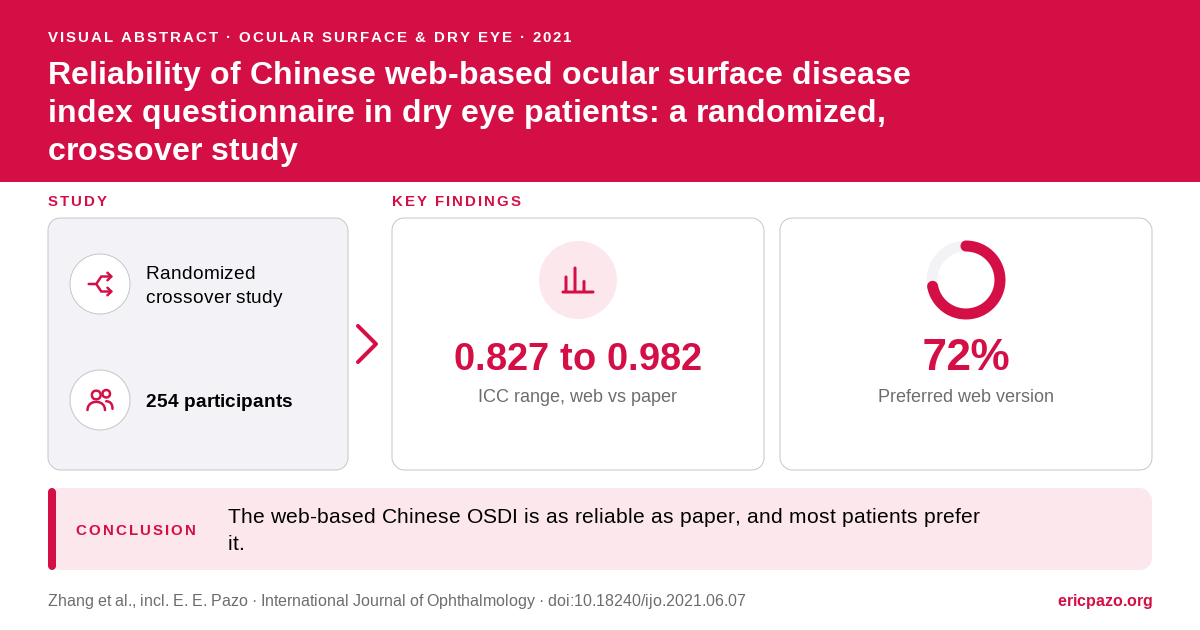
中国語ウェブ版 OSDI は紙版と同等に信頼でき、大半の患者がウェブ版を好む。
- 研究デザイン
- ランダム化クロスオーバー研究
- 対象
- 参加者 254 人
- ICC の範囲(ウェブ版対紙版)
- 0.827 to 0.982
- ウェブ版を好んだ割合
- 72%
抄録
この抄録は原語(英語)で表示しています。論文のライセンス(CC BY-NC-ND)では翻訳の公開が認められていないためです。
AIM: To assess the reliability of web-based version of ocular surface disease index in Chinese (C-OSDI) on clinically diagnosed dry eye disease (DE) patients. METHODS: A total of 254 Chinese participants (51% male, 129/254; mean age: 27.90±9.06y) with DED completed paper- and web-based versions of C-OSDI questionnaires in a randomized crossover design. Ophthalmology examination and DED diagnosis were performed prior to the participants being invited to join the study. Participants were randomly designated to either group A (paper-based first and web-based second) or group B (web-based first and paper-based second). Final data analysis included participants that had successfully completed both versions of the C-OSDI. Demographic characteristics, test-retest reliability, and agreement of individual items, subscales, and total score were evaluated with intraclass correlation coefficients (ICC), Spearman rank correlation, Wilcoxon test and Rasch analysis. RESULTS: Reliability indexes were adequate, Pearson correlation was greater than 0.8 and ICCs range was 0.827 to 0.982; total C-OSDI score was not statistically different between the two versions. The values of mean-squares fit statistics were very low compared to 1, indicating that the responses to the items by the model had a high degree of predictability. While comparing the favorability 72% (182/254) of the participants preferred web-based assessment. CONCLUSION: Web-based C-OSDI is reliable in assessing DED and correlation with the paper-based version is significant in all subscales and overall total score. Web-based C-OSDI can be administered to assess individuals with DED as participants predominantly favored online assessment.
キーワード: Ocular Surface Disease Index; dry eye; web-based questionnaire; Chinese version; test-retest reliability; patient-reported outcomes; questionnaire validation; Rasch analysis
アクセス
引用方法
BibTeX を表示
@article{zhang2021reliability,
  title = {{Reliability of Chinese web-based ocular surface disease index questionnaire in dry eye patients: a randomized, crossover study}},
  author = {Zhang, Xinmei and Zhang, Qing and Fan, Qing-Xia and Zhang, Can and You, Yue and Zhang, Chenguang and Lin, Tiezhu and Xu, Ling and Moutari, Salissou and Moore, Jonathan E. and Pazo, Emmanuel Eric and He, Wei},
  journal = {International Journal of Ophthalmology},
  year = {2021},
  doi = {10.18240/ijo.2021.06.07},
  url = {https://doi.org/10.18240/ijo.2021.06.07},
}
関連する論文
- フェムトセカンドレーザー併用 LASIK 後の角膜神経再生に対するフラップ縁間隙の影響の解析 (2026)
- 強パルス光と眼瞼清拭が涙液層と眼表面に及ぼす効果の比較:ランダム化比較試験 (2026)
- Effects of 3% diquafosol sodium on tear film stability, corneal aberration parameters, and vision-related quality of life in pediatric orthokeratology-associated dry eye disease (2026)
- 母親の妊娠前 BMI と子の乱視および角膜曲率との関連:横断研究 (2025)
- アレルギー性結膜炎に伴うドライアイにおける涙液中リンホトキシン α、免疫グロブリン E、マトリックスメタロプロテイナーゼ-9 の発現の違い (2025)