
Prevalencia del ojo seco sintomático en pacientes con cáncer de mama en tratamiento adyuvante sistémico: un estudio transversal
Título original: Prevalence of symptomatic dry eye in breast cancer patients undergoing systemic adjuvant treatment: A cross-sectional study
Jinfei Ma, Emmanuel Eric Pazo, Zihao Zou, Feng Jin
 The Breast, 2020 · artículo · doi:10.1016/j.breast.2020.07.009 · citado 39 veces · Acceso abierto (CC BY-NC-ND)
De un vistazo
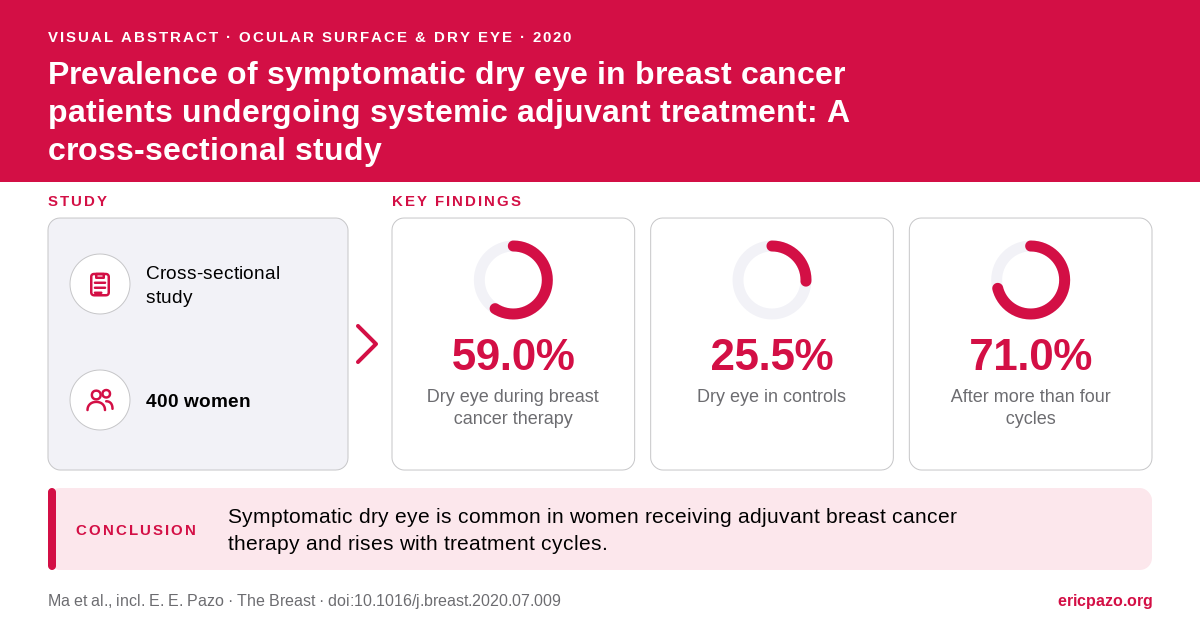
El ojo seco sintomático es frecuente en las mujeres que reciben tratamiento adyuvante del cáncer de mama y aumenta con los ciclos de tratamiento.
- Diseño
- Estudio transversal
- Muestra
- 400 mujeres
- Ojo seco durante el tratamiento del cáncer de mama
- 59.0%
- Ojo seco en los controles
- 25.5%
- Tras más de cuatro ciclos
- 71.0%
Resumen
Este resumen se muestra en su idioma original, el inglés, porque la licencia del artículo (CC BY-NC-ND) no permite publicar traducciones.
OBJECTIVES: To investigate the prevalence of symptomatic dry eye (SDE) on women undergoing systemic adjuvant therapy for breast cancer and its association with treatment settings. METHODS: Woman undergoing breast cancer systemic adjuvant therapy were included in exposure group. An age-matched non-treatment control group was recruited. This cross-sectional questionnaire-based study utilised validated Ocular Surface Disease Index (OSDI) and NCCN-FACT-Breast Cancer Symptom Index (NFBSI-16) questionnaires to determine the presence of SDE and investigate other breast cancer treatment complications. Additionally, demographic data and medical histories were collected. RESULTS: Of 423 eligible participants, 200 in each of the control group and the exposure group were included in the final analysis. The prevalence of SDE was 59.0% in breast cancer patients with adjuvant treatment, statistically significantly higher than 25.5% in the control group (P < 0.01). Additionally, exposure group experienced higher prevalence of moderate and severe SDE, which were 20.0% and 19.5% respectively compared with 9.0% and 4.0% in the control group (P = 0.002, P < 0.001). There was a significantly high prevalence of SDE among patients who had received over four cycles of systemic therapy (71.0%, P < 0.001) and the application of targeted therapy (71.2%, P = 0.014). The severity of SDE positively correlated with the cycles of treatment administered. CONCLUSION: SDE was significantly predominant in women with breast cancer undergoing systemic adjuvant treatment. Our findings suggest dry eye assessments among patients receiving more than four cycles of chemotherapy or targeted therapy, thus early revealing possible dry eye conditions to both patients and clinicians for further specialized examination and treatment.
Palabras clave: breast cancer; adjuvant systemic therapy; chemotherapy; targeted therapy; dry eye prevalence; treatment complications; Ocular Surface Disease Index; dry eye severity
Acceso
Cómo citar
Mostrar BibTeX
@article{ma2020prevalence,
  title = {{Prevalence of symptomatic dry eye in breast cancer patients undergoing systemic adjuvant treatment: A cross-sectional study}},
  author = {Ma, Jinfei and Pazo, Emmanuel Eric and Zou, Zihao and Jin, Feng},
  journal = {The Breast},
  year = {2020},
  doi = {10.1016/j.breast.2020.07.009},
  url = {https://doi.org/10.1016/j.breast.2020.07.009},
}
Trabajos relacionados
- Análisis de la influencia del espacio del margen del colgajo en la regeneración de los nervios corneales tras LASIK asistido por láser de femtosegundo (2026)
- Comparación entre el efecto de la luz pulsada intensa y la higiene palpebral sobre la película lagrimal y la superficie ocular: un estudio controlado aleatorizado (2026)
- Effects of 3% diquafosol sodium on tear film stability, corneal aberration parameters, and vision-related quality of life in pediatric orthokeratology-associated dry eye disease (2026)
- Asociación entre el índice de masa corporal materno previo al embarazo y el astigmatismo y la curvatura corneal de la descendencia: un estudio transversal (2025)
- Expresión diferencial de linfotoxina α, inmunoglobulina E y metaloproteinasa de matriz 9 en lágrimas en el ojo seco asociado a conjuntivitis alérgica (2025)