
Prévalence de la sécheresse oculaire symptomatique chez les patientes atteintes de cancer du sein sous traitement adjuvant systémique : une étude transversale
Titre original : Prevalence of symptomatic dry eye in breast cancer patients undergoing systemic adjuvant treatment: A cross-sectional study
Jinfei Ma, Emmanuel Eric Pazo, Zihao Zou, Feng Jin
 The Breast, 2020 · article · doi:10.1016/j.breast.2020.07.009 · cité 39 fois · Accès libre (CC BY-NC-ND)
Surface oculaire et sécheresse oculaire
En bref
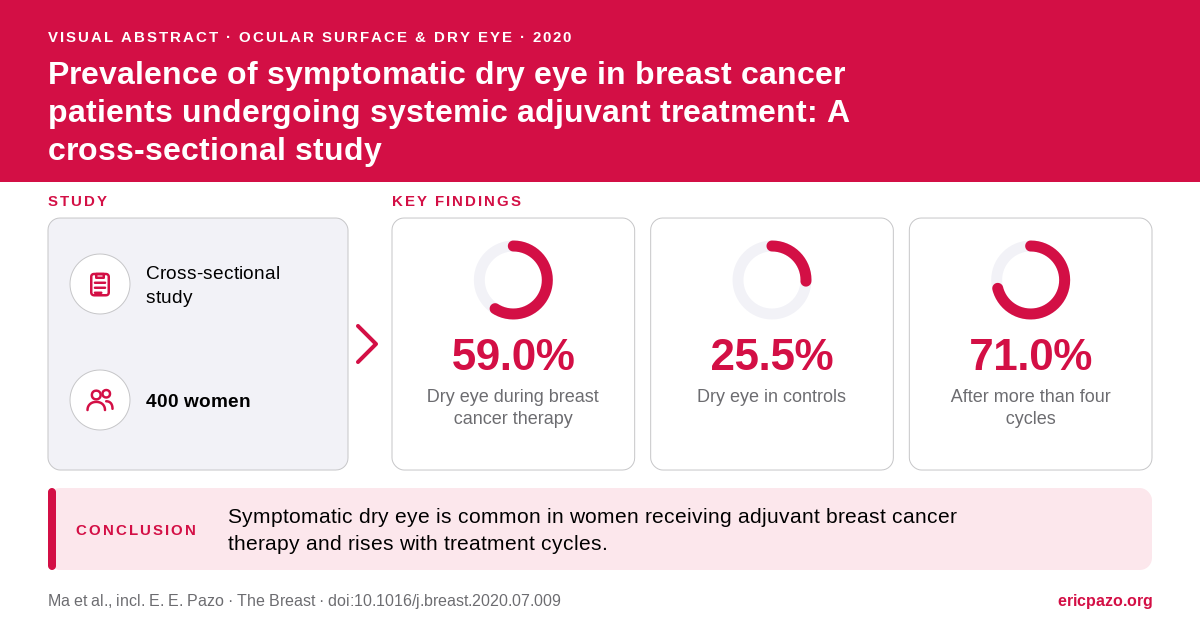
La sécheresse oculaire symptomatique est fréquente chez les femmes sous traitement adjuvant du cancer du sein et augmente avec le nombre de cycles.
- Type d'étude
- Étude transversale
- Échantillon
- 400 femmes
- Sécheresse oculaire sous traitement du cancer du sein
- 59.0%
- Sécheresse oculaire chez les témoins
- 25.5%
- Après plus de quatre cycles
- 71.0%
Résumé
Ce résumé est affiché dans sa langue d'origine, l'anglais, car la licence de l'article (CC BY-NC-ND) ne permet pas de publier des traductions.
OBJECTIVES: To investigate the prevalence of symptomatic dry eye (SDE) on women undergoing systemic adjuvant therapy for breast cancer and its association with treatment settings. METHODS: Woman undergoing breast cancer systemic adjuvant therapy were included in exposure group. An age-matched non-treatment control group was recruited. This cross-sectional questionnaire-based study utilised validated Ocular Surface Disease Index (OSDI) and NCCN-FACT-Breast Cancer Symptom Index (NFBSI-16) questionnaires to determine the presence of SDE and investigate other breast cancer treatment complications. Additionally, demographic data and medical histories were collected. RESULTS: Of 423 eligible participants, 200 in each of the control group and the exposure group were included in the final analysis. The prevalence of SDE was 59.0% in breast cancer patients with adjuvant treatment, statistically significantly higher than 25.5% in the control group (P < 0.01). Additionally, exposure group experienced higher prevalence of moderate and severe SDE, which were 20.0% and 19.5% respectively compared with 9.0% and 4.0% in the control group (P = 0.002, P < 0.001). There was a significantly high prevalence of SDE among patients who had received over four cycles of systemic therapy (71.0%, P < 0.001) and the application of targeted therapy (71.2%, P = 0.014). The severity of SDE positively correlated with the cycles of treatment administered. CONCLUSION: SDE was significantly predominant in women with breast cancer undergoing systemic adjuvant treatment. Our findings suggest dry eye assessments among patients receiving more than four cycles of chemotherapy or targeted therapy, thus early revealing possible dry eye conditions to both patients and clinicians for further specialized examination and treatment.
Mots-clés : breast cancer; adjuvant systemic therapy; chemotherapy; targeted therapy; dry eye prevalence; treatment complications; Ocular Surface Disease Index; dry eye severity
Accès
Comment citer
Afficher le BibTeX
@article{ma2020prevalence,
  title = {{Prevalence of symptomatic dry eye in breast cancer patients undergoing systemic adjuvant treatment: A cross-sectional study}},
  author = {Ma, Jinfei and Pazo, Emmanuel Eric and Zou, Zihao and Jin, Feng},
  journal = {The Breast},
  year = {2020},
  doi = {10.1016/j.breast.2020.07.009},
  url = {https://doi.org/10.1016/j.breast.2020.07.009},
}
Travaux liés
- Analyse de l'influence de l'espace au bord du volet sur la régénération des nerfs cornéens après LASIK assisté par laser femtoseconde (2026)
- Comparaison des effets de la lumière pulsée intense et de l'hygiène palpébrale sur le film lacrymal et la surface oculaire : une étude contrôlée randomisée (2026)
- Effects of 3% diquafosol sodium on tear film stability, corneal aberration parameters, and vision-related quality of life in pediatric orthokeratology-associated dry eye disease (2026)
- Association entre l'indice de masse corporelle maternel avant la grossesse et l'astigmatisme et la courbure cornéenne de l'enfant : une étude transversale (2025)
- Expression différentielle de la lymphotoxine α, de l'immunoglobuline E et de la métalloprotéinase matricielle 9 lacrymales dans la sécheresse oculaire associée à la conjonctivite allergique (2025)