
羟丁基壳聚糖和 5-氟尿嘧啶对鼻内镜下鼻腔泪囊吻合术的影响
原文标题: The impact of hydroxybutyl chitosan and 5-fluorouracil on the procedure of endoscopic endonasal dacryocystorhinostomy
Jia Qi Lin, Jin Zhao, Xun Liu, Emmanuel Eric Pazo, Qing Wang, Li Zhu, T.‐S. LIN
 Indian Journal of Ophthalmology, 2024 · 期刊论文 · doi:10.4103/ijo.ijo_3375_23 · 被引 2 次 · 开放获取(CC BY-NC-SA)
要点速览
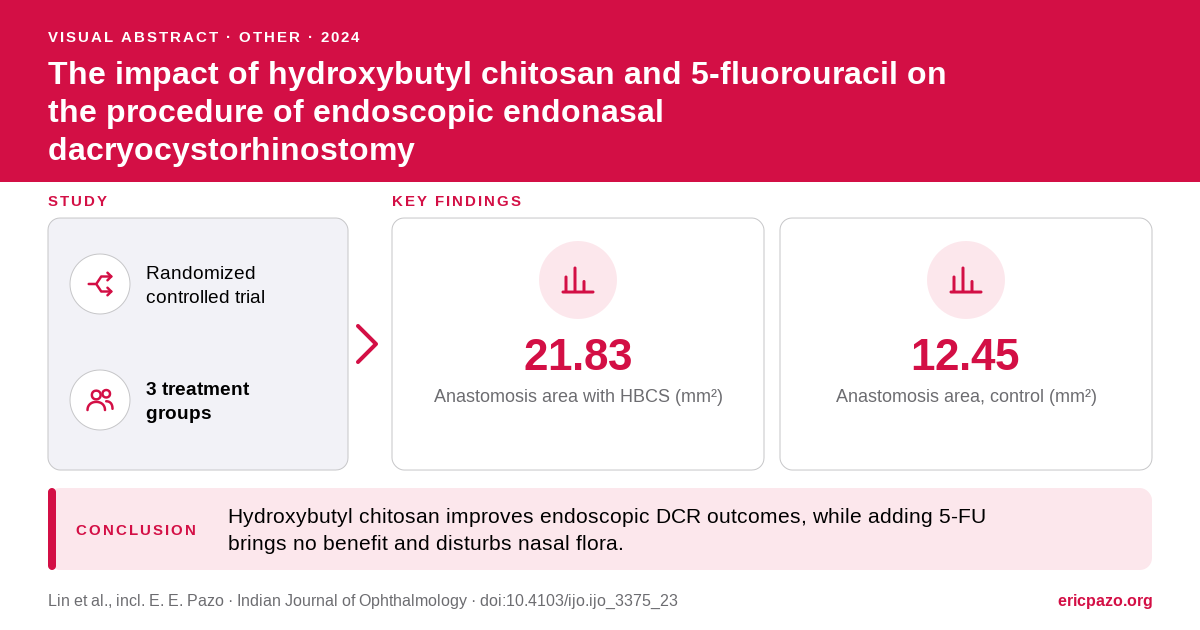
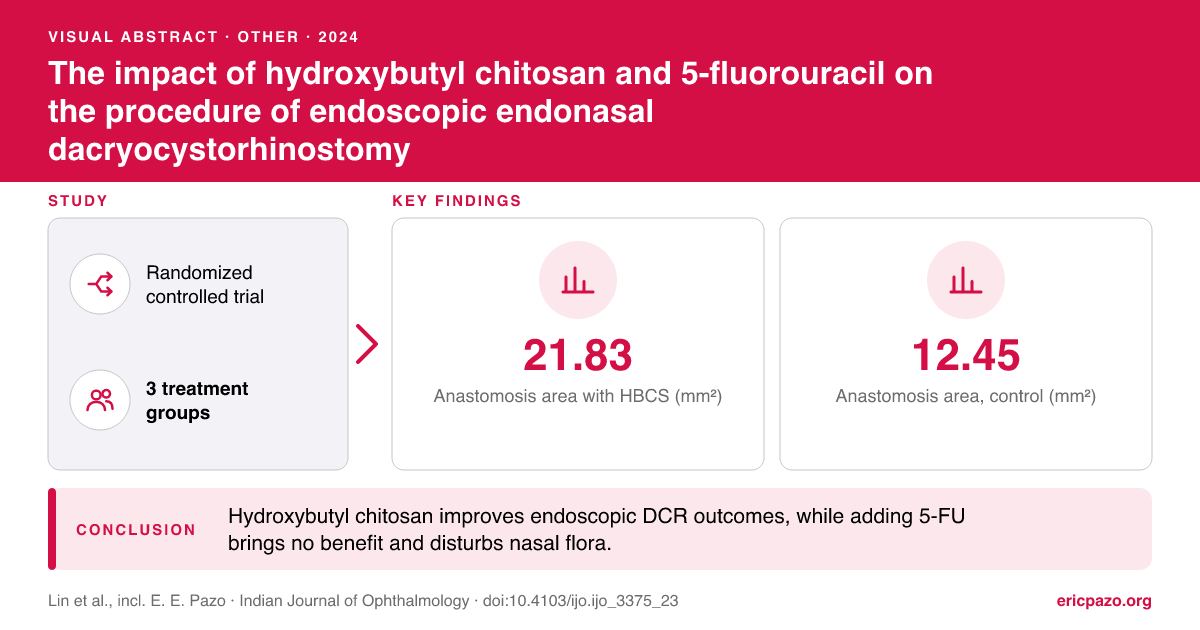
羟丁基壳聚糖可改善鼻内镜泪囊鼻腔吻合术的效果,而加用 5-FU 并无益处且会扰乱鼻腔菌群。
- 研究设计
- 随机对照试验
- 样本
- 3 个治疗组
- 使用 HBCS 的吻合口面积(mm²)
- 21.83
- 对照组吻合口面积(mm²)
- 12.45
摘要
目的:研究在鼻内镜下鼻腔泪囊吻合术(Endo-DCR)中使用羟丁基壳聚糖(HBCS)联合或不联合 5-氟尿嘧啶(5-FU)的效果。此外,本研究在体内观察了 HBCS 和 5-FU 对鼻黏膜细胞群功能的影响。方法:将患者随机分为 HBCS 组(A 组)、HBCS 联合 5-FU 组(B 组)和明胶海绵对照组(C 组)。采用 16S rRNA 高通量测序技术检测结膜囊和鼻腔菌群的变化。此外,采用 CCK8、细胞划痕和流式细胞术研究 HBCS 和 5-FU 对鼻黏膜细胞群的影响。结果:A、B、C 三组受试者的吻合口面积分别为 21.83 ± 12.69 mm 2 、21.57 ± 14.53 mm 2 和 12.45 ± 8.16 mm 2 ( P = 0.0359)。在术后 1、2 和 12 周随访时,A 组溢泪程度轻于其他两组( P < 0.05)。A 组吻合口周围并发症是三组中最轻的( P = 0.0259)。术后 A 组和 B 组结膜囊和鼻腔中致病菌的比例高于健康成人。在 2 周随访时,与 B 组相比,A 组鼻腔菌群结构与健康成人更为相似。结论:术中在吻合口使用 HBCS 可改善 En-DCR 的术后效果。5-FU 不能为 En-DCR 带来更好的术后结果,并且不利于慢性泪囊炎患者术后菌群的恢复正常。在细胞水平上,HBCS 和 5-FU 均抑制鼻黏膜细胞群的迁移,5-FU 还抑制增殖但不促进凋亡。
译自英文原文摘要(许可协议:CC BY-NC-SA)。
显示英文原文摘要
PURPOSE: To investigate the effects of hydroxybutyl chitosan (HBCS) with and without 5-fluorouracil (5-FU) during endoscopic endonasal dacryocystorhinostomy (Endo-DCR). In addition, the present study observed the impact of HBCS and 5-FU on the functions of the nasal mucosal cell population in vivo . METHODS: Patients were randomized into HBCS (group A), HBCS combined with 5-FU (group B), and gelatin sponge control group (group C). 16S rRNA high-throughput sequencing technology examined the conjunctival sac and nasal flora changes. In addition, CCK8, cell scratching, and flow cytometry were used to investigate the effects of HBCS and 5-FU on the nasal mucosal cell populations. RESULTS: Subjects in groups A, B, and C had anastomotic areas of 21.83 ± 12.69 mm 2 , 21.57 ± 14.53 mm 2 , and 12.45 ± 8.16 mm 2 , respectively ( P = 0.0359). Group A had less severe epiphora than the other two groups at 1-, 2-, and 12-week postoperative follow-up ( P < 0.05). Complications around the anastomosis in group A were the least severe of the three groups ( P = 0.0259). After surgery, the proportion of pathogenic bacteria in the conjunctival sac and nasal cavity was higher in groups A and B than in healthy adults. At the 2-week follow-up, the structure of nasal flora in group A was more similar to that of the healthy adults compared to group B. CONCLUSION: Intraoperative use of HBCS at the anastomose improves the postoperative outcome of En-DCR. 5-FU cannot give better postoperative results in En-DCR and is detrimental to the normalization of the postoperative flora in patients with chronic dacryocystitis. At the cellular level, both HBCS and 5-FU inhibit the migration of nasal mucosal cell populations, and 5-FU inhibits proliferation but does not promote apoptosis.
关键词: hydroxybutyl chitosan; 5-fluorouracil; endoscopic endonasal dacryocystorhinostomy; chronic dacryocystitis; nasal mucosa; nasal microbiota; anastomotic healing; epiphora
获取全文
引用格式
显示 BibTeX
@article{lin2024the,
  title = {{The impact of hydroxybutyl chitosan and 5-fluorouracil on the procedure of endoscopic endonasal dacryocystorhinostomy}},
  author = {Lin, Jia Qi and Zhao, Jin and Liu, Xun and Pazo, Emmanuel Eric and Wang, Qing and Zhu, Li and LIN, T.‐S.},
  journal = {Indian Journal of Ophthalmology},
  year = {2024},
  doi = {10.4103/ijo.ijo_3375_23},
  url = {https://doi.org/10.4103/ijo.ijo_3375_23},
}