
美国国立综合癌症网络-癌症治疗功能评估-乳腺癌症状指数(NFBSI-16)问卷纸质版与网络版在乳腺癌患者中的比较分析:随机交叉研究
原文标题: Comparative Analysis of Paper-Based and Web-Based Versions of the National Comprehensive Cancer Network-Functional Assessment of Cancer Therapy-Breast Cancer Symptom Index (NFBSI-16) Questionnaire in Breast Cancer Patients: Randomized Crossover Study
Jinfei Ma, Zihao Zou, Emmanuel Eric Pazo, Salissou Moutari, Ye Liu, Feng Jin
 JMIR Medical Informatics, 2021 · 期刊论文 · doi:10.2196/18269 · 被引 4 次 · 开放获取(CC BY)
要点速览
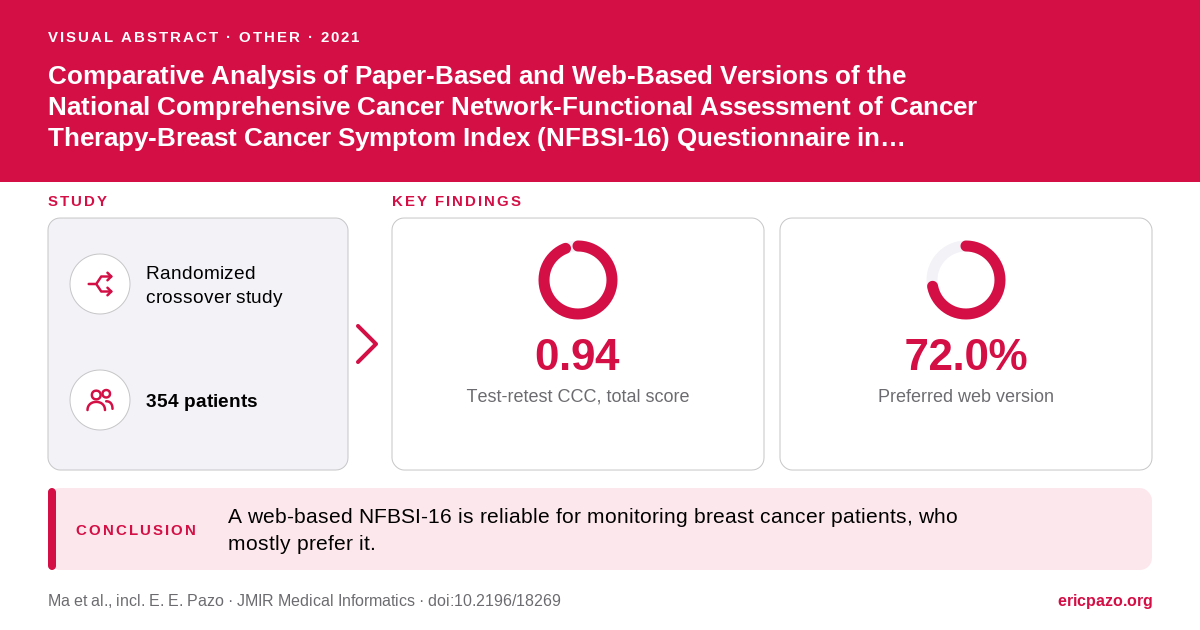
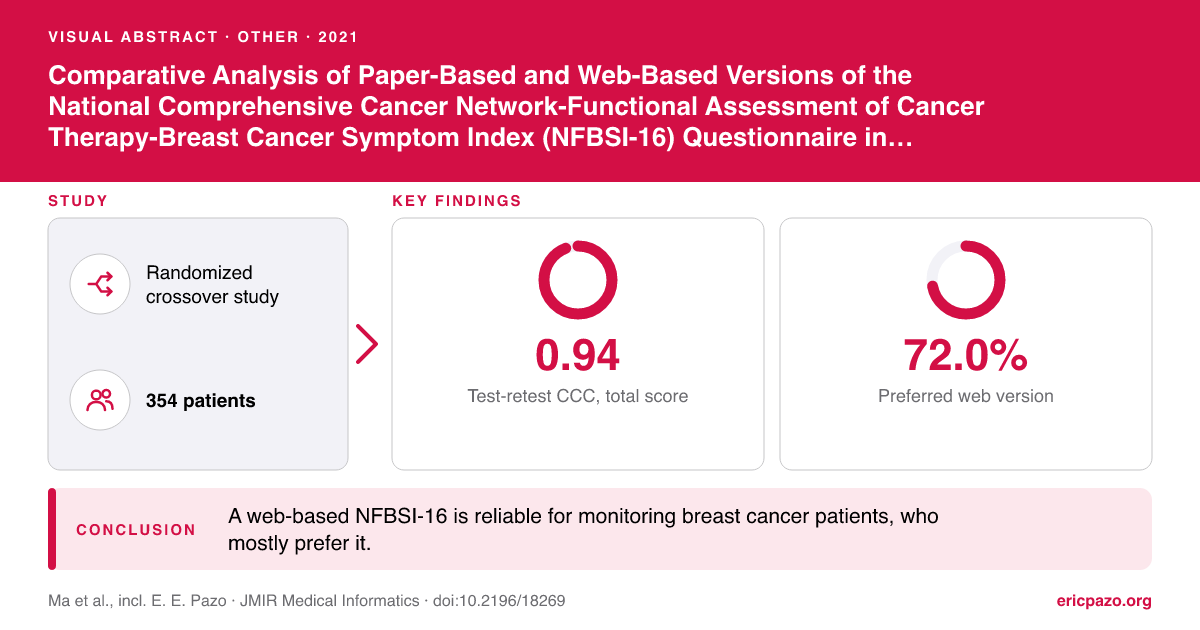
网络版 NFBSI-16 可可靠地用于监测乳腺癌患者,且多数患者更偏好网络版。
- 研究设计
- 随机交叉研究
- 样本
- 354 例患者
- 重测 CCC(总分)
- 0.94
- 偏好网络版
- 72.0%
摘要
背景:乳腺癌仍是中国乃至全球女性中最常确诊的肿瘤。在科研和临床肿瘤学中,与健康相关的问卷评估日益受到重视。美国国立综合癌症网络-癌症治疗功能评估-乳腺癌症状指数(NFBSI-16)是一种快速而有力的工具,可在临床和科研中帮助评估乳腺癌患者与疾病或治疗相关的躯体及情绪症状。个人智能手机的普及为通过网络方式施测问卷提供了可能;然而,电子版 NFBSI-16 的信度尚未得到评估。目的:本研究采用前瞻性开放标签随机交叉设计,评估网络版 NFBSI-16 问卷在接受系统治疗的乳腺癌患者中的信度。方法:我们从中心医院登记系统中随机招募接受系统治疗的乳腺癌患者,请其完成纸质版和网络版问卷,两版问卷均为自评。患者被随机分配至 A 组(先纸质版后网络版)或 B 组(先网络版后纸质版)。共 354 例患者纳入分析(A 组:n=177,B 组:n=177)。采用 Wilcoxon 检验分析描述性社会人口学特征,以及单个条目、分量表和总分的信度与一致率。采用 Lin 一致性相关系数(CCC)以及 Spearman 和 Kendall τ 秩相关评估重测信度。结果:以 CCC 衡量的 NFBSI-16 总分重测信度为 0.94。全部 4 个分量表——疾病相关症状分量表-躯体(ρ=0.93)、疾病相关症状分量表-情绪(ρ=0.85)、治疗副作用分量表(ρ=0.95)以及功能与健康分量表(ρ=0.91)——和 NFBSI-16 总分(ρ=0.94)均显示显著相关(Spearman ρ)。测试与重测的平均差值均接近零(≤0.06)。采用 Wilcoxon 检验比较各条目的分量表平行重测信度时,发现 GP3(条目 5)存在显著差异(P=.02)。本研究中大多数参与者(255/354,72.0%)更偏好网络版而非纸质版。结论:网络版 NFBSI-16 问卷是监测接受治疗的乳腺癌患者个体的优秀工具,且大多数参与者更偏好网络版而非纸质版。
译自英文原文摘要(许可协议:CC BY)。
显示英文原文摘要
BACKGROUND: Breast cancer remains the most common neoplasm diagnosed among women in China and globally. Health-related questionnaire assessments in research and clinical oncology settings have gained prominence. The National Comprehensive Cancer Network-Functional Assessment of Cancer Therapy-Breast Cancer Symptom Index (NFBSI-16) is a rapid and powerful tool to help evaluate disease- or treatment-related symptoms, both physical and emotional, in patients with breast cancer for clinical and research purposes. Prevalence of individual smartphones provides a potential web-based approach to administrating the questionnaire; however, the reliability of the NFBSI-16 in electronic format has not been assessed. OBJECTIVE: This study aimed to assess the reliability of a web-based NFBSI-16 questionnaire in breast cancer patients undergoing systematic treatment with a prospective open-label randomized crossover study design. METHODS: We recruited random patients with breast cancer under systematic treatment from the central hospital registry to complete both paper- and web-based versions of the questionnaires. Both versions of the questionnaires were self-assessed. Patients were randomly assigned to group A (paper-based first and web-based second) or group B (web-based first and paper-based second). A total of 354 patients were included in the analysis (group A: n=177, group B: n=177). Descriptive sociodemographic characteristics, reliability and agreement rates for single items, subscales, and total score were analyzed using the Wilcoxon test. The Lin concordance correlation coefficient (CCC) and Spearman and Kendall τ rank correlations were used to assess test-retest reliability. RESULTS: Test-retest reliability measured with CCCs was 0.94 for the total NFBSI-16 score. Significant correlations (Spearman ρ) were documented for all 4 subscales-Disease-Related Symptoms Subscale-Physical (ρ=0.93), Disease-Related Symptoms Subscale-Emotional (ρ=0.85), Treatment Side Effects Subscale (ρ=0.95), and Function and Well-Being Subscale (ρ=0.91)-and total NFBSI-16 score (ρ=0.94). Mean differences of the test and retest were all close to zero (≤0.06). The parallel test-retest reliability of subscales with the Wilcoxon test comparing individual items found GP3 (item 5) to be significantly different (P=.02). A majority of the participants in this study (255/354, 72.0%) preferred the web-based over the paper-based version. CONCLUSIONS: The web-based version of the NFBSI-16 questionnaire is an excellent tool for monitoring individual breast cancer patients under treatment, with the majority of participants preferring it over the paper-based version.
关键词: breast cancer; web-based questionnaire; paper-based questionnaires; test-retest reliability; questionnaire agreement; treatment-related symptoms; disease-related symptoms; emotional symptoms
获取全文
引用格式
显示 BibTeX
@article{ma2021comparative,
  title = {{Comparative Analysis of Paper-Based and Web-Based Versions of the National Comprehensive Cancer Network-Functional Assessment of Cancer Therapy-Breast Cancer Symptom Index (NFBSI-16) Questionnaire in Breast Cancer Patients: Randomized Crossover Study}},
  author = {Ma, Jinfei and Zou, Zihao and Pazo, Emmanuel Eric and Moutari, Salissou and Liu, Ye and Jin, Feng},
  journal = {JMIR Medical Informatics},
  year = {2021},
  doi = {10.2196/18269},
  url = {https://doi.org/10.2196/18269},
}