
Neutrophil-to-lymphocyte ratio (NLR), platelet-to-lymphocyte ratio (PLR) are more prominent in retinal artery occlusion (RAO) compared to retinal vein occlusion (RVO)
Guanghao Qin, Fang He, Hongda Zhang, Emmanuel Eric Pazo, Guangzheng Dai, Qingchi Yao, Wei He, Ling Xu, Tiezhu Lin
 PLoS ONE, 2022 · article · doi:10.1371/journal.pone.0263587 · cited by 20 · Open access (CC BY)
At a glance
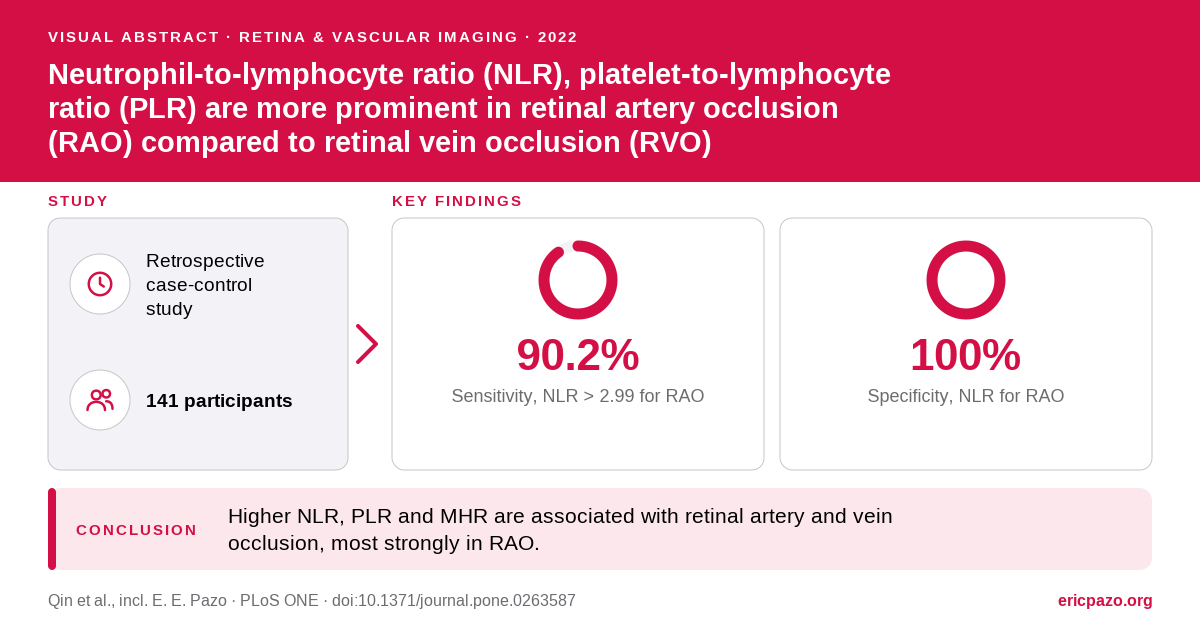
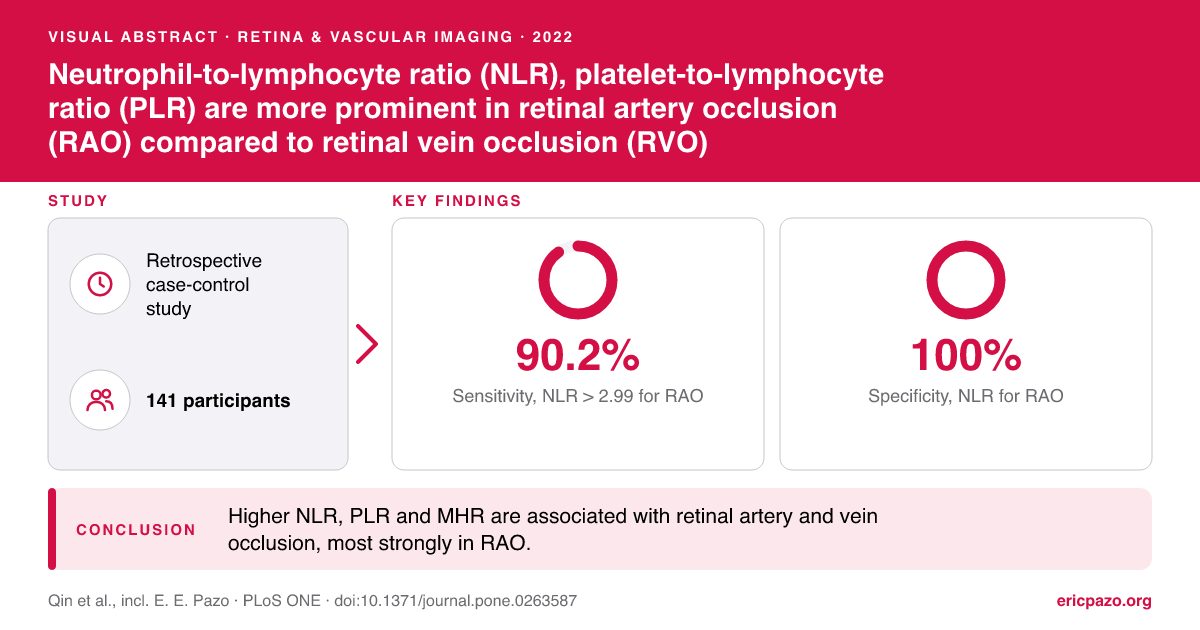
Higher NLR, PLR and MHR are associated with retinal artery and vein occlusion, most strongly in RAO.
- Design
- Retrospective case-control study
- Sample
- 141 participants
- Sensitivity, NLR > 2.99 for RAO
- 90.2%
- Specificity, NLR for RAO
- 100%
Abstract
AIM: To evaluate the association between the value of neutrophil to lymphocyte ratio (NLR), platelet to lymphocyte ratio (PLR), monocyte to high-density lipoprotein ratio (MHR) and the development of retinal artery occlusion (RAO) and retinal vein occlusion (RVO). METHODS: This retrospective study assessed 41 RAO, 50 RVO and 50 control (age and gender matched senile cataract) participants. The NLR, PLR and MHR parameters of patients' peripheral blood were analyzed. A receiver operating characteristics (ROC) curve analysis and the best cutoff value were used to specify the predictive value of NLR, PLR and MHR in RAO and RVO. RESULTS: The NLR, PLR and MHR were significantly higher in RAO group compared to the control group (p<0.001, p<0.001 and p = 0.008; respectively). The NLR, PLR and MHR were also significantly higher in the RVO group compared to the control group (p<0.001, p = 0.001 and p = 0.012, respectively). The NLR and PLR were significantly higher in the RAO group compared to the RVO group (p<0.001 and p = 0.022, respectively). The optimal cut-off value of NLR to predict RAO was >2.99, with 90.2% sensitivity and 100% specificity. The PLR to predict RAO was > 145.52, with 75.6% sensitivity and 80.0% specificity. CONCLUSION: Higher NLR, PLR and MHR are related to the occurrence of RAO and RVO. NLR and PLR are more prominent in RAO compared to RVO.
Keywords: neutrophil-to-lymphocyte ratio; platelet-to-lymphocyte ratio; monocyte-to-HDL cholesterol ratio; retinal artery occlusion; retinal vein occlusion; inflammatory markers; peripheral blood; diagnostic thresholds
Access
How to cite
Show BibTeX
@article{qin2022neutrophil,
  title = {{Neutrophil-to-lymphocyte ratio (NLR), platelet-to-lymphocyte ratio (PLR) are more prominent in retinal artery occlusion (RAO) compared to retinal vein occlusion (RVO)}},
  author = {Qin, Guanghao and He, Fang and Zhang, Hongda and Pazo, Emmanuel Eric and Dai, Guangzheng and Yao, Qingchi and He, Wei and Xu, Ling and Lin, Tiezhu},
  journal = {PLoS ONE},
  year = {2022},
  doi = {10.1371/journal.pone.0263587},
  url = {https://doi.org/10.1371/journal.pone.0263587},
}
Related work
- Association between mean ocular perfusion pressure and proliferative diabetic retinopathy in a northern Chinese population (2026)
- Association of Anti-VEGF Knowledge and Attitudes With Self-Reported Treatment Interruption: A Temporally Separated Classification Study (2026)
- Automated deep learning-based retinoschisis and detachment volume measurement in pathological myopia with posterior scleral contraction (2026)
- Development of a predictive model based on aqueous cytokines data for response to anti-VEGF therapy in diabetic macular edema (2026)
- Repeatability of cone photoreceptor metrics with a commercial adaptive optics scanning laser ophthalmoscopy (Mona II) in healthy adults (2026)