
Association of Anti-VEGF Knowledge and Attitudes With Self-Reported Treatment Interruption: A Temporally Separated Classification Study
Zhanhe Zhang, Liangzhang Tan, Qi Qi, Yongtao Li, Xiangying Liu, Qian Zhang, Xiang Li, Muhammad Usama, Emmanuel Eric Pazo, Xinjun Ren
Retina & vascular imagingAI & deep learning
At a glance
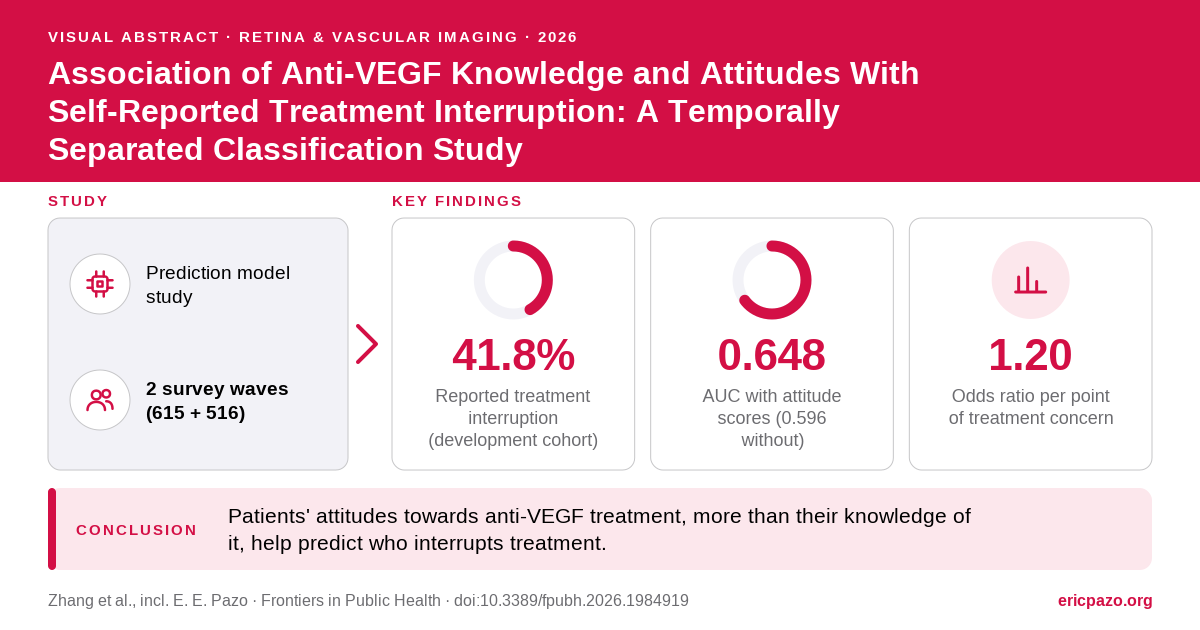
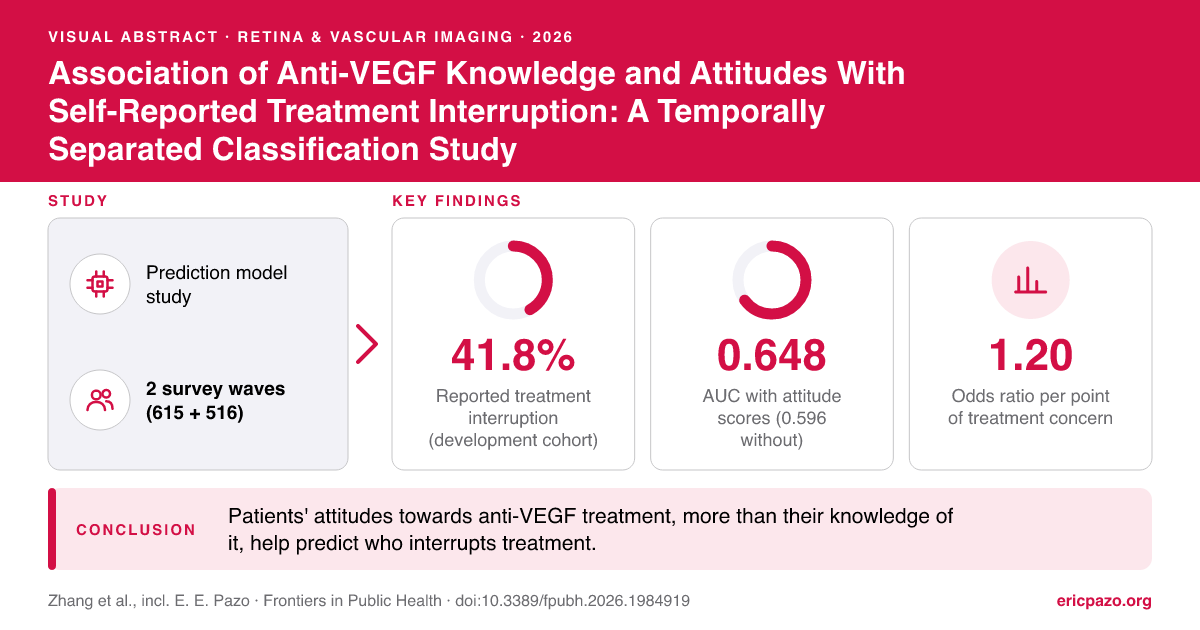
Patients' attitudes towards anti-VEGF treatment, more than their knowledge of it, help predict who interrupts treatment.
- Design
- Prediction model study
- Sample
- 2 survey waves (615 + 516)
- Reported treatment interruption (development cohort)
- 41.8%
- AUC with attitude scores (0.596 without)
- 0.648
- Odds ratio per point of treatment concern
- 1.20
Abstract
Purpose: To determine whether anti–vascular endothelial growth factor (anti-VEGF) knowledge and attitude scores predict treatment interruption beyond sociodemographic and clinical characteristics. Methods: Temporally separated prediction-model development and validation study. Two survey waves were analyzed independently. The later wave (n=615) was used for development and the earlier wave (n=516) for temporal validation. The outcome was self-reported delay or interruption of anti-VEGF follow-up or treatment during the preceding year. Nine classification algorithms compared clinical predictors alone with models additionally including total knowledge, Positive Treatment Attitude, and Treatment Concern Attitude scores. Performance was assessed using area under the receiver operating characteristic curve (AUC), Brier score, calibration, and decision-curve analysis. Associations were examined using multivariable logistic regression and SHapley Additive exPlanations. Results: Treatment interruption was reported by 41.8% and 29.5% of the development and validation cohorts, respectively. Questionnaire scores improved external discrimination across all nine algorithms. Logistic regression AUC increased from 0.596 to 0.648 (ΔAUC=0.052; P=.006), and random forest AUC increased from 0.591 to 0.647 (ΔAUC=0.056; P<.001). Treatment Concern Attitude was associated with higher interruption odds (OR, 1.20 per point; 95% CI, 1.12-1.29), whereas Positive Treatment Attitude was associated with lower odds (OR, 0.89; 95% CI, 0.83-0.95). Knowledge score was not independently associated. At the Youden threshold, logistic regression achieved 0.82 sensitivity and 0.40 specificity. Conclusions: Anti-VEGF treatment attitudes provided incremental information about self-reported treatment interruption beyond routine characteristics. Treatment concerns and positive attitudes may help identify patients for targeted adherence support, although prospective multicenter validation and recalibration are required.
Keywords: anti-VEGF; Intravitreal Injections; Knowledge, attitudes, and practices; machine learning; Prediction models; treatment interruption
Access
How to cite
Show BibTeX
@article{zhang2026association,
  title = {{Association of Anti-VEGF Knowledge and Attitudes With Self-Reported Treatment Interruption: A Temporally Separated Classification Study}},
  author = {Zhang, Zhanhe and Tan, Liangzhang and Qi, Qi and Li, Yongtao and Liu, Xiangying and Zhang, Qian and Li, Xiang and Usama, Muhammad and Pazo, Emmanuel Eric and Ren, Xinjun},
  journal = {Frontiers in Public Health},
  year = {2026},
  doi = {10.3389/fpubh.2026.1984919},
  url = {https://doi.org/10.3389/fpubh.2026.1984919},
}
Related work
- Automated deep learning-based retinoschisis and detachment volume measurement in pathological myopia with posterior scleral contraction (2026)
- Development of a predictive model based on aqueous cytokines data for response to anti-VEGF therapy in diabetic macular edema (2026)
- Structure-preserving super-resolution of retinal fundus images via a dual-transformer residual network (2026)
- Validation of the Eyerobo FC Portable Fundus Camera for Diabetic Retinopathy Screening Using Public Datasets and Deep Learning (2026)
- Exploring the effect of hypertension on retinal microvasculature using deep learning on East Asian population (2020)