
Les rapports neutrophiles/lymphocytes (NLR) et plaquettes/lymphocytes (PLR) sont plus élevés dans l'occlusion artérielle rétinienne (OAR) que dans l'occlusion veineuse rétinienne (OVR)
Titre original : Neutrophil-to-lymphocyte ratio (NLR), platelet-to-lymphocyte ratio (PLR) are more prominent in retinal artery occlusion (RAO) compared to retinal vein occlusion (RVO)
Guanghao Qin, Fang He, Hongda Zhang, Emmanuel Eric Pazo, Guangzheng Dai, Qingchi Yao, Wei He, Ling Xu, Tiezhu Lin
 PLoS ONE, 2022 · article · doi:10.1371/journal.pone.0263587 · cité 20 fois · Accès libre (CC BY)
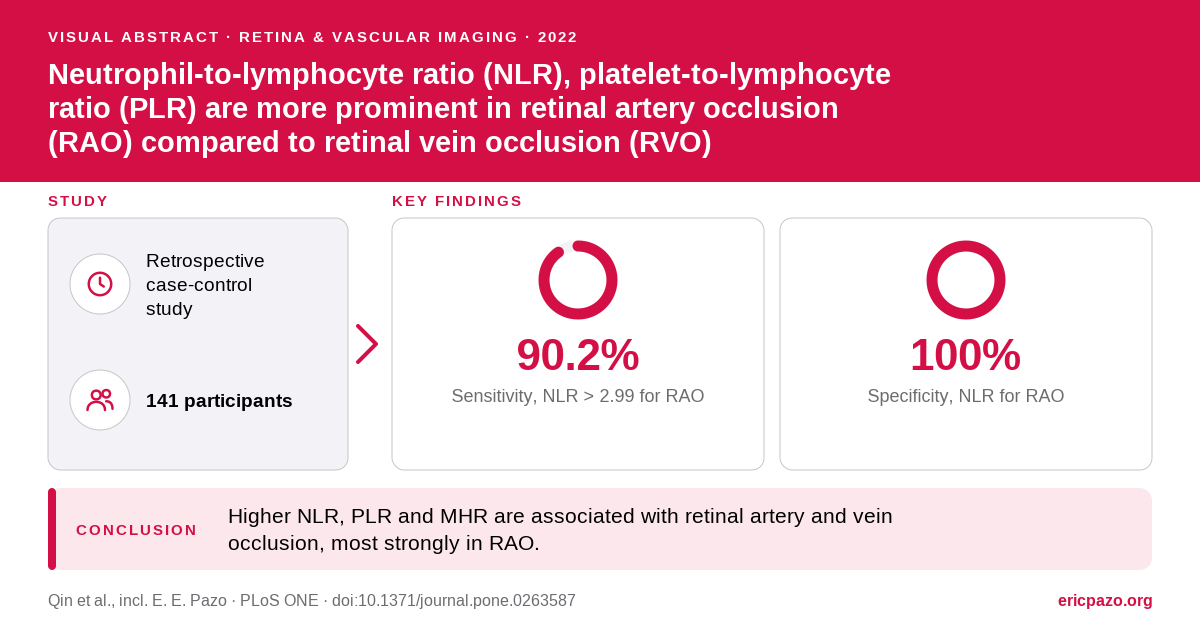
En bref
Des NLR, PLR et MHR plus élevés sont associés aux occlusions artérielles et veineuses rétiniennes, le plus fortement dans l'OAR.
- Type d'étude
- Étude cas-témoins rétrospective
- Échantillon
- 141 participants
- Sensibilité, NLR > 2.99 pour l'OAR
- 90.2%
- Spécificité, NLR pour l'OAR
- 100%
Résumé
OBJECTIF : Évaluer l'association entre les valeurs du rapport neutrophiles/lymphocytes (NLR), du rapport plaquettes/lymphocytes (PLR) et du rapport monocytes/lipoprotéines de haute densité (MHR) et la survenue d'une occlusion artérielle rétinienne (OAR) ou d'une occlusion veineuse rétinienne (OVR). MÉTHODES : Cette étude rétrospective a évalué 41 participants atteints d'OAR, 50 atteints d'OVR et 50 témoins (cataracte sénile, appariés sur l'âge et le sexe). Les paramètres NLR, PLR et MHR du sang périphérique des patients ont été analysés. Une analyse par courbes ROC et le meilleur seuil ont servi à déterminer la valeur prédictive du NLR, du PLR et du MHR dans l'OAR et l'OVR. RÉSULTATS : Le NLR, le PLR et le MHR étaient significativement plus élevés dans le groupe OAR que dans le groupe témoin (p<0.001, p<0.001 et p = 0.008, respectivement). Ils étaient également significativement plus élevés dans le groupe OVR que dans le groupe témoin (p<0.001, p = 0.001 et p = 0.012, respectivement). Le NLR et le PLR étaient significativement plus élevés dans le groupe OAR que dans le groupe OVR (p<0.001 et p = 0.022, respectivement). Le seuil optimal du NLR pour prédire l'OAR était >2.99, avec une sensibilité de 90.2 % et une spécificité de 100 %. Celui du PLR était > 145.52, avec une sensibilité de 75.6 % et une spécificité de 80.0 %. CONCLUSION : Des valeurs plus élevées de NLR, PLR et MHR sont liées à la survenue d'une OAR et d'une OVR. Le NLR et le PLR sont plus élevés dans l'OAR que dans l'OVR.
Traduit du résumé original en anglais (licence : CC BY).
Afficher le résumé original
AIM: To evaluate the association between the value of neutrophil to lymphocyte ratio (NLR), platelet to lymphocyte ratio (PLR), monocyte to high-density lipoprotein ratio (MHR) and the development of retinal artery occlusion (RAO) and retinal vein occlusion (RVO). METHODS: This retrospective study assessed 41 RAO, 50 RVO and 50 control (age and gender matched senile cataract) participants. The NLR, PLR and MHR parameters of patients' peripheral blood were analyzed. A receiver operating characteristics (ROC) curve analysis and the best cutoff value were used to specify the predictive value of NLR, PLR and MHR in RAO and RVO. RESULTS: The NLR, PLR and MHR were significantly higher in RAO group compared to the control group (p<0.001, p<0.001 and p = 0.008; respectively). The NLR, PLR and MHR were also significantly higher in the RVO group compared to the control group (p<0.001, p = 0.001 and p = 0.012, respectively). The NLR and PLR were significantly higher in the RAO group compared to the RVO group (p<0.001 and p = 0.022, respectively). The optimal cut-off value of NLR to predict RAO was >2.99, with 90.2% sensitivity and 100% specificity. The PLR to predict RAO was > 145.52, with 75.6% sensitivity and 80.0% specificity. CONCLUSION: Higher NLR, PLR and MHR are related to the occurrence of RAO and RVO. NLR and PLR are more prominent in RAO compared to RVO.
Mots-clés : neutrophil-to-lymphocyte ratio; platelet-to-lymphocyte ratio; monocyte-to-HDL cholesterol ratio; retinal artery occlusion; retinal vein occlusion; inflammatory markers; peripheral blood; diagnostic thresholds
Accès
Comment citer
Afficher le BibTeX
@article{qin2022neutrophil,
  title = {{Neutrophil-to-lymphocyte ratio (NLR), platelet-to-lymphocyte ratio (PLR) are more prominent in retinal artery occlusion (RAO) compared to retinal vein occlusion (RVO)}},
  author = {Qin, Guanghao and He, Fang and Zhang, Hongda and Pazo, Emmanuel Eric and Dai, Guangzheng and Yao, Qingchi and He, Wei and Xu, Ling and Lin, Tiezhu},
  journal = {PLoS ONE},
  year = {2022},
  doi = {10.1371/journal.pone.0263587},
  url = {https://doi.org/10.1371/journal.pone.0263587},
}
Travaux liés
- Association entre la pression de perfusion oculaire moyenne et la rétinopathie diabétique proliférante dans une population du nord de la Chine (2026)
- Association des connaissances et des attitudes vis-à-vis du traitement anti-VEGF avec l'interruption autodéclarée du traitement : une étude de classification à séparation temporelle (2026)
- Mesure automatisée par apprentissage profond du volume de rétinoschisis et de décollement dans la myopie pathologique avec contraction sclérale postérieure (2026)
- Développement d'un modèle prédictif fondé sur les cytokines de l'humeur aqueuse pour la réponse au traitement anti-VEGF dans l'œdème maculaire diabétique (2026)
- Répétabilité des mesures des photorécepteurs à cônes avec une ophtalmoscopie laser à balayage en optique adaptative commerciale (Mona II) chez des adultes en bonne santé (2026)