
Efficacité et sécurité à long terme de la vitréolyse au laser YAG dans les myodésopsies dégradant la vision
Titre original : Long-term efficacy and safety of YAG laser vitreolysis for vision degrading myodesopsia
Tiezhu Lin, Xing Yang, Emmanuel Eric Pazo, Yan-Nian Hui, Li-Jun Shen
 International Journal of Ophthalmology, 2023 · article · doi:10.18240/ijo.2023.11.10 · cité 1 fois · Accès libre (CC BY-NC-ND)
En bref
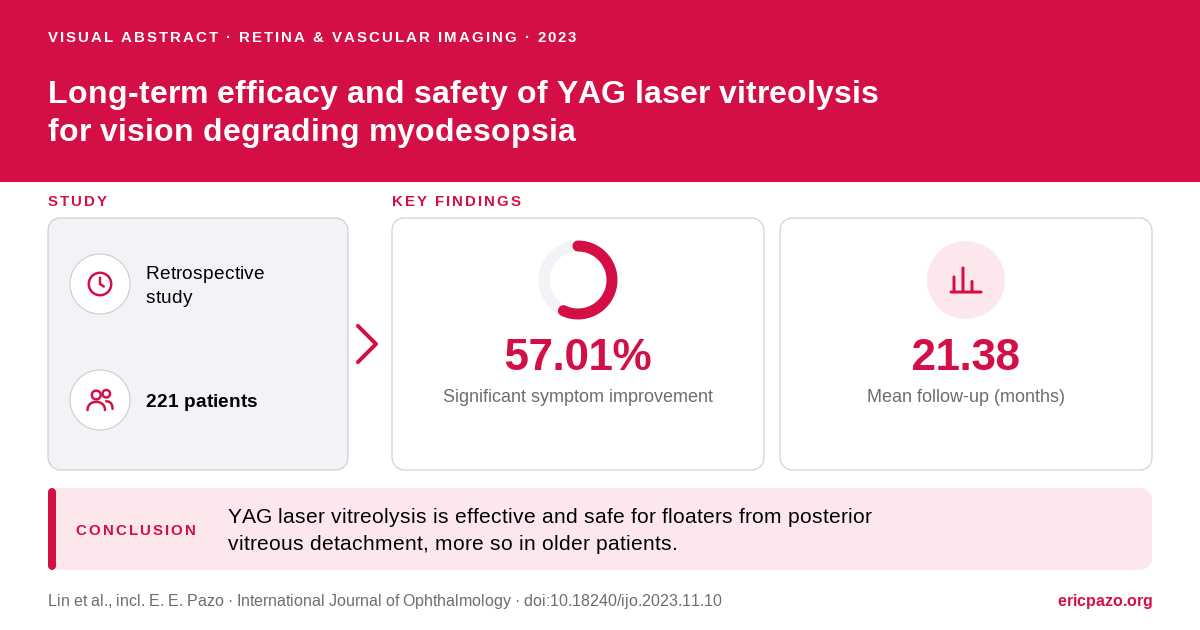
La vitréolyse au laser YAG est efficace et sûre pour les corps flottants liés au décollement postérieur du vitré, davantage chez les patients âgés.
- Type d'étude
- Étude rétrospective
- Échantillon
- 221 patients
- Amélioration significative des symptômes
- 57.01%
- Suivi moyen (mois)
- 21.38
Résumé
Ce résumé est affiché dans sa langue d'origine, l'anglais, car la licence de l'article (CC BY-NC-ND) ne permet pas de publier des traductions.
AIM: To assess the long-term efficacy and safety of yttrium-aluminum garnet (YAG) laser vitreolysis for vision degrading myodesopsia (VDM) caused by posterior vitreous detachment (PVD). METHODS: This retrospective study reviewed VDM patients of PVD type undergoing YAG laser vitreolysis. The baseline demographic information, the patterns of floaters, the number of floaters, and the subjective improvement of floater sympotoms (ranging from 0 to 100%) from medical records were collected. Significant improvement was defined as a relief of floater symptoms of ≥50% at the final visit. The long-term efficacy and safety of YAG laser vitreolysis were analyzed. The risk factors linked to significant improvement of floater symptoms were defined using univariate and multivariate logistic regression analyses. RESULTS: The final analysis included 221 patients with VDM. The mean age of patients was 61.08±7.74y, and the mean length of follow-up was 21.38±5.61mo. Totally 57.01% of patients experienced a significant improvement in their floater symptoms after YAG laser therapy, and none of them developed delayed retinal abnormalities such as retinal tears or detachments. Age (OR=1.049, 95%CI=1.007-1.092, P=0.021) was identified as a significant risk factor for significant improvement in VDM. CONCLUSION: YAG laser vitreolysis is an effective and secure treatment for PVD-type VDM, and patients of advanced age are more likely to get favorable outcomes.
Mots-clés : posterior vitreous detachment; vitreous opacities; long-term efficacy; treatment safety; retinal tears; retinal detachment; age as risk factor
Accès
Comment citer
Afficher le BibTeX
@article{lin2023long,
  title = {{Long-term efficacy and safety of YAG laser vitreolysis for vision degrading myodesopsia}},
  author = {Lin, Tiezhu and Yang, Xing and Pazo, Emmanuel Eric and Hui, Yan-Nian and Shen, Li-Jun},
  journal = {International Journal of Ophthalmology},
  year = {2023},
  doi = {10.18240/ijo.2023.11.10},
  url = {https://doi.org/10.18240/ijo.2023.11.10},
}
Travaux liés
- Association entre la pression de perfusion oculaire moyenne et la rétinopathie diabétique proliférante dans une population du nord de la Chine (2026)
- Association des connaissances et des attitudes vis-à-vis du traitement anti-VEGF avec l'interruption autodéclarée du traitement : une étude de classification à séparation temporelle (2026)
- Mesure automatisée par apprentissage profond du volume de rétinoschisis et de décollement dans la myopie pathologique avec contraction sclérale postérieure (2026)
- Développement d'un modèle prédictif fondé sur les cytokines de l'humeur aqueuse pour la réponse au traitement anti-VEGF dans l'œdème maculaire diabétique (2026)
- Répétabilité des mesures des photorécepteurs à cônes avec une ophtalmoscopie laser à balayage en optique adaptative commerciale (Mona II) chez des adultes en bonne santé (2026)