
Eficacia y seguridad a largo plazo de la vitreólisis con láser YAG en la miodesopsia con degradación visual
Título original: Long-term efficacy and safety of YAG laser vitreolysis for vision degrading myodesopsia
Tiezhu Lin, Xing Yang, Emmanuel Eric Pazo, Yan-Nian Hui, Li-Jun Shen
 International Journal of Ophthalmology, 2023 · artículo · doi:10.18240/ijo.2023.11.10 · citado 1 vez · Acceso abierto (CC BY-NC-ND)
De un vistazo
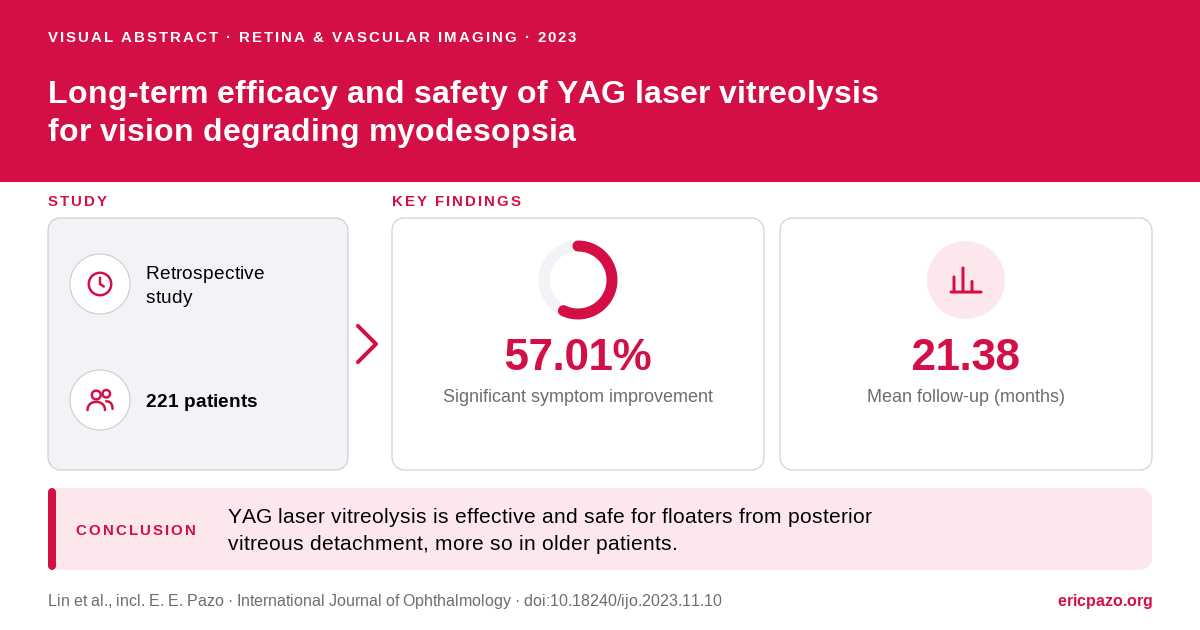
La vitreólisis con láser YAG es eficaz y segura para las miodesopsias por desprendimiento posterior del vítreo, sobre todo en pacientes de más edad.
- Diseño
- Estudio retrospectivo
- Muestra
- 221 pacientes
- Mejora significativa de los síntomas
- 57.01%
- Seguimiento medio (meses)
- 21.38
Resumen
Este resumen se muestra en su idioma original, el inglés, porque la licencia del artículo (CC BY-NC-ND) no permite publicar traducciones.
AIM: To assess the long-term efficacy and safety of yttrium-aluminum garnet (YAG) laser vitreolysis for vision degrading myodesopsia (VDM) caused by posterior vitreous detachment (PVD). METHODS: This retrospective study reviewed VDM patients of PVD type undergoing YAG laser vitreolysis. The baseline demographic information, the patterns of floaters, the number of floaters, and the subjective improvement of floater sympotoms (ranging from 0 to 100%) from medical records were collected. Significant improvement was defined as a relief of floater symptoms of ≥50% at the final visit. The long-term efficacy and safety of YAG laser vitreolysis were analyzed. The risk factors linked to significant improvement of floater symptoms were defined using univariate and multivariate logistic regression analyses. RESULTS: The final analysis included 221 patients with VDM. The mean age of patients was 61.08±7.74y, and the mean length of follow-up was 21.38±5.61mo. Totally 57.01% of patients experienced a significant improvement in their floater symptoms after YAG laser therapy, and none of them developed delayed retinal abnormalities such as retinal tears or detachments. Age (OR=1.049, 95%CI=1.007-1.092, P=0.021) was identified as a significant risk factor for significant improvement in VDM. CONCLUSION: YAG laser vitreolysis is an effective and secure treatment for PVD-type VDM, and patients of advanced age are more likely to get favorable outcomes.
Palabras clave: posterior vitreous detachment; vitreous opacities; long-term efficacy; treatment safety; retinal tears; retinal detachment; age as risk factor
Acceso
Cómo citar
Mostrar BibTeX
@article{lin2023long,
  title = {{Long-term efficacy and safety of YAG laser vitreolysis for vision degrading myodesopsia}},
  author = {Lin, Tiezhu and Yang, Xing and Pazo, Emmanuel Eric and Hui, Yan-Nian and Shen, Li-Jun},
  journal = {International Journal of Ophthalmology},
  year = {2023},
  doi = {10.18240/ijo.2023.11.10},
  url = {https://doi.org/10.18240/ijo.2023.11.10},
}
Trabajos relacionados
- Asociación entre la presión de perfusión ocular media y la retinopatía diabética proliferativa en una población del norte de China (2026)
- Asociación de los conocimientos y actitudes sobre el tratamiento anti-VEGF con la interrupción autodeclarada del tratamiento: un estudio de clasificación con separación temporal (2026)
- Medición automatizada basada en aprendizaje profundo del volumen de retinosquisis y desprendimiento en la miopía patológica con contracción escleral posterior (2026)
- Desarrollo de un modelo predictivo basado en datos de citocinas del humor acuoso para la respuesta al tratamiento anti-VEGF en el edema macular diabético (2026)
- Repetibilidad de las métricas de fotorreceptores de tipo cono con una oftalmoscopia láser de barrido con óptica adaptativa comercial (Mona II) en adultos sanos (2026)