
Effets du collyre de diquafosol sodique sur la métallopeptidase matricielle 9 du film lacrymal et la densité nerveuse cornéenne chez les patients atteints de sécheresse oculaire liée au diabète de type 2
Titre original : Effects of Diquafosol Sodium Ophthalmic Solution on Tear Film Matrix Metallopeptidase-9 and Corneal Nerve Density in Patients with Type 2 Diabetic Dry Eye
Guanghao Qin, Jiayan Chen, Liangzhe Li, Yifan Qi, Yimeng Chen, Qing Zhang, Yi Wu, Yue You, Lanting Yang, Naici Guo, Salissou Moutari, Shaochong Bu, Jonathan Edward Moore, Ling Xu, Wei He, Sile Yu, Xingru He, Emmanuel Eric Pazo
 Journal of Ocular Pharmacology and Therapeutics, 2023 · article · doi:10.1089/jop.2023.0098 · cité 10 fois
Surface oculaire et sécheresse oculaire
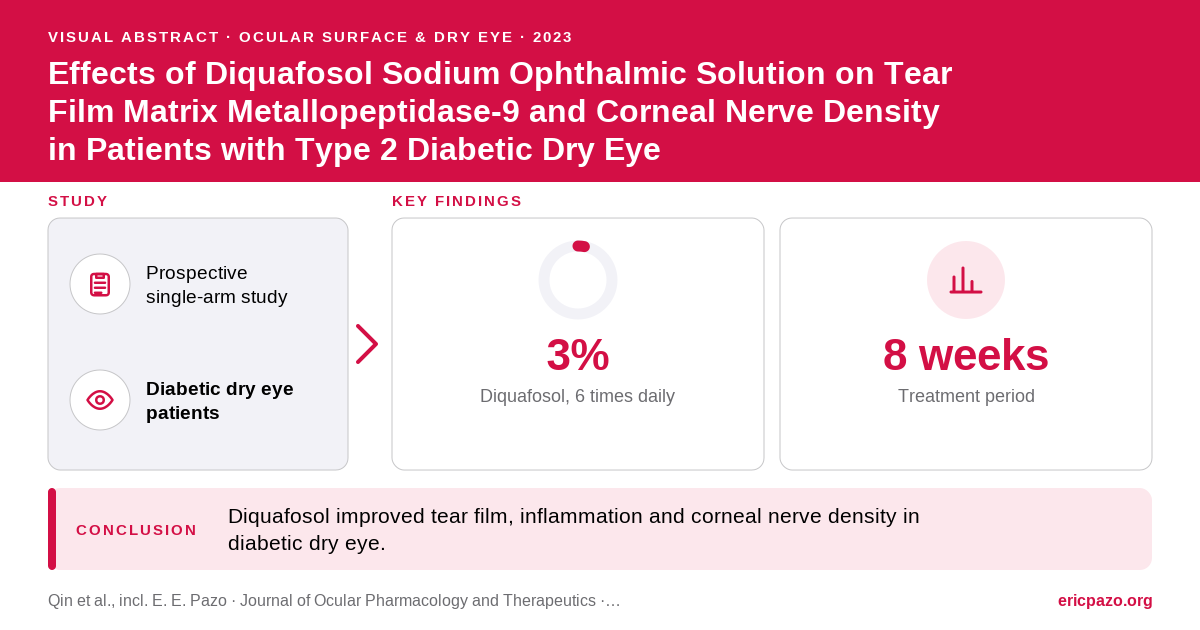
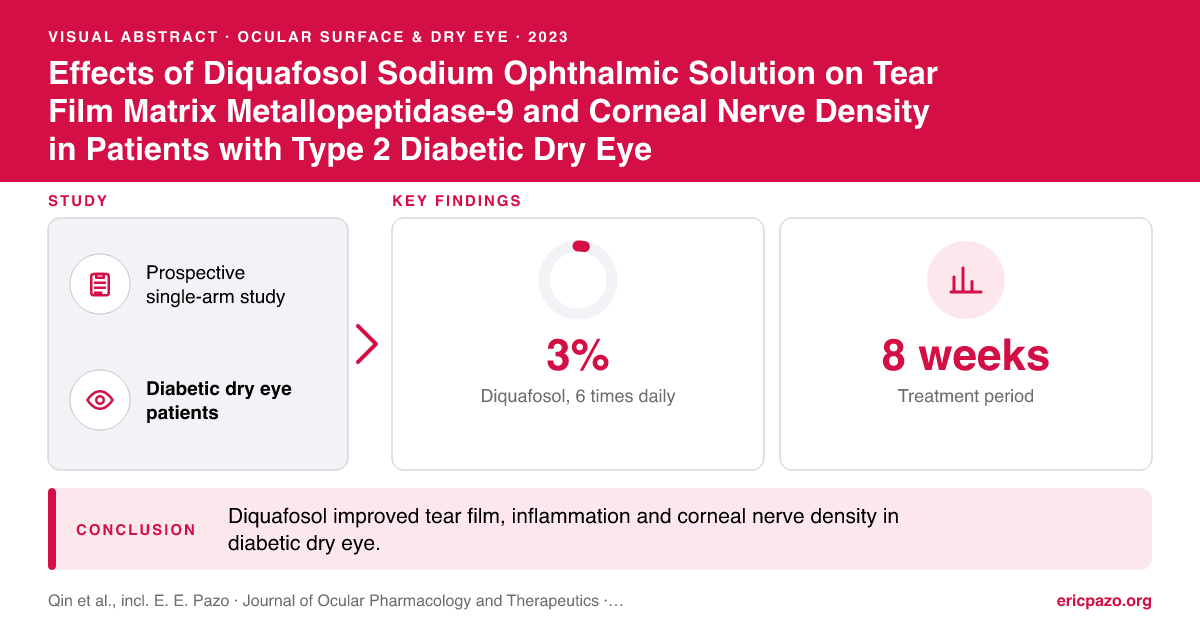
En bref
Le diquafosol a amélioré le film lacrymal, l'inflammation et la densité nerveuse cornéenne dans la sécheresse oculaire du diabétique.
- Type d'étude
- Étude prospective à bras unique
- Échantillon
- Patients diabétiques atteints de sécheresse oculaire
- Diquafosol, 6 fois par jour
- 3%
- Durée du traitement
- 8 weeks
Résumé
Ce résumé est affiché dans sa langue d'origine, l'anglais, car l'article n'est pas publié sous une licence ouverte autorisant les traductions.
Purpose: Diabetes mellitus has been associated with increased dry eye disease (DED) and exacerbates DED's pathology. This preliminary short-term study aimed to evaluate the effects of 3% Diquafosol Sodium ophthalmic solution (DQS) on ocular surface inflammation and corneal nerve density in diabetic dry eye (DDE) patients. Methods: In this perspective, participants used 1 drop of 3% DQS (Diquas; Santen Pharmaceutical Co., Ltd., Osaka, Japan) 6 times daily for 8 weeks. Non-invasive tear breakup time (NITBUT), tear film lipid layer (TFLL), conjunctival hyperemia [redness score (RS)], corneoconjunctival staining (CFS), corneal sensitivity (CS), Meibomian gland quality (MGQ) and Meibomian gland expressibility (MGEx), corneal nerve fiber density (CNFD), and Standard Patient Evaluation Eye Dryness (SPEED) questionnaire were assessed at baseline, at weeks 4, and up to 8 weeks. Matrix metalloproteinase-9 (MMP-9) of tear samples was measured at baseline and weeks 8. Results: The mean age was 61.27 ± 11.68 years. At baseline NITBUT = 5.89 ± 2.81 s, tear meniscus height = 0.17 ± 0.05 mm, TFLL = 2.74 ± 0.51, CFS = 4.35 ± 0.68, CS = 53.83 ± 9.63 mm, MMP-9 = 49.10 ± 10.42 ng/mL, RS = 1.65 ± 0.44, MGEx = 1.85 ± 0.72, MGQ = 2.65 ± 0.50, CNFD = 20.36 ± 8.20 no./mm 2 , and SPEED = 12.62 ± 3.91. At week 4, significant improvements were found in all parameters except RS (1.59 ± 0.46, P = 0.172) and CNFD (21.46 ± 8.41, P = 0.163). Finally, at week 8, all parameters had significant improvements. Conclusion: Preliminary short-term findings suggest that treatment of DDE patients with DQS was found to be safe and efficacious in improving dry eye parameters. In addition, inflammatory marker and corneal nerve density were significantly improved. This study was registered with ClinicalTrials.gov (NCT05193331).
Mots-clés : type 2 diabetes; MMP-9; corneal nerve fiber density; corneal innervation; tear film; ocular surface inflammation; meibomian gland dysfunction; tear film lipid layer
Accès
Comment citer
Afficher le BibTeX
@article{qin2023effects,
  title = {{Effects of Diquafosol Sodium Ophthalmic Solution on Tear Film Matrix Metallopeptidase-9 and Corneal Nerve Density in Patients with Type 2 Diabetic Dry Eye}},
  author = {Qin, Guanghao and Chen, Jiayan and Li, Liangzhe and Qi, Yifan and Chen, Yimeng and Zhang, Qing and Wu, Yi and You, Yue and Yang, Lanting and Guo, Naici and Moutari, Salissou and Bu, Shaochong and Moore, Jonathan Edward and Xu, Ling and He, Wei and Yu, Sile and He, Xingru and Pazo, Emmanuel Eric},
  journal = {Journal of Ocular Pharmacology and Therapeutics},
  year = {2023},
  doi = {10.1089/jop.2023.0098},
  url = {https://doi.org/10.1089/jop.2023.0098},
}
Travaux liés
- Analyse de l'influence de l'espace au bord du volet sur la régénération des nerfs cornéens après LASIK assisté par laser femtoseconde (2026)
- Comparaison des effets de la lumière pulsée intense et de l'hygiène palpébrale sur le film lacrymal et la surface oculaire : une étude contrôlée randomisée (2026)
- Effects of 3% diquafosol sodium on tear film stability, corneal aberration parameters, and vision-related quality of life in pediatric orthokeratology-associated dry eye disease (2026)
- Association entre l'indice de masse corporelle maternel avant la grossesse et l'astigmatisme et la courbure cornéenne de l'enfant : une étude transversale (2025)
- Expression différentielle de la lymphotoxine α, de l'immunoglobuline E et de la métalloprotéinase matricielle 9 lacrymales dans la sécheresse oculaire associée à la conjonctivite allergique (2025)