
Valeur pronostique de la classification de la rétinopathie diabétique proliférante de la Chinese Ocular Fundus Diseases Society sur l'acuité visuelle après vitrectomie par la pars plana dans le diabète de type 2
Titre original : Prognosis value of Chinese Ocular Fundus Diseases Society classification for proliferative diabetic retinopathy on postoperative visual acuity after pars plana vitrectomy in type 2 diabetes
Tiezhu Lin, Cheng Shi, Emmanuel Eric Pazo, Guangzheng Dai, Xianwei Wu, Ling Xu, Lijun Shen
 International Journal of Ophthalmology, 2022 · article · doi:10.18240/ijo.2022.10.10 · cité 8 fois · Accès libre (CC BY-NC-ND)
En bref
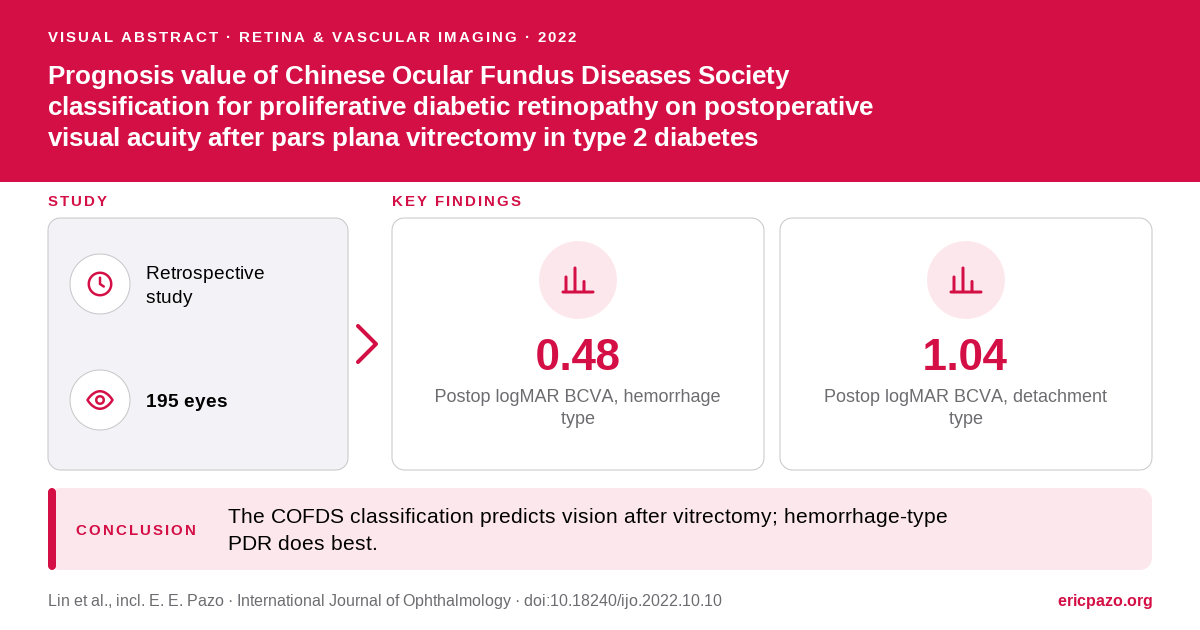
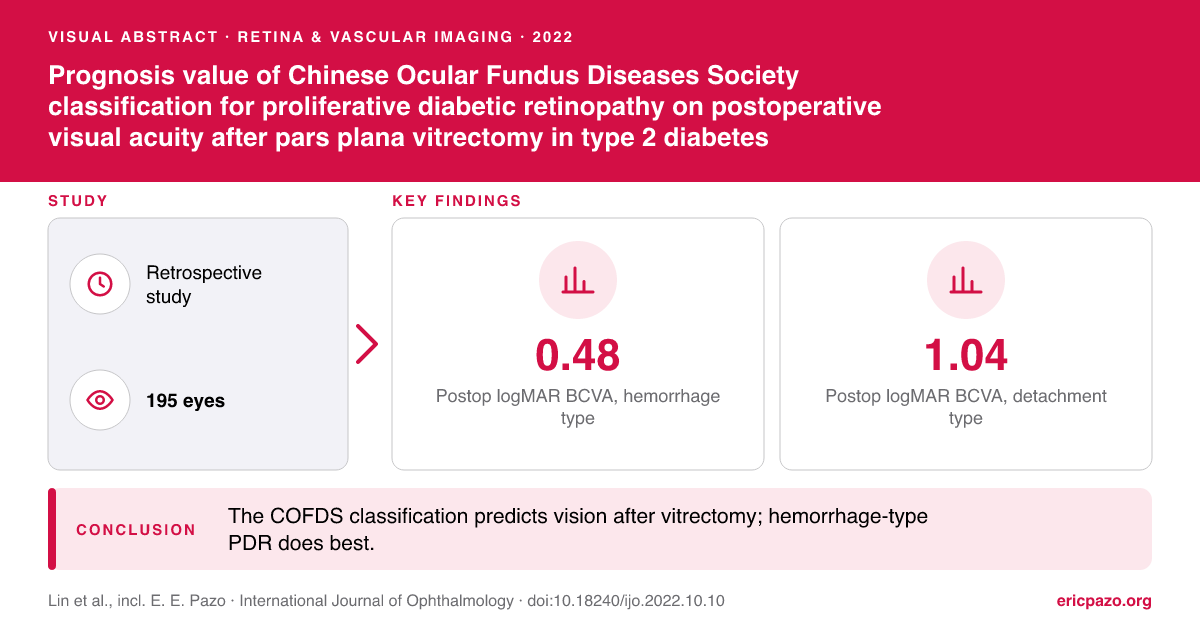
La classification COFDS prédit la vision après vitrectomie ; la RDP de type hémorragique a le meilleur pronostic.
- Type d'étude
- Étude rétrospective
- Échantillon
- 195 yeux
- MAVC logMAR postopératoire, type hémorragique
- 0.48
- MAVC logMAR postopératoire, type décollement
- 1.04
Résumé
Ce résumé est affiché dans sa langue d'origine, l'anglais, car la licence de l'article (CC BY-NC-ND) ne permet pas de publier des traductions.
AIM: To compare the postoperative visual acuity among eyes with proliferative diabetic retinopathy (PDR) of different stages after pars plana vitrectomy (PPV) in type 2 diabetic patients. METHODS: A retrospective study was conducted for PDR eyes undergoing PPV in type 2 diabetic patients. All patients were divided into three groups based on Chinese Ocular Fundus Diseases Society (COFDS) classification for PDR: Group A (primary vitreous hemorrhage), Group B (primary fibrovascular proliferation) and Group C (primary vitreous hemorrhage and/or fibrovascular proliferative combined with retinal detachment). The postoperative visual acuity and the change between postoperative and preoperative visual acuity were compared among three groups. The associated risk factors for postoperative visual acuity were analyzed in the univariate and multiple linear aggression. RESULTS: In total, 195 eyes of 195 patients were collected in this study, including 71 eyes of 71 patients in Group A, 75 eyes of 75 patients in Group B and 49 eyes of 49 patients in Group C. The eyes in Group A got better postoperative best-corrected visual acuity (BCVA) compared to the eyes in Group B and C (0.48±0.48 vs 0.89±0.63, P<0.001; 0.48±0.48 vs 1.04±0.67, P<0.001; respectively). The eyes in Group A got more improvement of BCVA compared to the eyes in Group B and C (1.07±0.70 vs 0.73±0.68, P=0.004; 1.07±0.70 vs 0.77±0.78, P=0.024; respectively). In the multiple linear regression analysis, primary fibro-proliferative type (β=0.194, 95%CI=0.060-0.447, P=0.01), retinal detachment type (β=0.244, 95%CI=0.132-0.579, P=0.02), baseline logMAR BCVA (β=0.192, 95%CI=0.068-0.345, P=0.004), silicone oil tamponade (β=0.272, 95%CI=0.173-0.528, P<0.001) was positively correlated with postoperative logMAR BCVA. Eyes undergoing phacovitrectomy had better postoperative BCVA (β=-0.144, 95%CI=-0.389 to -0.027, P=0.025). CONCLUSION: PDR eyes of primary vitreous hemorrhage type usually have better visual acuity prognosis compared to primary fibrovascular proliferation type and retinal detachment type. COFDS classification for PDR may have a high prognostic value for postoperative visual outcome and surgical management indications.
Mots-clés : proliferative diabetic retinopathy; type 2 diabetes; pars plana vitrectomy; postoperative visual acuity; vitreous hemorrhage; fibrovascular proliferation; retinal detachment; prognostic factors
Accès
Comment citer
Afficher le BibTeX
@article{lin2022prognosis,
  title = {{Prognosis value of Chinese Ocular Fundus Diseases Society classification for proliferative diabetic retinopathy on postoperative visual acuity after pars plana vitrectomy in type 2 diabetes}},
  author = {Lin, Tiezhu and Shi, Cheng and Pazo, Emmanuel Eric and Dai, Guangzheng and Wu, Xianwei and Xu, Ling and Shen, Lijun},
  journal = {International Journal of Ophthalmology},
  year = {2022},
  doi = {10.18240/ijo.2022.10.10},
  url = {https://doi.org/10.18240/ijo.2022.10.10},
}
Travaux liés
- Association entre la pression de perfusion oculaire moyenne et la rétinopathie diabétique proliférante dans une population du nord de la Chine (2026)
- Association des connaissances et des attitudes vis-à-vis du traitement anti-VEGF avec l'interruption autodéclarée du traitement : une étude de classification à séparation temporelle (2026)
- Mesure automatisée par apprentissage profond du volume de rétinoschisis et de décollement dans la myopie pathologique avec contraction sclérale postérieure (2026)
- Développement d'un modèle prédictif fondé sur les cytokines de l'humeur aqueuse pour la réponse au traitement anti-VEGF dans l'œdème maculaire diabétique (2026)
- Répétabilité des mesures des photorécepteurs à cônes avec une ophtalmoscopie laser à balayage en optique adaptative commerciale (Mona II) chez des adultes en bonne santé (2026)