
Valor pronóstico de la clasificación de la retinopatía diabética proliferativa de la Chinese Ocular Fundus Diseases Society sobre la agudeza visual tras la vitrectomía pars plana en la diabetes tipo 2
Título original: Prognosis value of Chinese Ocular Fundus Diseases Society classification for proliferative diabetic retinopathy on postoperative visual acuity after pars plana vitrectomy in type 2 diabetes
Tiezhu Lin, Cheng Shi, Emmanuel Eric Pazo, Guangzheng Dai, Xianwei Wu, Ling Xu, Lijun Shen
 International Journal of Ophthalmology, 2022 · artículo · doi:10.18240/ijo.2022.10.10 · citado 8 veces · Acceso abierto (CC BY-NC-ND)
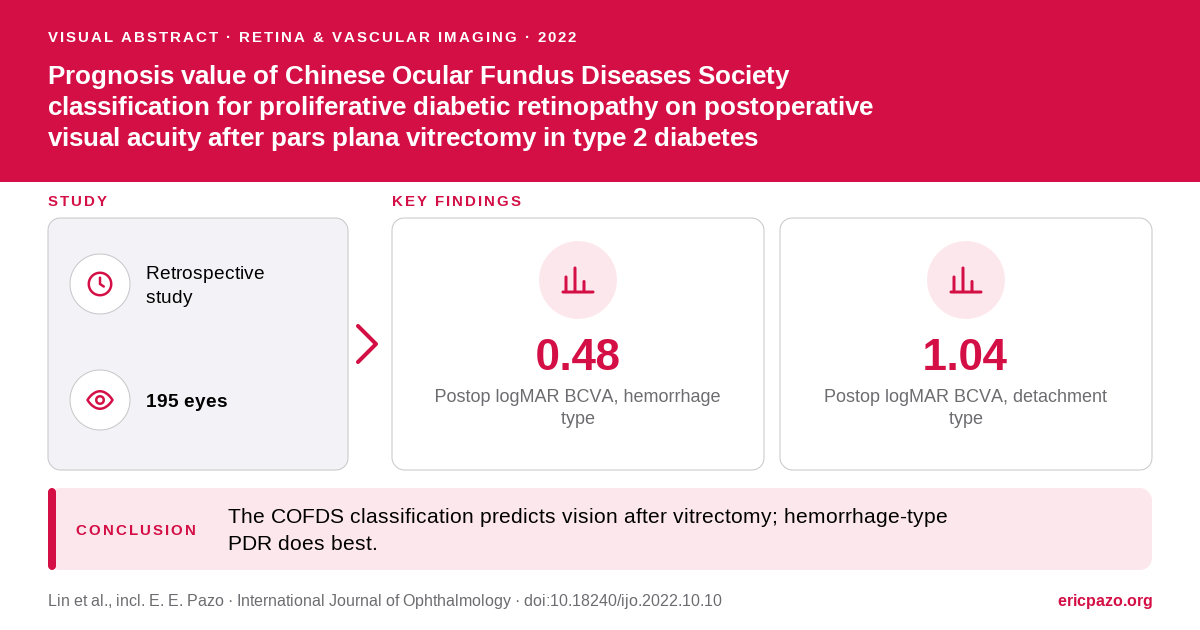
De un vistazo
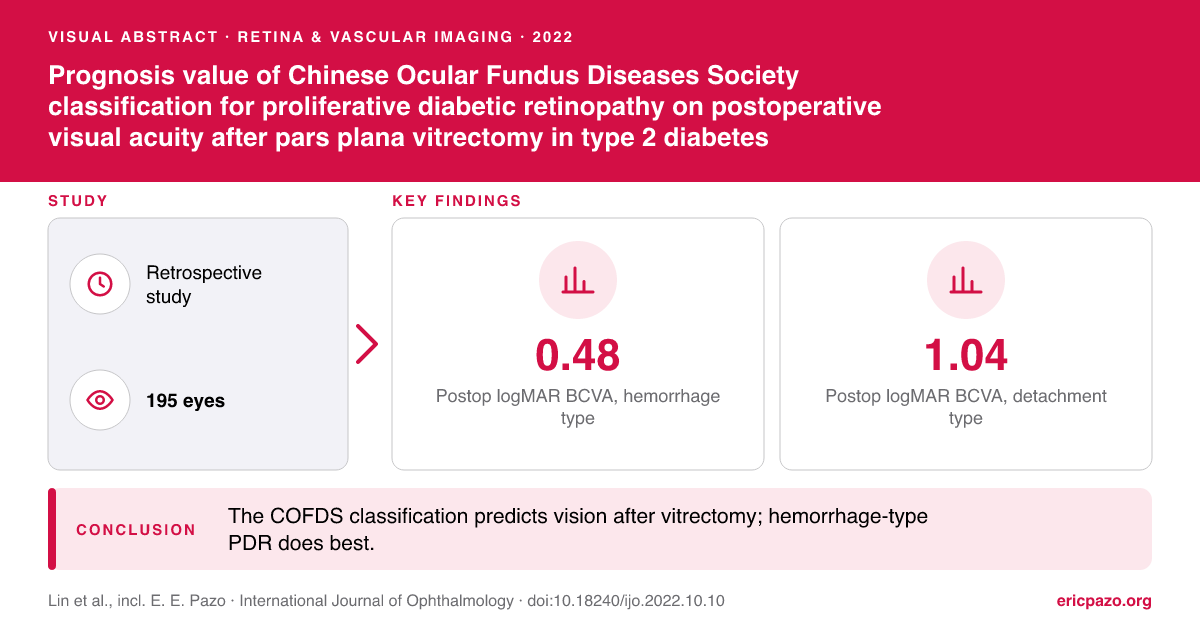
La clasificación COFDS predice la visión tras la vitrectomía; la RDP de tipo hemorrágico es la de mejor evolución.
- Diseño
- Estudio retrospectivo
- Muestra
- 195 ojos
- MAVC logMAR posoperatoria, tipo hemorrágico
- 0.48
- MAVC logMAR posoperatoria, tipo desprendimiento
- 1.04
Resumen
Este resumen se muestra en su idioma original, el inglés, porque la licencia del artículo (CC BY-NC-ND) no permite publicar traducciones.
AIM: To compare the postoperative visual acuity among eyes with proliferative diabetic retinopathy (PDR) of different stages after pars plana vitrectomy (PPV) in type 2 diabetic patients. METHODS: A retrospective study was conducted for PDR eyes undergoing PPV in type 2 diabetic patients. All patients were divided into three groups based on Chinese Ocular Fundus Diseases Society (COFDS) classification for PDR: Group A (primary vitreous hemorrhage), Group B (primary fibrovascular proliferation) and Group C (primary vitreous hemorrhage and/or fibrovascular proliferative combined with retinal detachment). The postoperative visual acuity and the change between postoperative and preoperative visual acuity were compared among three groups. The associated risk factors for postoperative visual acuity were analyzed in the univariate and multiple linear aggression. RESULTS: In total, 195 eyes of 195 patients were collected in this study, including 71 eyes of 71 patients in Group A, 75 eyes of 75 patients in Group B and 49 eyes of 49 patients in Group C. The eyes in Group A got better postoperative best-corrected visual acuity (BCVA) compared to the eyes in Group B and C (0.48±0.48 vs 0.89±0.63, P<0.001; 0.48±0.48 vs 1.04±0.67, P<0.001; respectively). The eyes in Group A got more improvement of BCVA compared to the eyes in Group B and C (1.07±0.70 vs 0.73±0.68, P=0.004; 1.07±0.70 vs 0.77±0.78, P=0.024; respectively). In the multiple linear regression analysis, primary fibro-proliferative type (β=0.194, 95%CI=0.060-0.447, P=0.01), retinal detachment type (β=0.244, 95%CI=0.132-0.579, P=0.02), baseline logMAR BCVA (β=0.192, 95%CI=0.068-0.345, P=0.004), silicone oil tamponade (β=0.272, 95%CI=0.173-0.528, P<0.001) was positively correlated with postoperative logMAR BCVA. Eyes undergoing phacovitrectomy had better postoperative BCVA (β=-0.144, 95%CI=-0.389 to -0.027, P=0.025). CONCLUSION: PDR eyes of primary vitreous hemorrhage type usually have better visual acuity prognosis compared to primary fibrovascular proliferation type and retinal detachment type. COFDS classification for PDR may have a high prognostic value for postoperative visual outcome and surgical management indications.
Palabras clave: proliferative diabetic retinopathy; type 2 diabetes; pars plana vitrectomy; postoperative visual acuity; vitreous hemorrhage; fibrovascular proliferation; retinal detachment; prognostic factors
Acceso
Cómo citar
Mostrar BibTeX
@article{lin2022prognosis,
  title = {{Prognosis value of Chinese Ocular Fundus Diseases Society classification for proliferative diabetic retinopathy on postoperative visual acuity after pars plana vitrectomy in type 2 diabetes}},
  author = {Lin, Tiezhu and Shi, Cheng and Pazo, Emmanuel Eric and Dai, Guangzheng and Wu, Xianwei and Xu, Ling and Shen, Lijun},
  journal = {International Journal of Ophthalmology},
  year = {2022},
  doi = {10.18240/ijo.2022.10.10},
  url = {https://doi.org/10.18240/ijo.2022.10.10},
}
Trabajos relacionados
- Asociación entre la presión de perfusión ocular media y la retinopatía diabética proliferativa en una población del norte de China (2026)
- Asociación de los conocimientos y actitudes sobre el tratamiento anti-VEGF con la interrupción autodeclarada del tratamiento: un estudio de clasificación con separación temporal (2026)
- Medición automatizada basada en aprendizaje profundo del volumen de retinosquisis y desprendimiento en la miopía patológica con contracción escleral posterior (2026)
- Desarrollo de un modelo predictivo basado en datos de citocinas del humor acuoso para la respuesta al tratamiento anti-VEGF en el edema macular diabético (2026)
- Repetibilidad de las métricas de fotorreceptores de tipo cono con una oftalmoscopia láser de barrido con óptica adaptativa comercial (Mona II) en adultos sanos (2026)