
Asociaciones específicas por estadio del tiempo al aire libre, la lectura y la exposición a pantallas con la aparición y la progresión de la miopía en 404,297 escolares chinos: un estudio de cohortes multiestado
Título original: Stage-specific associations of outdoor time, reading, and screen exposure with myopia onset and progression in 404,297 Chinese schoolchildren: a multistate cohort study
Bei Du, Desheng Song, Nan Jin, Lin Liu, Xuan Li, Bo Zhang, Jinghui Wang, Meinan He, Lei Wang, Ziyu Zhang, Shuwei Zhang, Emmanuel Eric Pazo, Hua Yan, Ruihua Wei
 BMC Public Health, 2026 · artículo · doi:10.1186/s12889-026-29173-4 · Acceso abierto (CC BY-NC-ND)
De un vistazo
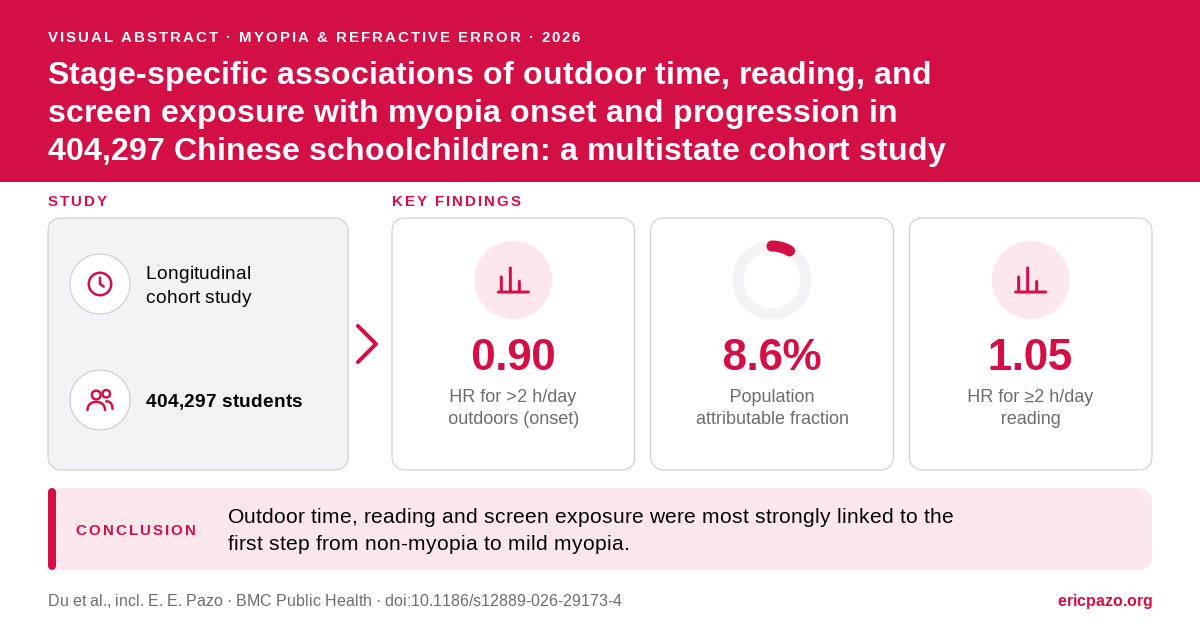
El tiempo al aire libre, la lectura y la exposición a pantallas se asociaron con mayor fuerza al primer paso, de la ausencia de miopía a la miopía leve.
- Diseño
- Estudio de cohortes longitudinal
- Muestra
- 404,297 estudiantes
- HR para >2 h/día al aire libre (aparición)
- 0.90
- Fracción atribuible poblacional
- 8.6%
- HR para ≥2 h/día de lectura
- 1.05
Resumen
Este resumen se muestra en su idioma original, el inglés, porque la licencia del artículo (CC BY-NC-ND) no permite publicar traducciones.
To determine how outdoor time, reading duration, and screen exposure, individually and in combination, affect stage-specific transitions in myopia development among schoolchildren. The longitudinal study included 404,297 primary school students (grades 1–6) participating in the Tianjin Child and Adolescent Research of Eye (TCARE) program from 2021 to 2024. Non-cycloplegic spherical equivalent (SE) was used to classify refractive states (non-myopia, mild, moderate, and high myopia). Cox proportional hazards models were used to quantify the associations with first incident mild, moderate, and high myopia. Multistate Markov models (MSMs) further estimated transition-specific associations for non-myopia, mild to moderate, and moderate to high myopia. The models were adjusted for age, sex, baseline SE, parental myopia, socioeconomic status, and NDVI. Over three years, 148,952 students progressed from non-myopia to mild myopia, 61,480 from mild to moderate myopia, and 7,847 from moderate to high myopia. Outdoor time exceeding 2 h per day was consistently associated with a lower risk of transition from non-myopia to mild myopia (HR, 0.90; 95% CI, 0.86–0.91), corresponding to a population attributable fraction (PAF) of 8.6% (95% CI, 7.2%–10.0%). In contrast, ≥ 2 h per day of reading (HR, 1.05; 95% CI, 1.03–1.06) and screen exposure (HR, 1.03; 95% CI, 1.01–1.04) at baseline were associated with the higher risk of this early transition. Although these associations were statistically significant, their magnitudes were modest and should be interpreted cautiously in terms of individual-level clinical relevance. None of these behaviors showed statistically significant associations with transitions between later myopia stages in multistate analyses. However, complementary analyses of continuous refractive change suggested that baseline outdoor time and screen exposure remained modestly associated with subsequent myopic progression among children with established myopia. All findings were robust across stratified and sensitivity analyses. Behavioral exposures showed stronger associations with the transition from non-myopia to mild myopia than with later transitions. This pattern should be interpreted cautiously because non-cycloplegic refraction may introduce misclassification around the onset threshold and may not necessarily reflect biological differences between myopia onset and progression. These findings underscore the potential relevance of behavioral factors during early refractive development, while suggesting that the strength of behavioral associations may vary across refractive transition stages.
Palabras clave: myopia onset; myopia progression; outdoor time; reading time; screen exposure; elementary school students; refractive error; multi-state Markov model
Acceso
Cómo citar
Mostrar BibTeX
@article{du2026stage,
  title = {{Stage-specific associations of outdoor time, reading, and screen exposure with myopia onset and progression in 404,297 Chinese schoolchildren: a multistate cohort study}},
  author = {Du, Bei and Song, Desheng and Jin, Nan and Liu, Lin and Li, Xuan and Zhang, Bo and Wang, Jinghui and He, Meinan and Wang, Lei and Zhang, Ziyu and Zhang, Shuwei and Pazo, Emmanuel Eric and Yan, Hua and Wei, Ruihua},
  journal = {BMC Public Health},
  year = {2026},
  doi = {10.1186/s12889-026-29173-4},
  url = {https://doi.org/10.1186/s12889-026-29173-4},
}
Trabajos relacionados
- Medición automatizada basada en aprendizaje profundo del volumen de retinosquisis y desprendimiento en la miopía patológica con contracción escleral posterior (2026)
- Desarrollo y validación interna de un modelo transformer sensible al tiempo para predecir la progresión de la miopía infantil a partir de datos longitudinales irregulares de cribado escolar (2026)
- Adherencia al seguimiento a largo plazo tras el implante de lente de colámero implantable en pacientes con miopía alta: un estudio unicéntrico de cohorte retrospectiva y encuesta CAP (2026)
- Predicción de la refracción ciclopléjica basada en aprendizaje automático con el Eyerobo Vision Screener: diseño, un estudio transversal comparativo de dispositivos (2026)
- Nuevo enfoque para la evaluación cuantitativa del estafiloma escleral: análisis de medidas de curvatura discreta de la esclera (2026)