
Resultados a dos años de la terapia repetida con luz roja en niños premiopes: eficacia sostenida y efecto rebote
Título original: Two-year outcomes of repeated red light therapy in premyopic children: sustained efficacy and rebound effects
Guihua Liu, Na Li, Hua Rong, Jiamei Hu, Enpei Pei, Emmanuel Eric Pazo, Bei Du, Ruihua Wei
 British Journal of Ophthalmology, 2025 · artículo · doi:10.1136/bjo-2025-327600 · citado 8 veces
De un vistazo
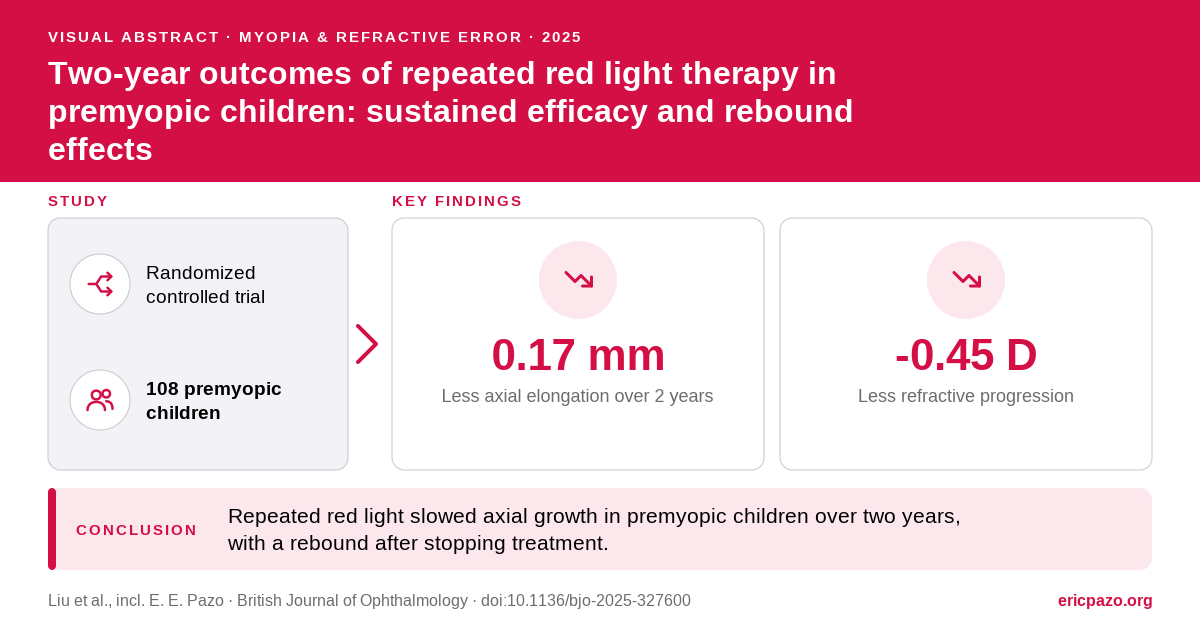
La luz roja repetida frenó el crecimiento axial en niños premiopes durante dos años, con un rebote al suspender el tratamiento.
- Diseño
- Ensayo controlado aleatorizado
- Muestra
- 108 niños premiopes
- Menor elongación axial en 2 años
- 0.17 mm
- Menor progresión refractiva
- -0.45 D
Resumen
Este resumen se muestra en su idioma original, el inglés, porque el artículo no tiene una licencia abierta que permita traducciones.
BACKGROUND: To evaluate the long-term prevention effectiveness and rebound effect of repeated red light therapy (RRLT) in children with premyopia over 2 years. METHODS: A total of 108 premyopic children (cycloplegia spherical equivalent refraction (SER): -0.50 to +0.75 D) were enrolled and followed for 24 months. Participants were randomly assigned to the RRLT or control groups. The RRLT was administered two times per day for 3 min per session, with at least 4-hour interval. At the beginning of the second year, participants receiving RRLT were further randomised into continued treatment and washout subgroups. Axial length (AL), SER and subfoveal choroidal thickness (SChT) were measured. RESULTS: Over 2 years, the RRLT group showed significantly smaller AL elongation (0.26 mm; 95% CI 0.18 to 0.35 mm) and SER progression (-0.21 D; 95% CI -0.35 to -0.08 D) compared with the controls (AL: 0.43 mm; 95% CI 0.36 to 0.49 mm; SER: -0.66 D; 95% CI -0.79 to -0.52 D). The RRLT group also demonstrated significantly less SChT thinning (-2.44 µm; 95% CI -16.11 to 11.23 µm) than the controls (-44.12 µm; 95% CI -53.05 to -35.19 µm). After RRLT cessation in the second year, the washout subgroup exhibited significantly faster AL elongation and more SChT thinning than the controls, with no significant difference in SER progression. CONCLUSIONS: The 2-year RRLT intervention effectively retarded AL elongation and SER progression in premyopic children by 0.17 mm and -0.45 D, respectively. Notably, a significant rebound effect was observed in AL growth following 1-year RRLT cessation.
Palabras clave: red light therapy; low-level laser therapy; myopia prevention; axial elongation; choroidal thickness; rebound effect; children; washout period
Acceso
Cómo citar
Mostrar BibTeX
@article{liu2025two,
  title = {{Two-year outcomes of repeated red light therapy in premyopic children: sustained efficacy and rebound effects}},
  author = {Liu, Guihua and Li, Na and Rong, Hua and Hu, Jiamei and Pei, Enpei and Pazo, Emmanuel Eric and Du, Bei and Wei, Ruihua},
  journal = {British Journal of Ophthalmology},
  year = {2025},
  doi = {10.1136/bjo-2025-327600},
  url = {https://doi.org/10.1136/bjo-2025-327600},
}
Trabajos relacionados
- Medición automatizada basada en aprendizaje profundo del volumen de retinosquisis y desprendimiento en la miopía patológica con contracción escleral posterior (2026)
- Desarrollo y validación interna de un modelo transformer sensible al tiempo para predecir la progresión de la miopía infantil a partir de datos longitudinales irregulares de cribado escolar (2026)
- Adherencia al seguimiento a largo plazo tras el implante de lente de colámero implantable en pacientes con miopía alta: un estudio unicéntrico de cohorte retrospectiva y encuesta CAP (2026)
- Predicción de la refracción ciclopléjica basada en aprendizaje automático con el Eyerobo Vision Screener: diseño, un estudio transversal comparativo de dispositivos (2026)
- Nuevo enfoque para la evaluación cuantitativa del estafiloma escleral: análisis de medidas de curvatura discreta de la esclera (2026)