
Eficacia y seguridad de la vitreólisis con láser YAG para las miodesopsias vítreas sintomáticas con DPV completo o sin DPV
Título original: The Efficacy and Safety of YAG Laser Vitreolysis for Symptomatic Vitreous Floaters of Complete PVD or Non-PVD
Tiezhu Lin, Tongtong Li, Xinmei Zhang, Yan-Nian Hui, Salissou Moutari, Emmanuel Eric Pazo, Guangzheng Dai, Lijun Shen
 Ophthalmology and Therapy, 2021 · artículo · doi:10.1007/s40123-021-00422-6 · citado 24 veces · Acceso abierto (CC BY-NC)
De un vistazo
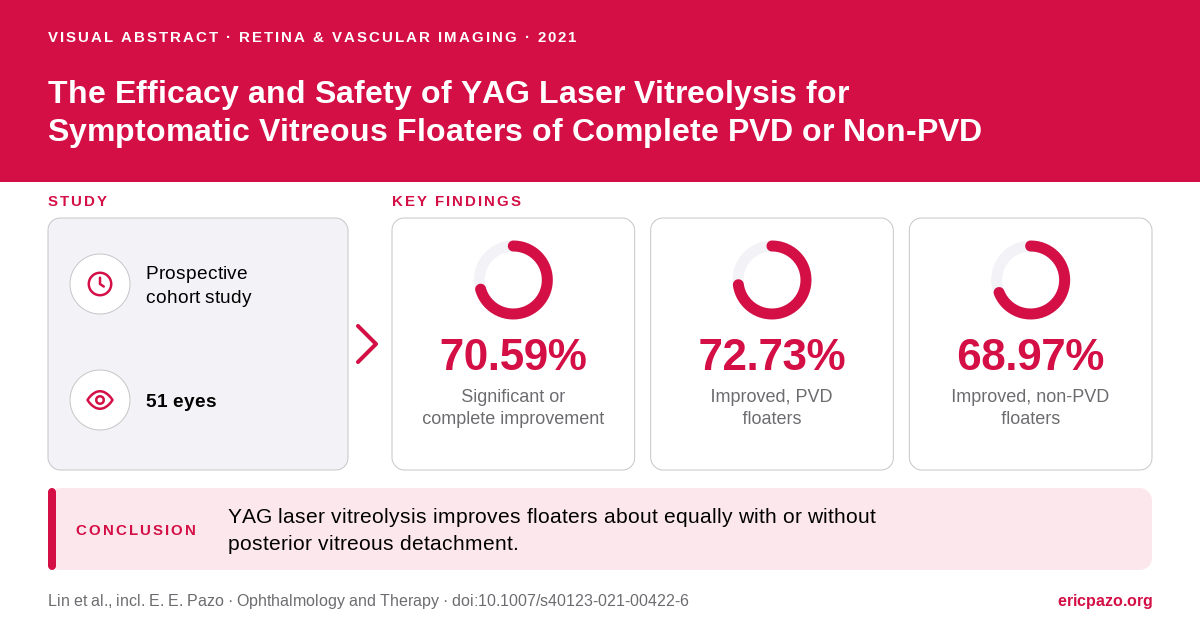
La vitreólisis con láser YAG mejora las miodesopsias de forma similar con o sin desprendimiento posterior del vítreo.
- Diseño
- Estudio de cohortes prospectivo
- Muestra
- 51 ojos
- Mejora significativa o completa
- 70.59%
- Mejoradas, miodesopsias con DPV
- 72.73%
- Mejoradas, miodesopsias sin DPV
- 68.97%
Resumen
INTRODUCCIÓN: Evaluar y comparar la eficacia y la seguridad de la vitreólisis con láser YAG en el tratamiento de las miodesopsias vítreas sintomáticas con desprendimiento posterior del vítreo (DPV) completo y sin DPV. MÉTODOS: En este estudio de cohortes prospectivo, se trataron con vitreólisis con láser YAG 51 ojos con miodesopsias sintomáticas. Los participantes se dividieron en un grupo con DPV completo y otro sin DPV. Para comparar la eficacia del tratamiento entre ambos grupos se utilizaron medidas objetivas de la calidad visual, como el cociente de Strehl (SR), la aberración esférica interna (SA), la aberración comática interna (CA), las aberraciones internas de alto orden (HOA) y el cociente de área de la función de transferencia de modulación (MTFa), así como las puntuaciones del Vitreous Floaters Symptom Questionnaire (VFSQ-13). RESULTADOS: La edad media de todos los pacientes fue de 56.80 ± 10.82 años. En total, 36 de 51 pacientes (70.59%; IC del 95% 58.10-83.10) refirieron una mejora significativa o completa de sus síntomas tras la vitreólisis con láser YAG. En todos los ojos, la MTFa, la SA interna y las HOA internas tras el tratamiento fueron significativamente mejores que al inicio (26.19 ± 14.73 frente a 29.19 ± 17.98, p = 0.013; 0.05 ± 0.05 frente a 0.04 ± 0.04, p = 0.031; y 0.23 ± 0.22 frente a 0.16 ± 0.07, p = 0.044; respectivamente). Veintinueve de 51 ojos (56.86%) tenían miodesopsias de tipo sin DPV. Las mejoras subjetivas significativas o completas en el grupo con DPV y en el grupo sin DPV fueron del 72.73% y el 68.97% (p = 0.344), respectivamente. CONCLUSIONES: En ambos grupos se observó una mejora de la calidad visual subjetiva y objetiva en los participantes con miodesopsias sintomáticas tras la vitreólisis con láser YAG. La eficacia de la vitreólisis con láser YAG fue comparable en las miodesopsias con DPV completo y sin DPV.
Traducido del resumen original en inglés (licencia: CC BY-NC).
Mostrar el resumen original
INTRODUCTION: To evaluate and compare the efficacy and safety of YAG laser vitreolysis in treating symptomatic vitreous floaters of complete posterior vitreous detachment (PVD) and non-PVD. METHODS: In this prospective cohort study, 51 eyes with symptomatic floaters were treated with YAG laser vitreolysis. Participants were divided into complete PVD and non-PVD groups. Objective visual quality measures including the Strehl ratio (SR), internal spherical aberration (SA), internal comatic aberration (CA), internal high-order aberration (HOA), area ratio of modulation transfer function (MTFa) and Vitreous Floaters Symptom Questionnaire (VFSQ-13) scores were used to compare the efficacy of YAG laser vitreolysis treatment between two groups. RESULTS: The mean age of all patients was 56.80 ± 10.82 years old. In total, 36 of 51 (70.59%; 95% CI 58.10-83.10) patients reported their symptoms as significant or complete improvement after YAG laser vitreolysis treatment. Post-treatment MTFa, internal SA and internal HOA were significantly better compared to baseline (26.19 ± 14.73 vs. 29.19 ± 17.98, p = 0.013; 0.05 ± 0.05 vs. 0.04 ± 0.04, p = 0.031 and 0.23 ± 0.22 vs. 0.16 ± 0.07, p = 0.044; respectively) in all eyes. Twenty-nine of 51 (56.86%) eyes had floaters of non-PVD type. Significant or complete subjective improvements in the PVD group and non-PVD group were 72.73% and 68.97% (p = 0.344), respectively. CONCLUSIONS: Improved subjective and objective visual quality in participants with symptomatic floaters following YAG laser vitreolysis was found in both groups. The efficacy of YAG laser vitreolysis was comparable in floaters of complete PVD and non-PVD types.
Palabras clave: vitreous floaters; posterior vitreous detachment; visual quality; higher-order aberrations; modulation transfer function; Strehl ratio; treatment efficacy and safety
Acceso
Cómo citar
Mostrar BibTeX
@article{lin2021the,
  title = {{The Efficacy and Safety of YAG Laser Vitreolysis for Symptomatic Vitreous Floaters of Complete PVD or Non-PVD}},
  author = {Lin, Tiezhu and Li, Tongtong and Zhang, Xinmei and Hui, Yan-Nian and Moutari, Salissou and Pazo, Emmanuel Eric and Dai, Guangzheng and Shen, Lijun},
  journal = {Ophthalmology and Therapy},
  year = {2021},
  doi = {10.1007/s40123-021-00422-6},
  url = {https://doi.org/10.1007/s40123-021-00422-6},
}
Trabajos relacionados
- Asociación entre la presión de perfusión ocular media y la retinopatía diabética proliferativa en una población del norte de China (2026)
- Asociación de los conocimientos y actitudes sobre el tratamiento anti-VEGF con la interrupción autodeclarada del tratamiento: un estudio de clasificación con separación temporal (2026)
- Medición automatizada basada en aprendizaje profundo del volumen de retinosquisis y desprendimiento en la miopía patológica con contracción escleral posterior (2026)
- Desarrollo de un modelo predictivo basado en datos de citocinas del humor acuoso para la respuesta al tratamiento anti-VEGF en el edema macular diabético (2026)
- Repetibilidad de las métricas de fotorreceptores de tipo cono con una oftalmoscopia láser de barrido con óptica adaptativa comercial (Mona II) en adultos sanos (2026)