
强脉冲光治疗睑板腺功能障碍所致蒸发过强型干眼后角膜前泪膜脂质层的干涉测量评估:一项随机、单盲、假治疗对照研究
原文标题: Interferometry Evaluation of Precorneal Tear Film Lipid Layer After Intense Pulsed Light in Evaporative Dry Eye Disease Owing to Meibomian Gland Dysfunction: A Randomized, Single Masked, Sham-Controlled Study
Yilin Song, Sile Yu, Xingru He, Lanting Yang, Yi Wu, Guanghao Qin, Qing Zhang, Gagan Deep Singh Talwar, Ling Xu, Jonathan Edward Moore, Wei He, Emmanuel Eric Pazo
要点速览
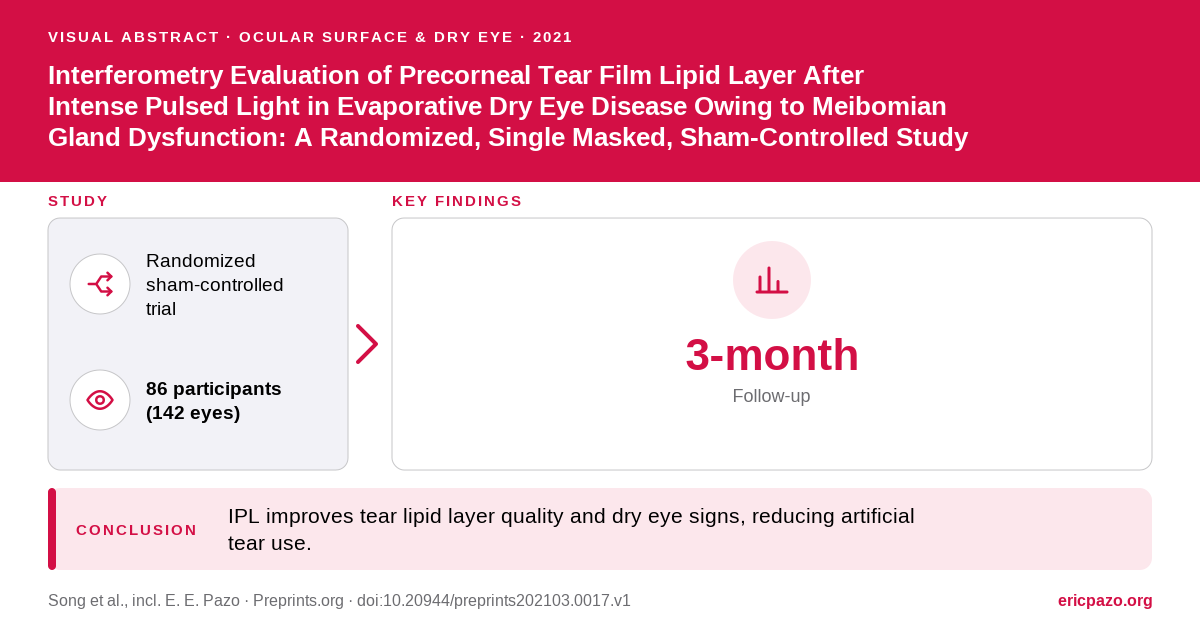
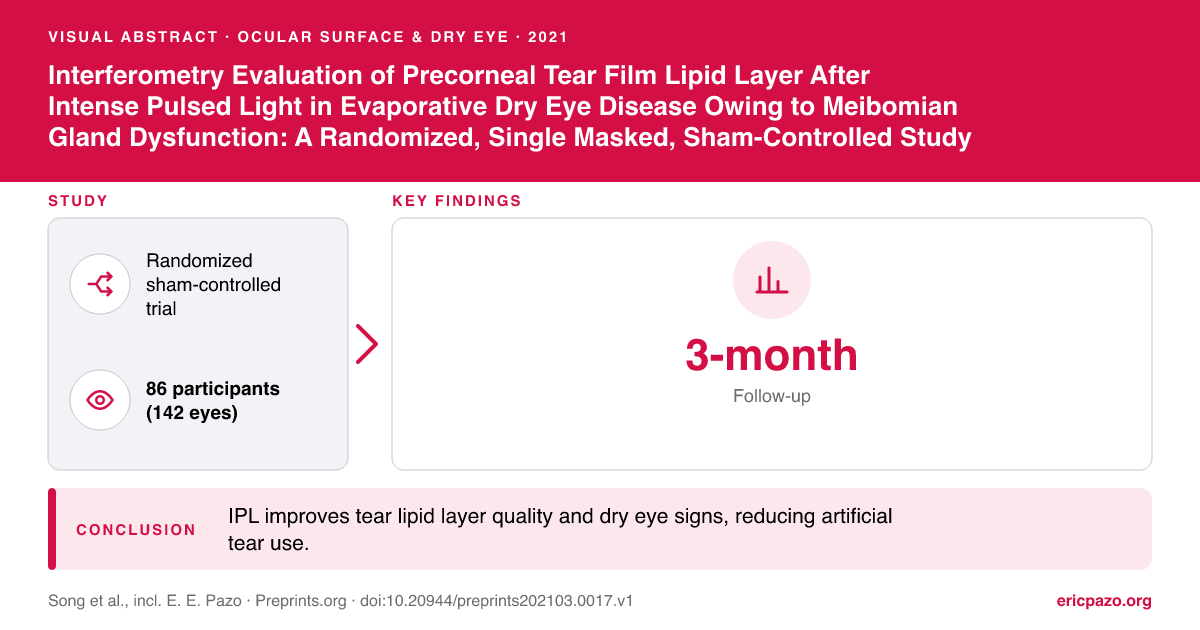
强脉冲光可改善泪膜脂质层质量和干眼体征,减少人工泪液的使用。
- 研究设计
- 随机假治疗对照试验
- 样本
- 86 名参与者(142 只眼)
- 随访时间
- 3-month
摘要
背景:睑板腺(MG)分泌不足可导致干眼体征和症状。由 MG 分泌的泪膜脂质层(TFLL)可保护泪膜并防止其快速蒸发。本研究旨在采用泪膜干涉测量,评估优化脉冲光技术(OPT)强脉冲光(IPL)治疗后蒸发过强型干眼(EDE)患者 TFLL 的变化及功能。方法:这项前瞻性随机、检查者设盲、假治疗对照研究纳入 86 名 DED 参与者(142 只眼)。在第 0、21 和 42 天进行 IPL 或假治疗。在第 0、21、42 天及 3 个月时评估眼表疾病指数(OSDI)、非侵入性泪膜破裂时间(NITBUT)、由干涉条纹图样判定的 TFLL 质量、荧光素染色(FS)以及睑板腺(MG)情况。结果:3 个月时,IPL 组的 TFLL、NITBUT、MG 缺失、MG 质量、MG 可挤压性、FS 和 OSDI 均显著改善(P<0.05),而假治疗组无显著改善。所有 DE 参数均与 IPL 治疗后 TFLL 的改善显著相关。此外,自 D-42 起,IPL 组的人工泪液使用量显著减少。结论:IPL 治疗能够改善 TFLL 质量,并在临床上减轻 DED 的体征和症状,从而降低人工泪液的使用频率。
译自英文原文摘要(许可协议:CC BY)。
显示英文原文摘要
Background: Inadequate meibomian glands (MGs) secretion can lead to dry eye signs and symptoms. Tear film lipid layer (TFLL) secreted by MGs protects and prevents rapid evaporation of tear film. Our purpose was to assess TFLL alteration and function in patients with evaporative dry eye (EDE) using tear interferometry after optimal pulse light technology (OPT) intense pulsed light (IPL). Methods: This prospective randomized examiner-masked sham- controlled study included 86 participants (142 eyes) with DED. IPL or sham procedure was performed on day 0, 21, and 42. Ocular Surface Disease Index (OSDI), non-invasive breakup time (NITBUT), interferometric fringe pattern determined TFLL quality, fluorescein staining (FS), and meibum gland (MG) were assessed at day 0, 21, 42 and 3-month. Results: At 3-month, TFLL, NITBUT, MG drop-out, MG quality, MG expressibility, FS and OSDI improved significantly (P<0.05) in the IPL group, while the sham group had no significant improvements. All DE parameters significantly correlated with the improvement in TFLL following IPL treatment. Additionally, artificial tears usage was significantly less in the IPL group from D-42 onwards. Conclusion: IPL treatment demonstrated the ability to improve TFLL quality and clinically reduced sign and symptoms of DED thereby reducing the frequency of artificial tears usage.
关键词: intense pulsed light; evaporative dry eye disease; meibomian gland dysfunction; tear film lipid layer; non-invasive tear break-up time; fluorescein staining; meibomian gland expressibility; Ocular Surface Disease Index
获取全文
引用格式
显示 BibTeX
@article{song2021interferometry,
  title = {{Interferometry Evaluation of Precorneal Tear Film Lipid Layer After Intense Pulsed Light in Evaporative Dry Eye Disease Owing to Meibomian Gland Dysfunction: A Randomized, Single Masked, Sham-Controlled Study}},
  author = {Song, Yilin and Yu, Sile and He, Xingru and Yang, Lanting and Wu, Yi and Qin, Guanghao and Zhang, Qing and Talwar, Gagan Deep Singh and Xu, Ling and Moore, Jonathan Edward and He, Wei and Pazo, Emmanuel Eric},
  journal = {Preprints.org},
  year = {2021},
  doi = {10.20944/preprints202103.0017.v1},
  url = {https://doi.org/10.20944/preprints202103.0017.v1},
}
相关研究
- 飞秒激光辅助 LASIK 术后角膜瓣边缘间隙对角膜神经再生影响的分析 (2026)
- 强脉冲光与睑缘清洁对泪膜和眼表影响的比较:一项随机对照研究 (2026)
- Effects of 3% diquafosol sodium on tear film stability, corneal aberration parameters, and vision-related quality of life in pediatric orthokeratology-associated dry eye disease (2026)
- 母亲孕前体重指数与子代散光及角膜曲率的关联:一项横断面研究 (2025)
- 过敏性结膜炎相关干眼中泪液淋巴毒素-α、免疫球蛋白 E 及基质金属蛋白酶-9 的差异表达 (2025)