
糖尿病黄斑浮腫における抗 VEGF 療法への反応を予測する前房水サイトカインデータに基づく予測モデルの開発
原題: Development of a predictive model based on aqueous cytokines data for response to anti-VEGF therapy in diabetic macular edema
Fuhua Yang, Yi Gong, Xiaoying Pan, Jinzhi Zhao, Rongguo Yu, Liangzhang Tan, Emmanuel Eric Pazo, Xiaomin Zhang, Xiaorong Li
 Eye and Vision, 2026 · 原著論文 · doi:10.1186/s40662-026-00479-z · 被引用 3 回 · オープンアクセス(CC BY)
要点
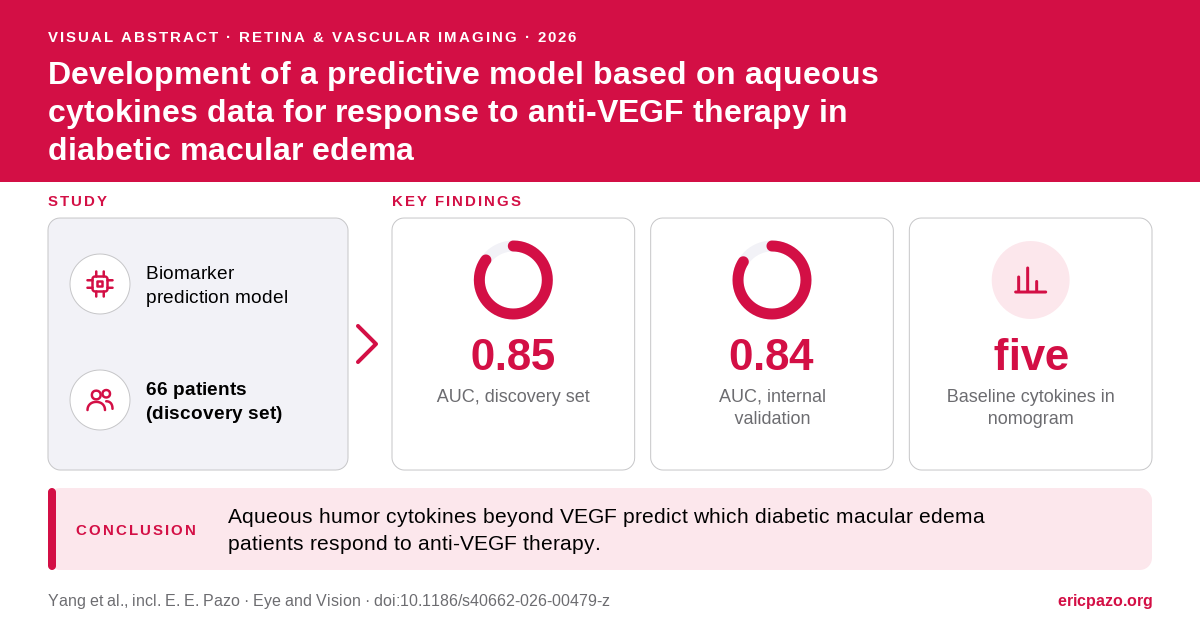
VEGF 以外の前房水サイトカインにより、どの糖尿病黄斑浮腫患者が抗 VEGF 療法に反応するかを予測できる。
- 研究デザイン
- バイオマーカー予測モデル
- 対象
- 患者 66 人(探索セット)
- AUC(探索セット)
- 0.85
- AUC(内部検証)
- 0.84
- ノモグラムに含まれるベースラインサイトカイン
- five
抄録
背景:硝子体内抗血管内皮増殖因子(VEGF)薬は糖尿病黄斑浮腫(DME)の視力を改善する。しかし、多くの患者で抵抗性、無反応、再発がみられ、抗 VEGF 反応を予測するバイオマーカーは存在しない。本研究の目的は、抗 VEGF 反応を予測するサイトカインマーカーを特定し、反応不良 DME の病態に関与するサイトカインを明らかにすることである。方法:Luminex アッセイにより前房水中のサイトカイン濃度を測定した。反応例 46 人と非反応例 20 人からなる探索セットで、ベースラインサイトカインに基づく予測モデルを構築した。さらに、反応例 15 人と非反応例 12 人のベースラインサイトカインを検証セットとして解析した。ノモグラムの性能は受信者動作特性曲線下面積(AUC)と Hosmer-Lemeshow 適合度検定で評価した。結果:血管新生関連サイトカインである VEGF(P < 0.0001)、胎盤増殖因子(PIGF)(P < 0.0001)、アンジオポエチン-2(Ang-2)(P < 0.0001)、炎症因子インターロイキン-6(IL-6)(P < 0.0001)、IL-8(P < 0.0001)、ケモカインである単球走化性タンパク質-1(MCP-1)(P < 0.0001)、接着因子である細胞間接着分子-1(ICAM-1)(P < 0.001)のベースライン濃度は、対照と比べて有意に上昇していた。VEGF、IL-6、Ang-2、MCP-1、ICAM-1 の 5 つのベースラインサイトカインを含む予測ノモグラムモデルを構築した。AUC は探索セットで 0.85(95% CI:0.74-0.96)、内部検証で 0.84 であり、予測モデルの予測精度は良好であった。Hosmer-Lemeshow 適合度検定ではモデルのキャリブレーションは良好であった(P = 0.295)。非反応群の患者では、抗 VEGF 薬の複数回注射後の 6 か月時点でも、Ang-2(P = 0.0042)、IL-6(P < 0.0001)、IL-8(P < 0.0001)、MCP-1(P < 0.0001)、PIGF(P < 0.0001)の濃度が有意に高いままであった。結論:ベースラインサイトカインに基づくモデルは、抗 VEGF 療法への個々の反応確率の評価に役立った。DME の病態には VEGF 以外のサイトカインも関与しており、これらのサイトカインを標的とする治療法により視力が改善し黄斑浮腫が軽減する可能性がある。
英語の原文抄録からの翻訳です(ライセンス:CC BY)。
原文の抄録を表示
BACKGROUND: Intravitreal anti-vascular endothelial growth factor (VEGF) agents improve visual acuity in diabetic macular edema (DME). However, resistance, non-response, or recurrence occurs in many patients. Predictive biomarkers for anti-VEGF response are lacking. We aim to identify cytokine markers predictive of anti-VEGF response and elucidate cytokines involved in poor-response DME pathogenesis. METHODS: A luminex assay was carried out to measure the concentration of cytokines in the aqueous humor. A predictive model based on baseline cytokines was constructed in a discovery set that comprised 46 responders and 20 non-responders. In addition, an analysis of baseline cytokines of 15 responders and 12 non-responders was conducted as a validation set. The performance of the nomogram was determined using the area under the receiver operating characteristic curve (AUC) and Hosmer-Lemeshow goodness of fit test. RESULTS: Baseline concentrations of angiogenesis-related cytokines VEGF (P < 0.0001), placenta growth factor (PIGF) (P < 0.0001), angiopoietin-2 (Ang-2) (P < 0.0001), inflammatory factor interleukin-6 (IL-6) (P < 0.0001), IL-8 (P < 0.0001), chemokine monocyte chemoattractant protein-1 (MCP-1) (P < 0.0001), and adhesion factor intercellular adhesion molecule-1 (ICAM-1) (P < 0.001) were significantly increased compared to controls. The prediction nomogram model included five baseline cytokines: VEGF, IL-6, Ang-2, MCP-1, and ICAM-1 were constructed. The AUC for the discovery set was 0.85 (95% CI: 0.74-0.96) and for the internal validation was 0.84, indicating that the prediction model has good predictive accuracy. The Hosmer-Lemeshow goodness of fit test showed good model calibration (P = 0.295). The levels of Ang-2 (P = 0.0042), IL-6 (P < 0.0001), IL-8 (P < 0.0001), MCP-1 (P < 0.0001), and PIGF (P < 0.0001) were still significantly increased at the 6-month timepoint after multiple injections of anti-VEGF drugs for non-response group patients. CONCLUSION: The baseline cytokine-based model helped to assess the individual probability of response to anti-VEGF therapy. There are cytokines beyond VEGF that are involved in the pathogenesis of DME, therapeutic regimens targeting these cytokines may improve the visual acuity and reduce macular edema.
キーワード: diabetic macular edema; anti-VEGF therapy; aqueous humor cytokines; predictive biomarkers; treatment response prediction; angiogenesis; angiopoietin-2; interleukin-6
アクセス
引用方法
BibTeX を表示
@article{yang2026development,
  title = {{Development of a predictive model based on aqueous cytokines data for response to anti-VEGF therapy in diabetic macular edema}},
  author = {Yang, Fuhua and Gong, Yi and Pan, Xiaoying and Zhao, Jinzhi and Yu, Rongguo and Tan, Liangzhang and Pazo, Emmanuel Eric and Zhang, Xiaomin and Li, Xiaorong},
  journal = {Eye and Vision},
  year = {2026},
  doi = {10.1186/s40662-026-00479-z},
  url = {https://doi.org/10.1186/s40662-026-00479-z},
}