
東アジア人集団における深層学習を用いた高血圧の網膜微小血管への影響の検討
原題: Exploring the effect of hypertension on retinal microvasculature using deep learning on East Asian population
Guangzheng Dai, Wei He, Ling Xu, Emmanuel Eric Pazo, Tiezhu Lin, Shasha Liu, Chenguang Zhang
 PLoS ONE, 2020 · 原著論文 · doi:10.1371/journal.pone.0230111 · 被引用 78 回 · オープンアクセス(CC BY)
要点
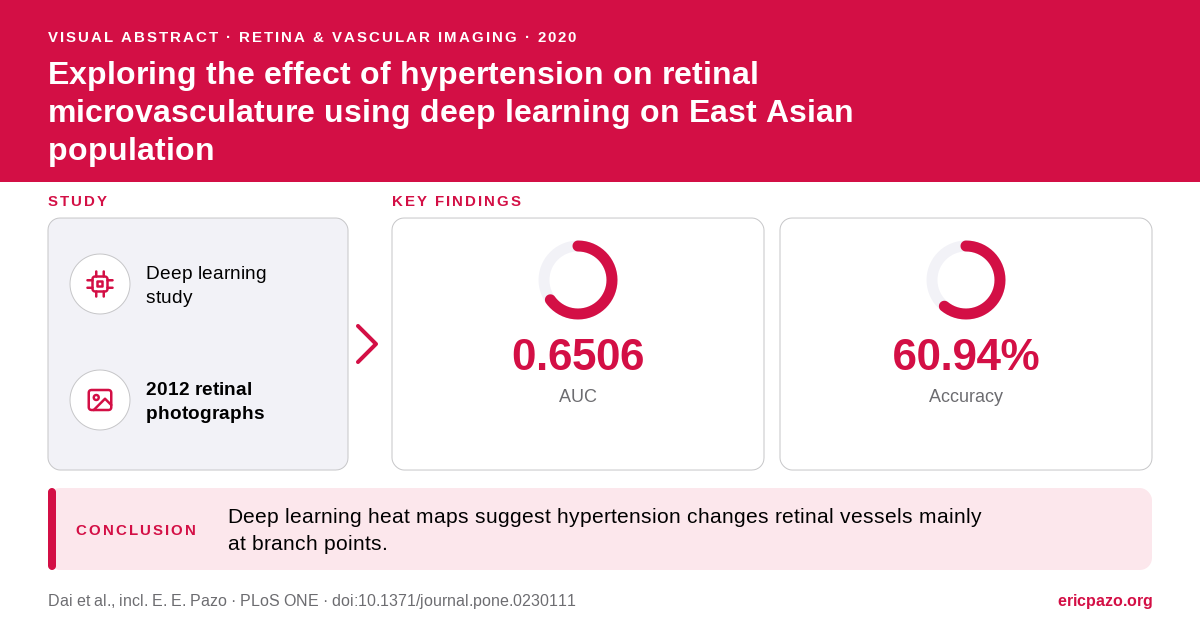
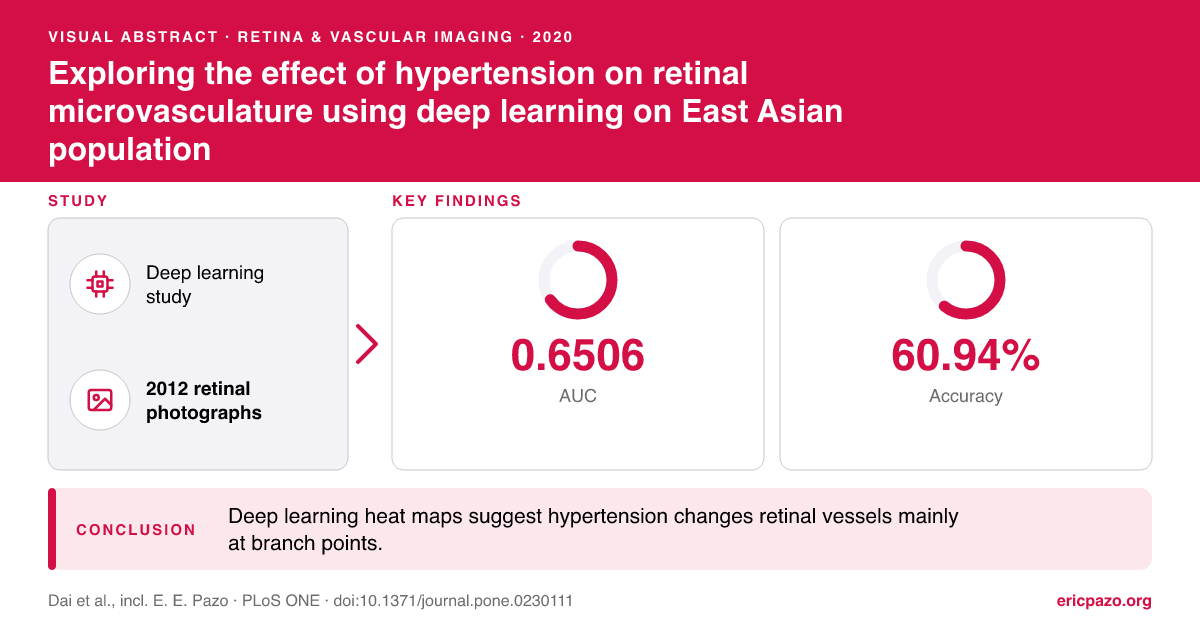
深層学習のヒートマップから、高血圧は主に分岐部で網膜血管を変化させることが示唆される。
- 研究デザイン
- 深層学習研究
- 対象
- 網膜写真 2012 枚
- AUC
- 0.6506
- 正解率
- 60.94%
抄録
高血圧は心血管疾患の主要な危険因子であり、微小血管の構造と機能の両方に大きな影響を及ぼす。網膜血管の異常は高血圧による微小血管障害の程度を反映しうるものであり、これらの変化は眼底写真で検出できる。本研究は、人間の観察者の閾値以下に現れる潜在的な特徴を検出できる深層学習技術を用いて、高血圧が網膜微小血管の形態学的特徴に及ぼす影響を調べることを目的とした。網膜写真 2012 枚を収集し、そのうち 1007 枚は高血圧と診断された患者、1005 枚は正常血圧の対照者のものであった。血管セグメンテーションにより網膜血管以外の干渉情報を除去し、血管の形態情報のみを残した。これらのセグメンテーション画像を用いて小規模な畳み込みニューラルネットワーク(CNN)分類モデルを学習させ、Gradient-weighted Class Activation Mapping(Grad-CAM)と呼ばれる深層学習技術で「高血圧」クラスのヒートマップを生成した。モデルの正解率は 60.94%、特異度は 51.54%、適合率は 59.27%、再現率は 70.48% であった。AUC は 0.6506 であった。「高血圧」クラスのヒートマップでは、赤い斑状の領域が主に動脈・静脈の分岐部上またはその周囲に分布していた。これは、モデルがこれらの領域を高血圧の予測に最も重要と判断したことを示している。本研究は、高血圧の網膜微小血管形態への影響が主に血管の分岐部で生じることを示唆した。網膜血管の分岐パターンの変化は、血圧上昇に対する最も顕著な反応である可能性が高い。
英語の原文抄録からの翻訳です(ライセンス:CC BY)。
原文の抄録を表示
Hypertension is the leading risk factor of cardiovascular disease and has profound effects on both the structure and function of the microvasculature. Abnormalities of the retinal vasculature may reflect the degree of microvascular damage due to hypertension, and these changes can be detected with fundus photographs. This study aimed to use deep learning technique that can detect subclinical features appearing below the threshold of a human observer to explore the effect of hypertension on morphological features of retinal microvasculature. We collected 2012 retinal photographs which included 1007 from patients with a diagnosis of hypertension and 1005 from normotensive control. By method of vessel segmentation, we removed interference information other than retinal vasculature and contained only morphological information about blood vessels. Using these segmented images, we trained a small convolutional neural networks (CNN) classification model and used a deep learning technique called Gradient-weighted Class Activation Mapping (Grad-CAM) to generate heat maps for the class "hypertension". Our model achieved an accuracy of 60.94%, a specificity of 51.54%, a precision of 59.27%, and a recall of 70.48%. The AUC was 0.6506. In the heat maps for the class "hypertension", red patchy areas were mainly distributed on or around arterial/venous bifurcations. This indicated that the model has identified these regions as being the most important for predicting hypertension. Our study suggested that the effect of hypertension on retinal microvascular morphology mainly occurred at branching of vessels. The change of the branching pattern of retinal vessels was probably the most significant in response to elevated blood pressure.
キーワード: hypertension; retinal microvasculature; retinal vessel segmentation; fundus images; convolutional neural networks; Grad-CAM; heatmaps; East Asian populations
アクセス
引用方法
BibTeX を表示
@article{dai2020exploring,
  title = {{Exploring the effect of hypertension on retinal microvasculature using deep learning on East Asian population}},
  author = {Dai, Guangzheng and He, Wei and Xu, Ling and Pazo, Emmanuel Eric and Lin, Tiezhu and Liu, Shasha and Zhang, Chenguang},
  journal = {PLoS ONE},
  year = {2020},
  doi = {10.1371/journal.pone.0230111},
  url = {https://doi.org/10.1371/journal.pone.0230111},
}