
生体内での YAG レーザー硝子体切開は網膜と硝子体の微小環境に副作用を及ぼさない
原題: No side effects on retina or vitreous microenvironment by YAG laser vitreolysis in vivo
Tiezhu Lin, Mingqin Zhang, Bing Heng Wu, Yuanlong An, Emmanuel Eric Pazo, Rong Li, Lijun Shen
要点
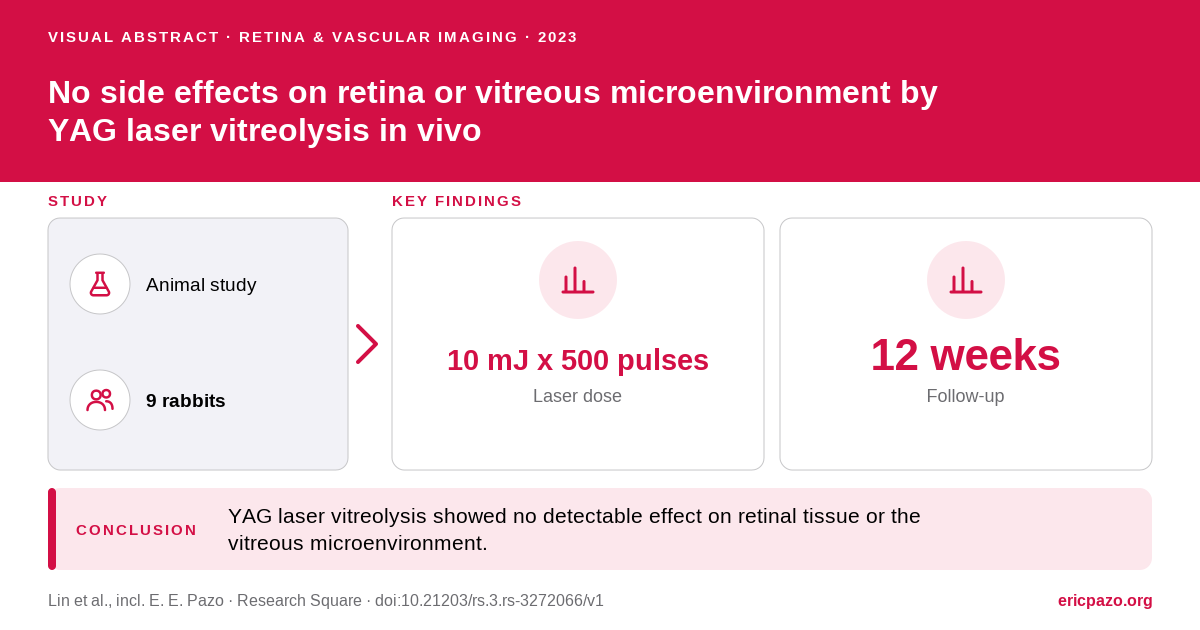
YAG レーザー硝子体切開は、網膜組織や硝子体の微小環境に検出可能な影響を示さなかった。
- 研究デザイン
- 動物実験
- 対象
- ウサギ 9 羽
- レーザー照射量
- 10 mJ x 500 pulses
- 経過観察期間
- 12 weeks
抄録
要旨 背景:網膜の組織学的検査と生体内での硝子体サイトカインの変化に基づき、イットリウム・アルミニウム・ガーネット(YAG)レーザー硝子体切開の安全性を検討する。方法:ニュージーランド白色種の雄ウサギ 9 羽の左眼に 10 mJ x 500 パルスの YAG レーザー硝子体切開を行い、右眼を対照とした。眼圧、カラー眼底写真、超音波 B モードを、YAG レーザー硝子体切開の前、および 1 日後、4 週後、12 週後に測定した。治療後 1 日、4 週、12 週にそれぞれ 3 羽を安楽死させた。網膜の病理学的変化を調べるため、TdT 介在 dUTP ニック末端標識(TUNEL)染色とヘマトキシリン・エオジン(H&E)染色を用いた。酵素結合免疫吸着測定法(ELISA)により、硝子体液中の血管内皮増殖因子(VEGF)と、インターフェロン誘導タンパク質 10(IP-10)、単球走化性タンパク質 1(MCP-1)、インターロイキン 6(IL-6)などの炎症性サイトカインの発現を検出した。硝子体液中のアスコルビン酸(AsA)と総反応性抗酸化能(TRAP)も測定した。結果:YAG レーザー硝子体切開後、硝子体液中の VEGF、IP-10、MCP-1、IL6、AsA、TRAP の濃度に大きな変化はなかった(P > 0.05)。網膜組織に検出可能な病理学的変化はなく、アポトーシスのシグナルも認められなかった。結論:YAG レーザー硝子体切開は網膜組織や硝子体の微小環境に目立った影響を及ぼさず、安全な処置である。
英語の原文抄録からの翻訳です(ライセンス:CC BY)。
原文の抄録を表示
Abstract Background: To explore the safety of yttrium-aluminum-garnet (YAG) laser vitreolysis based on the histological examination of the retina and the alteration of vitreous cytokines in vivo. Methods: Nine male New Zealand rabbits underwent YAG laser vitreolysis of 10 mJ x 500 pulses in the left eyes, while the right eyes were used as controls. Intraocular pressure, color fundus photography, and ultrasound B scan were measured before, as well as 1 day, 4 weeks, and 12 weeks after YAG laser vitreolysis. Three rabbits were euthanized 1 day, 4 weeks, and 12 weeks after treatment, respectively. Terminal deoxynucleotidyl transferase dUTP nick end labeling (TUNEL) staining and hematoxylin-eosin (H&E) staining were used to look for pathological changes in the retina. An enzyme-linked immunosorbent assay (ELISA) was utilized to detect the expression of vascular endothelial growth factor (VEGF) and some inflammatory cytokines, including interferon inducible protein 10 (IP-10), monocyte chemoattractant protein 1 (MCP-1) and interlenkin 6 (IL-6) in the vitreous humor. The ascorbic acid (AsA) and total reactive antioxidant potential (TRAP) in the vitreous humor were also measured. Results: Following YAG laser vitreolysis, the levels of VEGF, IP-10, MCP-1, IL6, AsA, and TRAP in the vitreous humor did not change substantially (P > 0.05). There were no detectable pathological changes in the retinal tissues, and no apoptotic signal was found. Conclusions: YAG laser vitreolysis has no noticeable effects on retinal tissue or the microenvironment of the vitreous, so it is a safe procedure.
キーワード: retinal safety; vitreous humor; retinal histology; apoptosis; vascular endothelial growth factor; inflammatory cytokines; oxidative stress; vitamin C
アクセス
引用方法
BibTeX を表示
@article{lin2023no,
  title = {{No side effects on retina or vitreous microenvironment by YAG laser vitreolysis in vivo}},
  author = {Lin, Tiezhu and Zhang, Mingqin and Wu, Bing Heng and An, Yuanlong and Pazo, Emmanuel Eric and Li, Rong and Shen, Lijun},
  journal = {Research Square},
  year = {2023},
  doi = {10.21203/rs.3.rs-3272066/v1},
  url = {https://doi.org/10.21203/rs.3.rs-3272066/v1},
}