
Impact du massage oculaire sur la pression intraoculaire et les dimensions du canal de Schlemm chez l'adulte sain : protocole d'un essai contrôlé randomisé
Titre original : Impact of Ocular Massage on Intraocular Pressure and Schlemm Canal Dimensions in Healthy Adults: Protocol for a Randomized Controlled Trial
Mingxuan Zhang, Luning Qin, Liangzhang Tan, Yongtao Li, Qing Zhang, Shuhan Wang, Zhihui Zhang, Emmanuel Eric Pazo, Xinjun Ren
 JMIR Research Protocols, 2025 · article · doi:10.2196/78864 · Accès libre (CC BY)
En bref
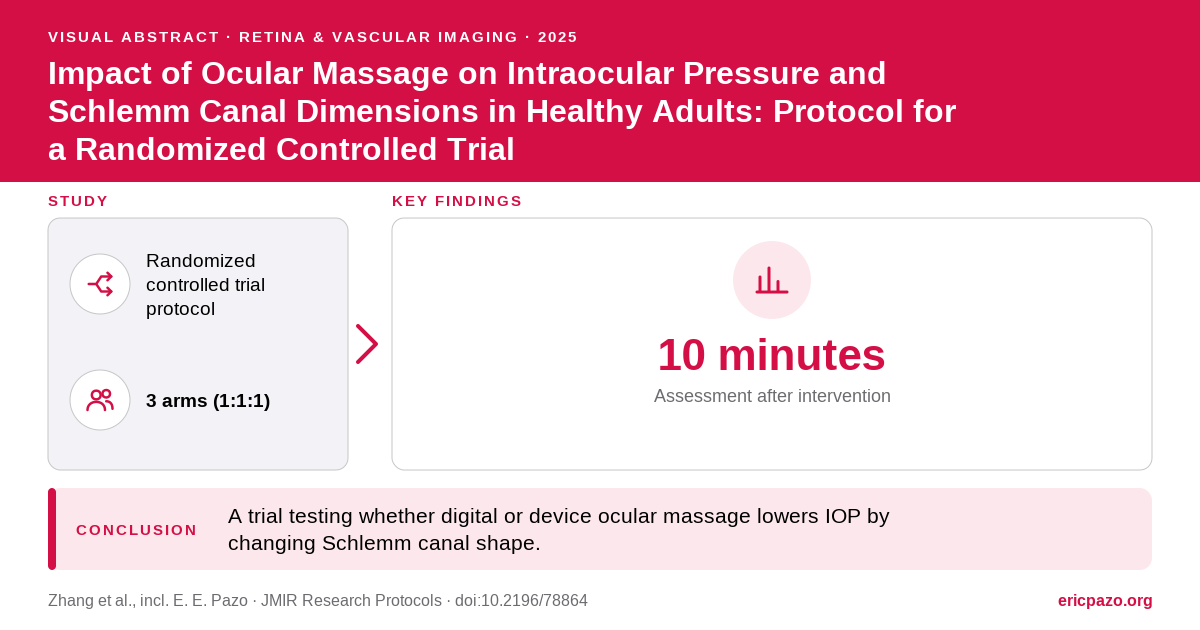
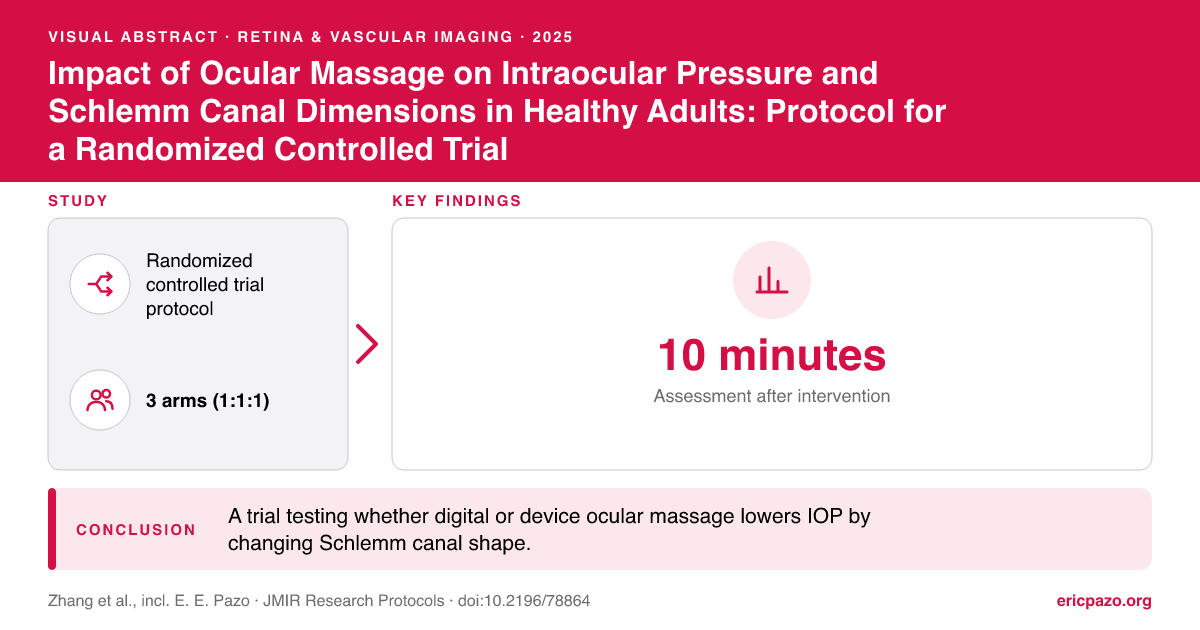
Un essai visant à déterminer si le massage oculaire digital ou par appareil abaisse la PIO en modifiant la forme du canal de Schlemm.
- Type d'étude
- Protocole d'essai contrôlé randomisé
- Échantillon
- 3 bras (1:1:1)
- Évaluation après l'intervention
- 10 minutes
Résumé
CONTEXTE : Il a été rapporté que le massage oculaire abaisse temporairement la pression intraoculaire (PIO). Cet effet pourrait être lié à une augmentation de l'écoulement de l'humeur aqueuse, mais le mécanisme reste incertain. OBJECTIF : Cette étude vise à examiner l'impact du massage oculaire digital et par EyePeace sur les fluctuations de la PIO et à déterminer si la baisse de PIO observée est attribuable à des modifications morphologiques du canal de Schlemm (CS). MÉTHODES : Les participants ont été répartis au hasard selon un rapport 1:1:1 dans 1 des 3 groupes : massage oculaire digital, massage oculaire par EyePeace ou absence de massage. Le critère de jugement principal sera la PIO. Les critères secondaires comprendront l'évaluation du CS et du trabéculum par tomographie par cohérence optique du segment antérieur. En outre, les événements indésirables touchant la qualité de vision seront surveillés et consignés à l'aide d'un questionnaire sur application mobile. Toutes les évaluations seront réalisées à l'inclusion et 10 minutes après les interventions attribuées. RÉSULTATS : Le recueil des données s'est achevé à l'été 2025. Les résultats de l'étude devraient être publiés d'ici la fin de 2025. CONCLUSIONS : Cette étude examinera l'impact du massage oculaire sur la PIO et les dimensions du CS selon un plan contrôlé randomisé. Les données préliminaires suggérant que le massage oculaire peut réduire transitoirement la PIO en améliorant l'écoulement de l'humeur aqueuse, cette étude cherchera à en éclaircir le mécanisme. En comparant le massage oculaire digital, le massage par EyePeace et l'absence de massage, l'étude évaluera les variations de la PIO et de la morphologie du CS. Les résultats devraient éclairer le rôle de la manipulation mécanique dans la modulation de l'écoulement de l'humeur aqueuse et pourraient orienter des stratégies non pharmacologiques de prise en charge du glaucome. ENREGISTREMENT DE L'ESSAI : Chinese Clinical Trial Registry ChiCTR2400093512 ; https://www.chictr.org.cn/showproj.html?proj=250459. IDENTIFIANT INTERNATIONAL DE RAPPORT ENREGISTRÉ (IRRID) : DERR1-10.2196/78864.
Traduit du résumé original en anglais (licence : CC BY).
Afficher le résumé original
BACKGROUND: Ocular massage has been reported to lower intraocular pressure (IOP) temporarily. This effect could be related to enhanced aqueous humor outflow; however, the mechanism is unclear. OBJECTIVE: This study aims to examine the impact of digital and EyePeace ocular massage on IOP fluctuations and investigate whether the observed reduction in IOP is attributable to morphological changes in the Schlemm canal (SC). METHODS: Participants were randomly assigned in a 1:1:1 ratio to 1 of 3 groups: digital ocular massage, EyePeace ocular massage, or no ocular massage. The primary outcome measure will be IOP. The secondary outcome measures will include anterior segment optical coherence tomography assessment of the SC and trabecular meshwork. In addition, adverse events in the quality of vision will be monitored and documented using a mobile app-based questionnaire. All assessments will be performed at baseline and 10 minutes after the assigned interventions. RESULTS: Data collection was completed in the summer of 2025. The study results are expected to be published by the end of 2025. CONCLUSIONS: This study will investigate the impact of ocular massage on IOP and SC dimensions by using a randomized controlled design. As preliminary evidence suggests that ocular massage may transiently reduce IOP by enhancing aqueous humor outflow, this study will aim to clarify the underlying mechanism. By comparing digital ocular massage, EyePeace ocular massage, and no ocular massage, the study will assess changes in IOP and SC morphology. The findings are expected to provide insights into the role of mechanical manipulation in modulating aqueous humor outflow, potentially informing nonpharmacological strategies for possible glaucoma management. TRIAL REGISTRATION: Chinese Clinical Trial Registry ChiCTR2400093512; https://www.chictr.org.cn/showproj.html?proj=250459. INTERNATIONAL REGISTERED REPORT IDENTIFIER (IRRID): DERR1-10.2196/78864.
Mots-clés : ocular massage; intraocular pressure; Schlemm's canal; aqueous humor outflow; trabecular meshwork; glaucoma management; non-pharmacological treatment; anterior segment optical coherence tomography
Accès
Comment citer
Afficher le BibTeX
@article{zhang2025impact,
  title = {{Impact of Ocular Massage on Intraocular Pressure and Schlemm Canal Dimensions in Healthy Adults: Protocol for a Randomized Controlled Trial}},
  author = {Zhang, Mingxuan and Qin, Luning and Tan, Liangzhang and Li, Yongtao and Zhang, Qing and Wang, Shuhan and Zhang, Zhihui and Pazo, Emmanuel Eric and Ren, Xinjun},
  journal = {JMIR Research Protocols},
  year = {2025},
  doi = {10.2196/78864},
  url = {https://doi.org/10.2196/78864},
}
Travaux liés
- Association entre la pression de perfusion oculaire moyenne et la rétinopathie diabétique proliférante dans une population du nord de la Chine (2026)
- Association des connaissances et des attitudes vis-à-vis du traitement anti-VEGF avec l'interruption autodéclarée du traitement : une étude de classification à séparation temporelle (2026)
- Mesure automatisée par apprentissage profond du volume de rétinoschisis et de décollement dans la myopie pathologique avec contraction sclérale postérieure (2026)
- Développement d'un modèle prédictif fondé sur les cytokines de l'humeur aqueuse pour la réponse au traitement anti-VEGF dans l'œdème maculaire diabétique (2026)
- Répétabilité des mesures des photorécepteurs à cônes avec une ophtalmoscopie laser à balayage en optique adaptative commerciale (Mona II) chez des adultes en bonne santé (2026)